Lesson 4 · 13 min
Port State Control and your lifeboats
What port State inspectors look at around the lifeboats, what the Tokyo MOU figures show, and how to be ready.
Start here
The 2-minute primer
New to this? These 6 cards explain the lesson in plain words. Go through them first and the lesson will make sense.
Primer done.
-
1/6Picture this
An inspector who asks one question
Think of a food inspector walking into a restaurant. They don’t care who built the kitchen. They want to know one thing: is it safe to serve food today?
A port state control officer is like that. When a foreign ship arrives, an officer from that country may come on board and ask: can this ship go to sea safely?
-
2/6The big idea
Ready for immediate use, every time
Before a ship leaves port, its life-saving equipment must be in working order and ready for immediate use. Lifeboats are near the top of the inspector’s list.
They need no special tools. They look at the hooks, wires, davit and engine, read the log-book and service reports, and may ask the crew to run a drill.
-
3/6Words you'll meet
Five words, in plain English
- Port State Control (PSC)
- the inspection of foreign ships by the country whose port they visit.
- Deficiency
- a fault the inspector records, often with a deadline to put it right.
- Detention
- the ship is held in port until a serious problem is fixed.
- Tokyo MOU
- the Tokyo Memorandum of Understanding, an Asia-Pacific group of countries that share port inspection results.
- Log-book
- the ship’s official diary, where checks and drills are written down.
-
4/6Why it matters
A held ship costs time and trust
In the Asia-Pacific region, “lifeboats” was one of the most common reasons for holding a ship in port in 2025. A detained ship stays put until the fault is fixed.
The good news: a crew that does its weekly and monthly checks honestly, and keeps its papers in order, has little to fear.
-
5/6In this lesson
What you’ll be able to do
- Know what port state control is and when it leads to detention.
- Read what the regional figures say about lifeboats.
- Spot what an inspector checks at the boat station.
- Get the papers and the boat ready before every port.
-
6/6Quick check
What must lifeboats be before a ship leaves port?
Right: before sailing and throughout the voyage, every life-saving appliance must work and be ready to use straight away.
In plain words
When a ship arrives in a foreign port, an officer from that country may come on board to check that it is safe. This is Port State Control, or PSC. The officer is not the flag’s surveyor and not the class surveyor. They are there to decide one thing: can this ship go to sea safely?
Lifeboats are near the top of their list. In the Asia-Pacific region, life-saving appliances are the second-largest group of problems found, and “lifeboats” is one of the most common reasons a ship is held in port.
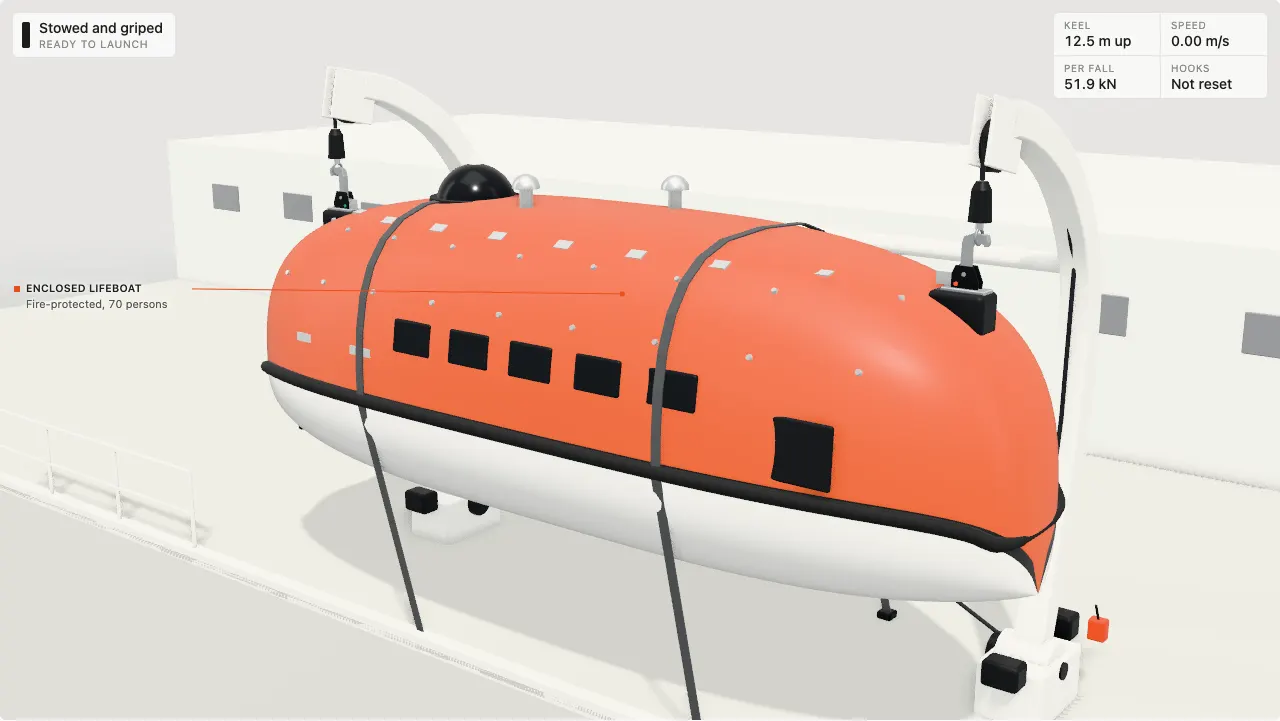
An inspector does not need special tools to find a lifeboat problem. They look at the hooks, the falls, the davit and the engine. They read the log-book and the service reports. They may ask the crew to show a drill. A ship that does the weekly and monthly checks honestly, and keeps its papers in order, has little to fear.
Key points
- Before the ship leaves port, all life-saving appliances must be “in working order and ready for immediate use” (SOLAS III/20.2).
- In 2025 the Tokyo MOU recorded 11,818 life-saving appliance deficiencies out of 90,168, the second-largest category after fire safety (Tokyo MOU Annual Report 2025).
- “Lifeboats” was the third most frequent detainable deficiency in the Tokyo MOU region in 2025, with 152 cases (Tokyo MOU Annual Report 2025, Figure 8).
- In the 2019 campaign on emergency systems, 74 of the 2,098 witnessed fire or abandon ship drills in the Tokyo MOU region were not satisfactory (Tokyo MOU CIC report, Q9).
- The weekly inspection must include the hooks and the on-load release gear “being properly and completely reset” (SOLAS III/20.6.1).
- Service reports must be signed, countersigned and kept on board for the life of the equipment (MSC.402(96) §5.1–5.2).
Sign in to read the rest of this lesson
Continue reading
Save your progress, open all 115 lessons and get a Course completed card when you finish.
or use your email
In the rest of this lesson
- The detail
- Deep dive
- Try it: Inspect a boat station as PSC would
- Quiz: 5 questions
- Ask our engineers about this lesson
Familiarisation training from Al Safwan Academy. Finishing a course shows completion of online familiarisation training: it is not an STCW, flag-approved or manufacturer qualification, and these courses don't replace that training. The manufacturer's manual and your flag's rules always come first.