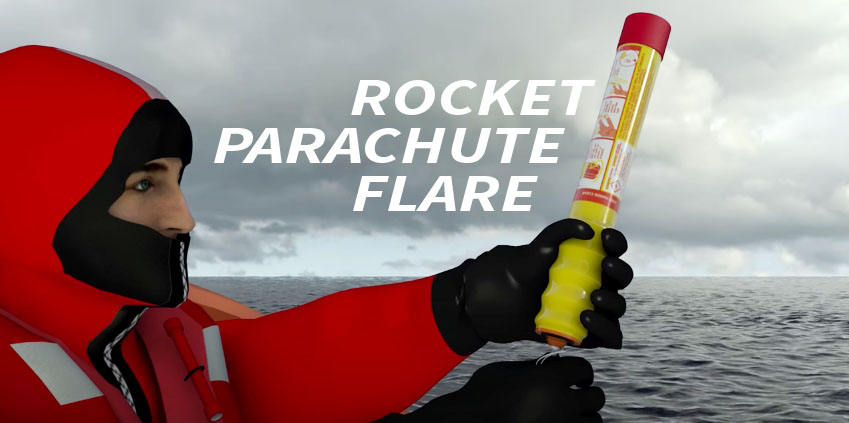
A distress flare only works if it can be seen. Here’s what actually makes a rocket parachute flare reliable — from its casing to the exact altitude, brightness, and burn time it must achieve.
Rocket parachute flares are indispensable safety equipment for any maritime expedition. Designed to provide a highly visible distress signal in an emergency, they ensure that help can be summoned swiftly, even in the most challenging conditions. Because understanding the specifications and requirements of these tools is paramount for any seafarer, here’s a closer look at the key features and standards that define them.
Water Resistance & Durability
Manufacturers encase rocket parachute flares in water-resistant casings, safeguarding their functionality in the harsh marine environment. As a result, the flares remain operational even when exposed to rain, spray, or immersion in water — crucial for emergencies at sea, where conditions can turn unpredictable in moments.
Clear Instructions for Ease of Use
The casing of a rocket parachute flare includes clear, concise instructions or diagrams illustrating proper use. This way, even in a stressful situation, a person can easily understand how to deploy the flare effectively, maximizing its potential to attract attention and signal distress.
Integral Means of Ignition
Rocket parachute flares come equipped with an integral means of ignition, simplifying activation. Because this design eliminates the need for additional ignition devices, it streamlines the deployment procedure and helps ensure swift action during an emergency.
Comfort & Safety
Crucially, rocket parachute flares are designed with user comfort and safety in mind. When someone activates one according to the manufacturer’s instructions, it shouldn’t cause discomfort to the person holding the casing. This matters because distress situations are already stressful — the last thing anyone needs is discomfort from the very tool meant to help them.
Related reading: Flares are one part of a vessel’s wider distress and lifesaving signal equipment. See our Fire Fighting Equipment Inspections and Testing of Life-Saving Appliances (MSC.81(70)) guide for the broader compliance picture.
Performance Standards
Rocket parachute flares must meet stringent performance standards to guarantee their effectiveness in an emergency. When fired vertically, a flare must reach an altitude of not less than 300 metres. At the apex of its trajectory, it ejects a parachute flare with the following characteristics:
| Specification | Requirement |
|---|---|
| Colour | Bright red, for visibility against sea and sky |
| Luminous intensity | Not less than 30,000 candelas (average) |
| Burning period | Not less than 40 seconds |
| Rate of descent | Not exceeding 5 metres per second |
| Parachute & attachments | Must not be damaged by the burning flare |
Bright Red Colour
The flare must burn with a bright red colour, enhancing its visibility against the backdrop of the sea and sky.
Uniform Luminous Intensity
With an average luminous intensity of not less than 30,000 candelas, the flare emits a powerful light that rescuers can see over long distances, increasing the likelihood of being spotted.
Extended Burning Period
The flare must burn for not less than 40 seconds, providing a sustained signal to attract attention.
Controlled Descent Rate
With a descent rate not exceeding 5 metres per second, the flare falls gradually, maximizing its visibility and keeping it within the vicinity of the distress location.
Protection of Parachute & Attachments
Crucially, the flare must not damage its parachute or attachments while burning, so it remains fully operational until help arrives.
By meeting these stringent standards, rocket parachute flares serve as reliable, effective distress signals, giving mariners reassurance while navigating the unpredictable waters of the open sea. Whether you’re embarking on a leisurely voyage or a demanding oceanic expedition, having these essential safety tools onboard can make all the difference to a swift, successful rescue.
Frequently Asked Questions
How high must a rocket parachute flare reach?
When fired vertically, a rocket parachute flare must reach an altitude of not less than 300 metres before ejecting its parachute flare.
How long does a rocket parachute flare burn for?
The flare must have a burning period of not less than 40 seconds, providing a sustained signal to attract attention.
Why does the descent rate matter?
A controlled descent rate — not exceeding 5 metres per second — keeps the flare visible for longer and closer to the distress location, improving the chances of a rescuer spotting it.
Are rocket parachute flares safe to hold when activated?
Yes — when activated according to the manufacturer’s instructions, a compliant flare should not cause discomfort to the person holding the casing.
Why Choose Al Safwan Marine?
Al Safwan Marine supplies and inspects pyrotechnic distress signals and lifesaving appliances for commercial vessels, offshore installations, and marine operators worldwide, in accordance with IMO, SOLAS, LSA Code, Flag State, and manufacturer requirements — helping keep your vessel’s emergency signalling equipment compliant and ready for use.
Our services include
Fire Fighting Equipments — Inspections Testing of Life-Saving Appliances Lifeboats — Inspections and Repair Liferafts — Inspections and Rental Immersion Suits CO2 Hoses Supply — Marine Approved
Al Safwan Marine — your global partner for marine inspection, testing & certification. Follow us on LinkedIn for the latest updates on lifesaving and distress signal equipment.
Frequently asked questions
How many rocket parachute flares must a ship carry?
SOLAS chapter III requires at least 12 rocket parachute flares stowed on or near the navigation bridge. Each lifeboat must also carry 4, and each liferaft carries 4 in its equipment pack.
How long does a rocket parachute flare burn?
The LSA Code requires a burning period of at least 40 seconds at a luminous intensity of at least 30,000 candela, after reaching an altitude of at least 300 m.
When do rocket parachute flares expire?
Most manufacturers give a 3-year service life from the date of manufacture. Expired pyrotechnics must be landed ashore for approved disposal, not fired or thrown overboard.
Filed under Fire fighting, Marine supply