Crane load testing confirms that marine and offshore cranes can safely lift their rated capacity.
Water bag testing and dead weight testing are the two most common methods. However, each suits different cranes, locations, and project requirements.
Therefore, this guide compares both methods to help shipowners, offshore operators, shipyards, and industrial facilities choose the right solution.
Why Crane Load Testing Is Important
Over time, heavy loads, corrosion, vibration, and harsh weather affect crane performance. Consequently, load testing proves that lifting equipment stays safe, reliable, and capable of handling its designed working load.
Routine crane load testing helps to:
- Verify lifting performance
- Confirm structural integrity
- Improve operational safety
- Support regulatory compliance
- Reduce equipment failure and downtime
- Extend the service life of lifting equipment
Moreover, regular testing works best inside a planned programme. For example, our guide to preventive vs corrective marine maintenance shows how scheduled checks reduce costly breakdowns.
What Is Crane Load Testing?
Crane load testing is a controlled inspection that verifies a crane can safely lift its rated capacity. During the test, qualified inspectors assess structural components, lifting mechanisms, brakes, wire ropes, hooks, electrical controls, and safety devices while the crane works under a specified load. In addition, they check the hydraulic systems for leaks and abnormal pressure.
Depending on the project and operating environment, teams typically use water bags or dead weights. Each method offers specific advantages.
Understanding Water Bag Load Testing
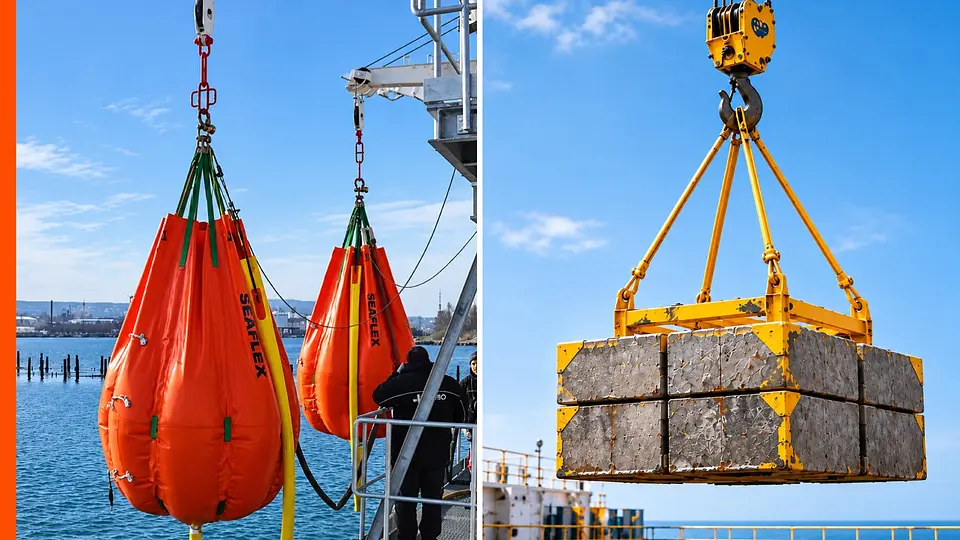
Water bag load testing is one of the most widely used methods for testing cranes, davits, lifting beams, and other lifting equipment offshore and onboard ships. Instead of heavy steel or concrete weights, technicians suspend specially designed water bags from the crane and fill them gradually until they reach the required test load.
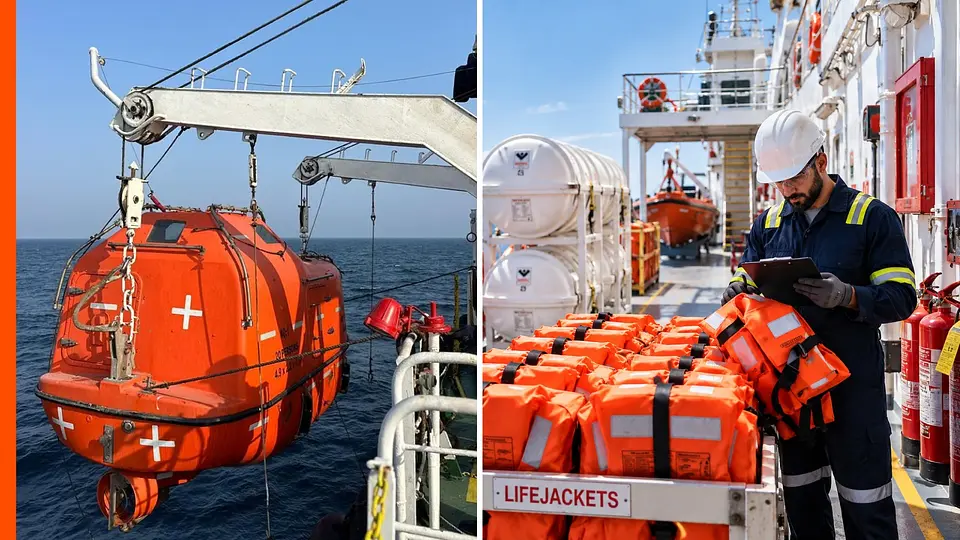
Because water bags are lightweight when empty and easy to transport, they suit vessels, offshore platforms, ports, and shipyards where handling heavy test weights is difficult. Likewise, they work well for lifeboat and davit testing.
How Water Bag Load Testing Works
First, technicians attach certified water bags to the crane hook. Then they fill the bags gradually until the crane reaches the required proof load. Meanwhile, inspectors monitor crane performance, structural stability, hydraulic systems, wire ropes, brakes, and safety devices.
Once the test ends, the team discharges the water safely. As a result, removing and transporting the equipment is easy.
Benefits of Water Bag Load Testing
- Easy to transport and deploy
- Safer than handling heavy solid weights
- Suitable for restricted or offshore locations
- Allows precise load adjustment
- Reduces project downtime
- Cost-effective for marine operations
In short, flexibility and efficiency have made water bag testing the preferred choice for many marine and offshore lifting applications.
Understanding Dead Weight Load Testing
Dead weight load testing is the traditional method of proving a crane's lifting capacity. It uses solid test weights such as concrete blocks, steel weights, or certified test masses. Shipyards, ports, construction sites, and industrial facilities commonly use it because heavy test weights are readily available there.
Unlike water bags, dead weights provide a fixed load throughout the test. Therefore, they suit sites where permanent testing equipment and lifting infrastructure already exist.
How Dead Weight Load Testing Works
Technicians securely attach certified test weights to the crane hook and lift them according to the required proof load. Meanwhile, qualified inspectors monitor structural integrity, lifting performance, wire ropes, brakes, hooks, hydraulic systems, and safety devices.
After a successful test, inspectors check the crane for deformation, abnormal movement, or mechanical issues. Only then does the crane return to service.
Advantages of Dead Weight Load Testing
Dead weight testing remains a reliable choice for many lifting operations because of its simplicity and proven effectiveness.
Stable Test Load
Solid weights provide a consistent load throughout the testing process.
Suitable for High-Capacity Cranes
Ideal for testing large cranes in ports, shipyards, and industrial facilities.
Proven Testing Method
Industries widely recognise and accept it for proof load testing.
Accurate Load Verification
Certified test weights provide precise and repeatable testing conditions.
Limitations of Dead Weight Testing
Despite these advantages, dead weight testing has practical limitations:
- Heavy weights require specialised transport and lifting equipment.
- Mobilisation can increase project costs.
- Teams need more storage space.
- Handling large weights may increase safety risks.
- It is less practical for offshore installations and onboard vessels.
Water Bags vs Dead Weight – A Comparison
| Feature | Water Bags | Dead Weights |
|---|---|---|
| Transportation | Easy | Difficult |
| Setup Time | Fast | Longer |
| Safety | Higher | Moderate |
| Offshore Use | Excellent | Limited |
| Space Requirement | Minimal | High |
| Load Adjustment | Flexible | Fixed |
| Logistics | Simple | Complex |
| Cost Efficiency | High | Moderate |
Both methods provide reliable proof load testing when technicians perform them correctly. Ultimately, the best choice depends on the project location, crane capacity, accessibility, and operational requirements.
Which Method Should You Choose?
There is no one-size-fits-all solution. Instead, the right method depends on the crane type, working environment, available space, and project logistics.
Water bag load testing is often preferred for:
- Ships and vessels
- Offshore platforms
- Floating cranes
- Davits and rescue boat systems
- Remote project locations
- Marine maintenance projects
Dead weight load testing is more suitable for:
- Shipyards
- Manufacturing facilities
- Construction projects
- Fixed industrial cranes
- Ports with permanent testing infrastructure
Selecting the most appropriate method improves efficiency while maintaining safe lifting operations. For oil and gas sites, our guide to ADNOC approved lifting equipment inspection explains the wider inspection requirements.
International Standards and Compliance
Teams should always carry out crane load testing according to applicable international standards, manufacturer recommendations, and project-specific requirements. For vessels, these requirements sit within the wider framework of the IMO SOLAS Convention. In addition, valid test records help vessels prepare for port state control, as our Pre-PSC inspection checklist shows.
Routine inspections, preventive maintenance, and periodic testing work together to extend equipment life and reduce operational risks.
Conclusion
Both water bag and dead weight load testing effectively verify crane performance and lifting safety. While water bags give greater flexibility and easier deployment for marine and offshore operations, dead weights remain a reliable option for fixed industrial environments.
Therefore, choose the method that fits your operational needs, equipment type, and project location.
Why Choose Al Safwan Marine?
At Al Safwan Marine, we deliver professional crane load testing, LSA inspections, FFE inspections, davit and winch testing, marine engineering, and offshore technical services across global marine and offshore industries. Our global network supports vessels and platforms wherever they operate.
Our experienced team provides safe, reliable, and compliant testing solutions that help vessel owners, shipyards, ports, and offshore operators maintain operational efficiency and meet international safety standards. Whether you need water bag load testing or dead weight testing, we tailor our solutions to your project.
Request an InspectionFollow Al Safwan Marine on LinkedIn for more marine safety insights.
Frequently asked questions
What is crane load testing?
Crane load testing verifies that a crane or lifting equipment can safely handle its rated load while complying with applicable industry standards.
Why are water bags used for load testing?
Water bags provide a safer, flexible, and cost-effective alternative to solid test weights, especially for marine and offshore applications.
What is the difference between water bag and dead weight testing?
Water bags are lightweight when empty and easy to transport, while dead weights require heavy lifting equipment and more logistical planning.
Which load testing method is safer?
Water bag load testing is generally considered safer because the load can be increased gradually and released quickly if required.
Where is water bag load testing commonly used?
It is widely used for testing marine cranes, offshore cranes, davits, lifeboats, lifting beams, and other lifting equipment.
How often should cranes be load tested?
Load testing should be carried out according to manufacturer recommendations, regulatory requirements, and periodic inspection schedules.
Filed under Load testing & lifting