Lesson 6 · 13 min
Drills without accidents
How often lifeboats, free-fall boats and rescue boats must be drilled and launched under SOLAS III/19, and how to run those drills safely.
Start here
The 2-minute primer
New to this? These 6 cards explain the lesson in plain words. Go through them first and the lesson will make sense.
Primer done.
-
1/6Picture this
Ride the lift empty first
When engineers finish working on a lift, they send it up and down empty before anyone steps in. Only then do people ride, and at first just the ones who need to.
A lifeboat drill follows the same idea. Prove the machine works with nobody aboard, then put in only the crew needed.
-
2/6The big idea
Practise often, but practise safely
Drills teach the crew to use the boats and show that the boats work. So there is an abandon ship drill every month, and each lifeboat goes in the water with its crew at least every three months.
But drills have hurt people too. So each drill is planned, checked and done step by step.
-
3/6Words you'll meet
Five words, in plain English
- Abandon ship drill
- a practice of everything the crew would do to leave the ship in an emergency.
- Free-fall lifeboat
- a boat that sits on a sloping ramp and drops straight into the sea.
- Simulated launch
- practising the free-fall release steps without actually letting the boat go.
- Rescue boat
- a smaller, fast boat used to pick people out of the water.
- Gripes
- the lashings that hold a stowed boat in place, released before it swings out.
-
4/6Why it matters
A drill can be the riskiest day
Boats have fallen during drills when a hook opened, a wire broke or a lashing was left on. In one drill, a forgotten lashing made the boat tilt and fall from its hooks.
Good planning, a check of the gripes and an empty first lowering help stop these accidents before they start.
-
5/6In this lesson
What you’ll be able to do
- Know how often each kind of boat must be drilled and launched.
- Tell what a free-fall drill involves, including a simulated launch.
- Follow the steps that keep a drill safe.
- Record a drill so the three-monthly launches can be checked.
-
6/6Quick check
What comes before people ride a lowered boat?
Right: lowering the boat empty first proves the arrangement works, and then only the people needed to drive it get in.
In plain words
Drills teach the crew to use the lifeboats before a real emergency. They also show whether the boats and davits actually work. That is why SOLAS asks for an abandon ship drill every month, and for every lifeboat to be put in the water and driven by its crew at least every three months.
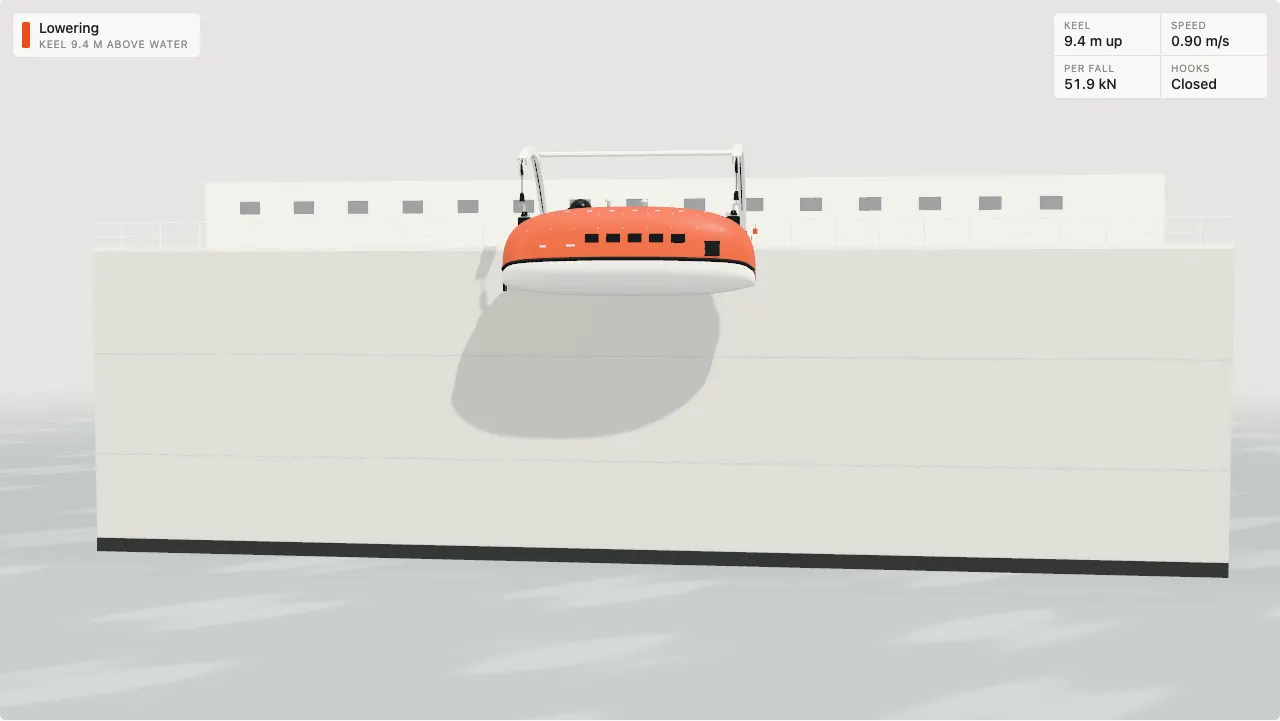
But drills have also hurt and killed seafarers. Boats have fallen when a hook opened, a wire broke or a lashing was left in place. So the drill rules come with safety guidance from IMO: plan the drill, read the manual first, lower the boat empty before anyone gets in, and put only the people needed to drive it in the boat.
This lesson sets out what must happen and how often, then the steps that keep a drill safe. The tool below turns the frequencies into a one-year calendar for your ship.
Key points
- Every crew member takes part in at least one abandon ship drill every month, and drills are held within 24 hours of leaving port if more than 25% of the crew missed last month’s drill on that ship (SOLAS III/19.3.2).
- Each abandon ship drill includes lowering at least one lifeboat and starting and operating its engine (SOLAS III/19.3.4.1).
- Each lifeboat is launched and manoeuvred in the water by its assigned operating crew at least once every three months (SOLAS III/19.3.4.3).
- Free-fall boats: every three months the crew boards and goes through the launch procedure up to release; at least every six months the boat is free-fall launched with its operating crew, or a simulated launch is done (SOLAS III/19.3.4.4).
- Rescue boats are launched with their crew and manoeuvred each month where reasonable and practicable, and in all cases at least every three months (SOLAS III/19.3.4.6).
- Lower and recover the boat empty first, then put in only the people needed to operate it (MSC.1/Circ.1578/Rev.1, 2.3.2).
Sign in to read the rest of this lesson
Continue reading
Save your progress, open all 115 lessons and get a Course completed card when you finish.
or use your email
In the rest of this lesson
- The detail
- Deep dive
- Try it: Plan a year of drills
- Quiz: 5 questions
- Ask our engineers about this lesson
Familiarisation training from Al Safwan Academy. Finishing a course shows completion of online familiarisation training: it is not an STCW, flag-approved or manufacturer qualification, and these courses don't replace that training. The manufacturer's manual and your flag's rules always come first.