Lesson 5 · 12 min
Weekly and monthly lifeboat checks
What the crew must check every week and every month under SOLAS III/20, and how to write it up in the log-book.
Start here
The 2-minute primer
New to this? These 6 cards explain the lesson in plain words. Go through them first and the lesson will make sense.
Primer done.
-
1/6Picture this
Press the test button on the smoke alarm
A smoke alarm on the ceiling may stay silent for years. You only find out its battery is flat if you press the test button now and then.
Lifeboats are checked for the same reason. Little and often, so a fault shows up on an ordinary Tuesday, not on the day the ship needs the boat.
-
2/6The big idea
Short weekly checks, fuller monthly ones
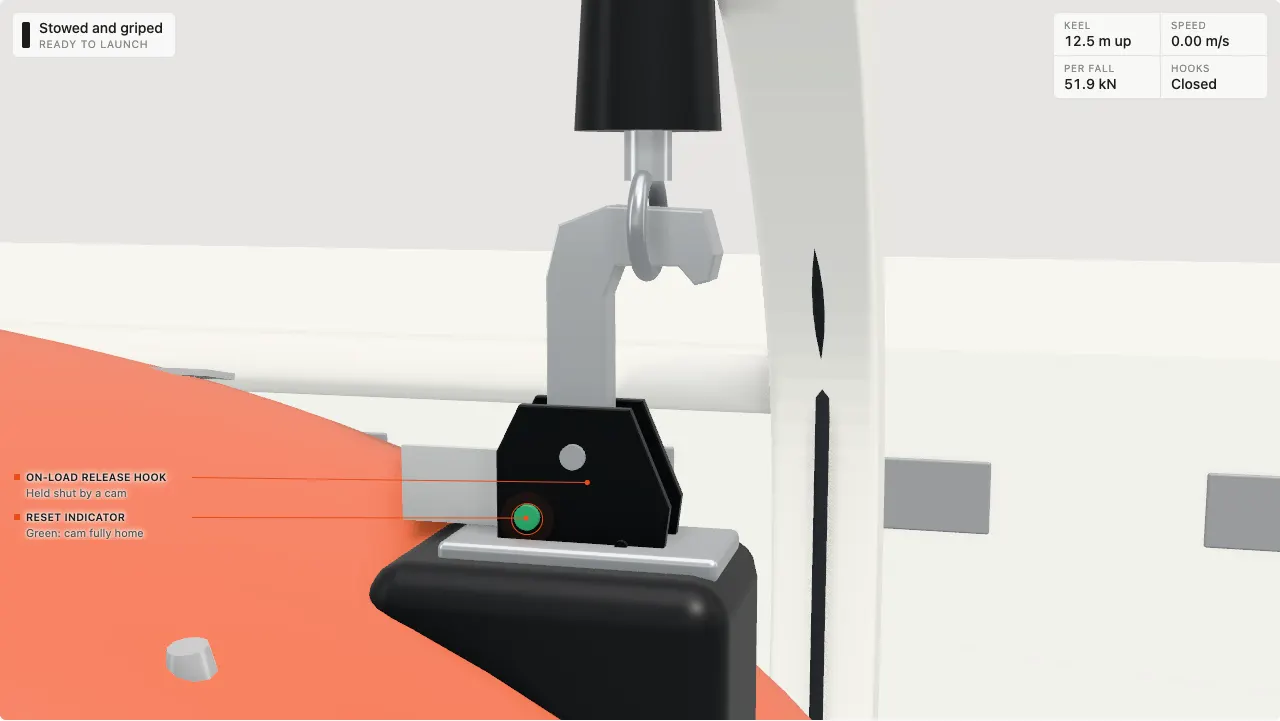
Every week the crew look at each boat and davit, check the hooks are fully reset, run the engine for at least 3 minutes and test the general alarm.
Every month most boats are swung out with nobody inside, and the equipment is checked against a list. Each check ends with a log-book entry.
-
3/6Words you'll meet
Six words, in plain English
- Turning out
- swinging the boat out from its stowed place to the position where it would be lowered.
- Gearbox
- the part that sends engine power to the propeller, forwards or backwards.
- Log-book
- the ship’s official diary, where checks, drills and defects are written down.
- Checklist
- the maker’s list of items to inspect each month, part of the on-board maintenance instructions.
- Senior ship's officer
- an experienced officer who directs the crew when they do the checks.
- Pyrotechnics
- the flares and smoke signals carried in the boat, which have expiry dates.
-
4/6Why it matters
The hook check is the most important line
Hooks that were not fully reset have caused deadly accidents. The weekly look is the crew’s chance to catch one before it opens under load.
A vague log entry like “all OK” helps nobody. Clear entries prove the check happened and give the annual examiners a place to start.
-
5/6In this lesson
What you’ll be able to do
- Know what the weekly inspection must include.
- Run the weekly engine check the right way.
- Check the boat’s equipment against the monthly list.
- Write a log entry that is actually useful.
-
6/6Quick check
How long does the weekly engine run last?
Right: the rule asks for at least 3 minutes in total, while showing that the gearbox engages properly.
In plain words
A lifeboat is only useful if it works on the day it is needed, and nobody knows when that day will come. So the rules ask the crew to look at the boats often: a short check every week and a fuller one every month.
Every week, someone looks at each boat and its davit, checks that the hooks are properly closed and reset, runs the engine for a few minutes and tests the general alarm. On cargo ships, conventional boats are also moved a little from their stowed position to prove the davit and winch work. Every month, the boats are swung out and all the equipment inside is checked against a list.
Each check ends with an entry in the log-book. That entry is the proof the check happened. It is also where the service technicians start when they come for the annual examination.
Key points
- Weekly: every survival craft, rescue boat and launching appliance is visually inspected, including the hooks and that the on-load release gear is “properly and completely reset” (SOLAS III/20.6.1).
- Weekly: every lifeboat and rescue boat engine runs for at least 3 minutes in total, showing that the gearbox engages (SOLAS III/20.6.2).
- Weekly on cargo ships: lifeboats other than free-fall boats are moved from their stowed position, with nobody on board, if weather and sea allow; the general emergency alarm is tested (SOLAS III/20.6.3–.4).
- Monthly: lifeboats other than free-fall boats are turned out, with nobody on board, if weather and sea allow (SOLAS III/20.7.1).
- Monthly: all life-saving appliances, including lifeboat equipment, are inspected using the checklist in the on-board maintenance instructions (SOLAS III/20.7.2, III/36.1).
- Both checks are reported in the log-book, and the crew may do them under the direction of a senior ship’s officer (SOLAS III/20.6, III/20.7.2; MSC.402(96) §4.1).
Sign in to read the rest of this lesson
Continue reading
Save your progress, open all 115 lessons and get a Course completed card when you finish.
or use your email
In the rest of this lesson
- The detail
- Deep dive
- Try it: Walk round a boat and write the log entry
- Quiz: 5 questions
- Ask our engineers about this lesson
Familiarisation training from Al Safwan Academy. Finishing a course shows completion of online familiarisation training: it is not an STCW, flag-approved or manufacturer qualification, and these courses don't replace that training. The manufacturer's manual and your flag's rules always come first.