Lesson 4 · 14 min
Hooks and release gear
On-load and off-load release, the hydrostatic interlock, why a hook must be completely reset, the 2014–2019 hook replacement and fall preventer devices.
Start here
The 2-minute primer
New to this? These 6 cards explain the lesson in plain words. Go through them first and the lesson will make sense.
Primer done.
-
1/6Picture this
A buckle that only looks closed
Think of a seat belt buckle. If it clicks fully home, it holds in a crash. If it is only half in, it can look fine and still pop open the moment it is pulled hard.
A lifeboat hook is like that buckle, except it holds a whole boat full of people.
-
2/6The big idea
Two ways to let go, one way to close
The boat hangs from two hooks. Off-load release opens them only once the boat floats and the weight is off. On-load release can open them while they still carry the weight, for emergencies.
That power is the danger. After every use, each hook must be completely reset, and it is checked every week.
-
3/6Words you'll meet
Six words, in plain English
- Off-load release
- the normal way to open the hooks, once the boat is afloat and no weight hangs on them.
- On-load release
- opening the hooks while they still carry the boat’s weight, kept for emergencies.
- Hydrostatic interlock
- a device that senses water pressure and blocks the on-load release until the boat is afloat.
- Override
- a protected way round the interlock in an emergency, behind a cover that must be broken.
- Reset indicator
- a mark or window showing whether a hook is back fully closed and locked.
- Fall preventer device
- an extra strap that holds the boat if a hook opens by accident.
-
4/6Why it matters
Half-reset hooks have killed people
A hook that is only partly reset can hold the boat while it is hoisted. Then the weight presses on a lock that is not fully home, and the hook opens with the boat in the air.
That is why hooks that failed the newer design rules were replaced, and why hooks on boats installed from 2026 won’t take any weight unless completely reset.
-
5/6In this lesson
What you’ll be able to do
- Tell off-load release from on-load release.
- Name the parts of a release system and what each one does.
- Know the safe habits for resetting a hook.
- Know why many hooks were replaced between 2014 and 2019.
-
6/6Quick check
A hook won’t reset fully. What do you do?
Right: a hook that is not completely reset can open under load, and nobody may adjust release gear while the hooks carry weight.
In plain words
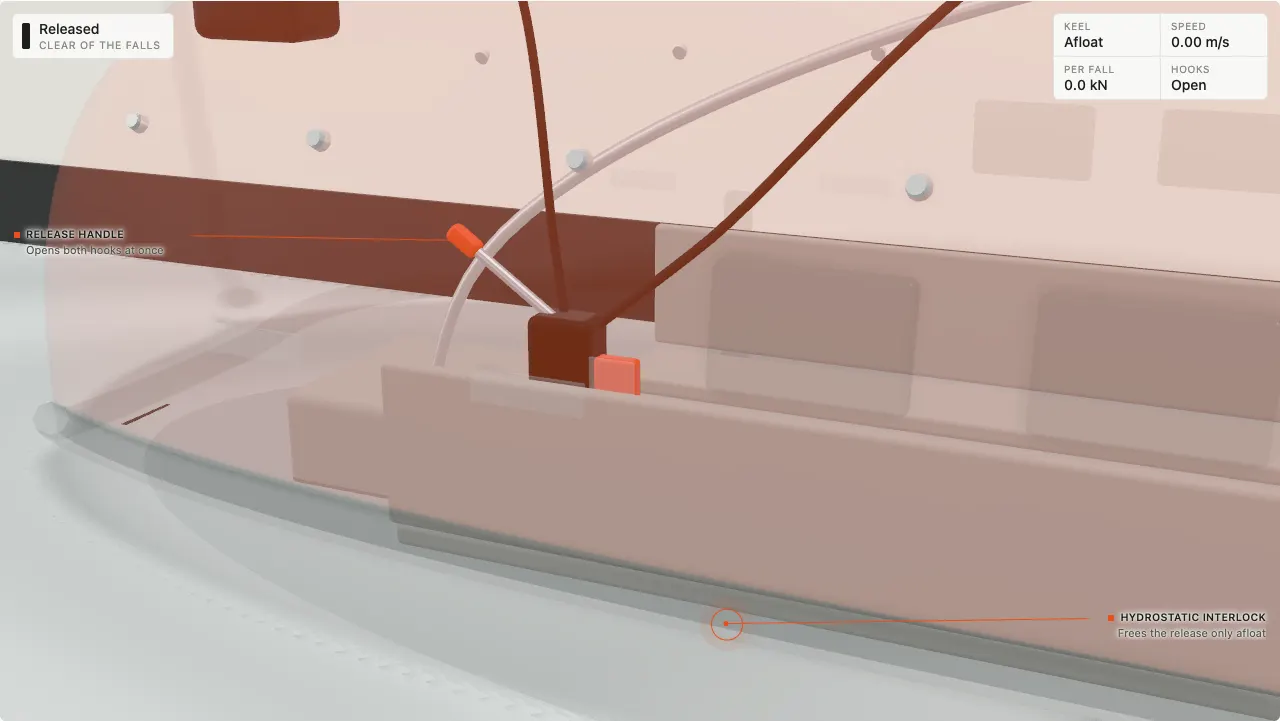
A lifeboat lowered by a davit hangs from two hooks, one at each end. When the boat reaches the water, the crew open the hooks so the boat can get away. That is the release gear.
There are two ways to open the hooks. Off-load release works only when the boat is afloat and the weight is off the hooks. On-load release can open the hooks while they still carry the boat’s weight. It exists for emergencies, when the weight may not come off the hooks.
On-load release is powerful, and that makes it dangerous. If a hook is not fully closed and locked after use, the weight of the boat can force it open. People have died this way.
So every hook must be completely reset, and you must check it every week. Always follow the manufacturer’s manual for your own gear, because designs differ.
Key points
- Off-load release frees the boat when it is waterborne or when there is no load on the hooks; on-load release frees it with a load on the hooks (LSA Code 4.4.7.6, MSC.320(89)).
- On-load release must have a hydrostatic interlock, unless other means ensure the boat is waterborne, and an override for emergencies that is protected against accidental use (LSA Code 4.4.7.6, MSC.320(89)).
- On-load operation “shall require multiple, deliberate and sustained action or actions by the operator” (LSA Code 4.4.7.6, MSC.320(89)).
- On-load release mechanisms not meeting the new criteria had to be replaced by the first scheduled dry-docking after 1 July 2014, and no later than 1 July 2019 (SOLAS III/1.5, MSC.317(89)).
- For lifeboats installed on or after 1 January 2026, “the hook shall not be able to support any load unless the hook is completely reset” (LSA Code 4.4.7.6.8, MSC.554(108)).
- The weekly inspection includes the on-load release gear “being properly and completely reset” (SOLAS III/20.6.1).
- “No maintenance or adjustment of the release gear shall be undertaken while the hooks are under load” (MSC.402(96) §6.2.4).
Sign in to read the rest of this lesson
Continue reading
Save your progress, open all 115 lessons and get a Course completed card when you finish.
or use your email
In the rest of this lesson
- The detail
- Deep dive
- Try it: Reset a release hook
- Quiz: 5 questions
- Ask our engineers about this lesson
Familiarisation training from Al Safwan Academy. Finishing a course shows completion of online familiarisation training: it is not an STCW, flag-approved or manufacturer qualification, and these courses don't replace that training. The manufacturer's manual and your flag's rules always come first.