Lesson 4 · 14 min
ISPS Code verification: the ship security plan and the ISSC
You will know how the ISSC cycle works, which security records must be on board, and what a port State officer may and may not ask to see.
Start here
The 2-minute primer
New to this? These 6 cards explain the lesson in plain words. Go through them first and the lesson will make sense.
Primer done.
-
1/6Picture this
A block of flats with a front desk
Think of a big block of flats. There is a front desk, visitors sign in, some doors need a key card, and one person is in charge of security. The building also has a quiet alarm button that calls for help.
A ship on international voyages is run the same way. It has a written security plan, a named officer in charge, checks at the gangway and a hidden alarm.
-
2/6The big idea
Plan it, run it, prove it works
The ISPS Code asks every ship on international voyages to plan against people who might harm it, and to put one person on board in charge.
The plan works at three security levels: normal, heightened and very high risk. When the plan is in place and working, an auditor checks it and the ship gets a security certificate, valid up to five years, with one check in the middle.
-
3/6Words you'll meet
Six words, in plain English
- ISPS Code (International Ship and Port Facility Security Code)
- the international rule on protecting ships and ports from security threats.
- Ship security plan
- the ship’s approved written plan for keeping it secure at each security level.
- SSO (ship security officer)
- the person on board, answering to the master, who runs the security plan.
- ISSC (International Ship Security Certificate)
- the certificate showing the ship’s security plan has been checked and works.
- Security level
- a setting from 1 to 3, chosen by the flag state, that says how high the threat is.
- Ship security alert system
- a hidden button that silently sends an alarm ashore, without warning anyone on board.
-
4/6Why it matters
Security has to work, not just exist
It is easy to treat security as paperwork: a plan in a locked cabinet and a certificate on the wall. Port inspectors now look at whether it works in practice.
An unattended gangway, crew who cannot say what their security duties are, or an alarm that was never tested can lead to a closer inspection. Real gaps can hold a ship in port.
-
5/6In this lesson
What you’ll be able to do
- Know which security records must be kept on board.
- Work out when drills and the certificate check are due.
- Know what a port inspector may and may not ask to see.
- Know what happens when a ship changes flag or company.
-
6/6Quick check
Who sets the ship’s security level?
Right: the flag state tells its ships which security level to apply. In port, a ship may run at a higher level than the port, but never lower.
The basics
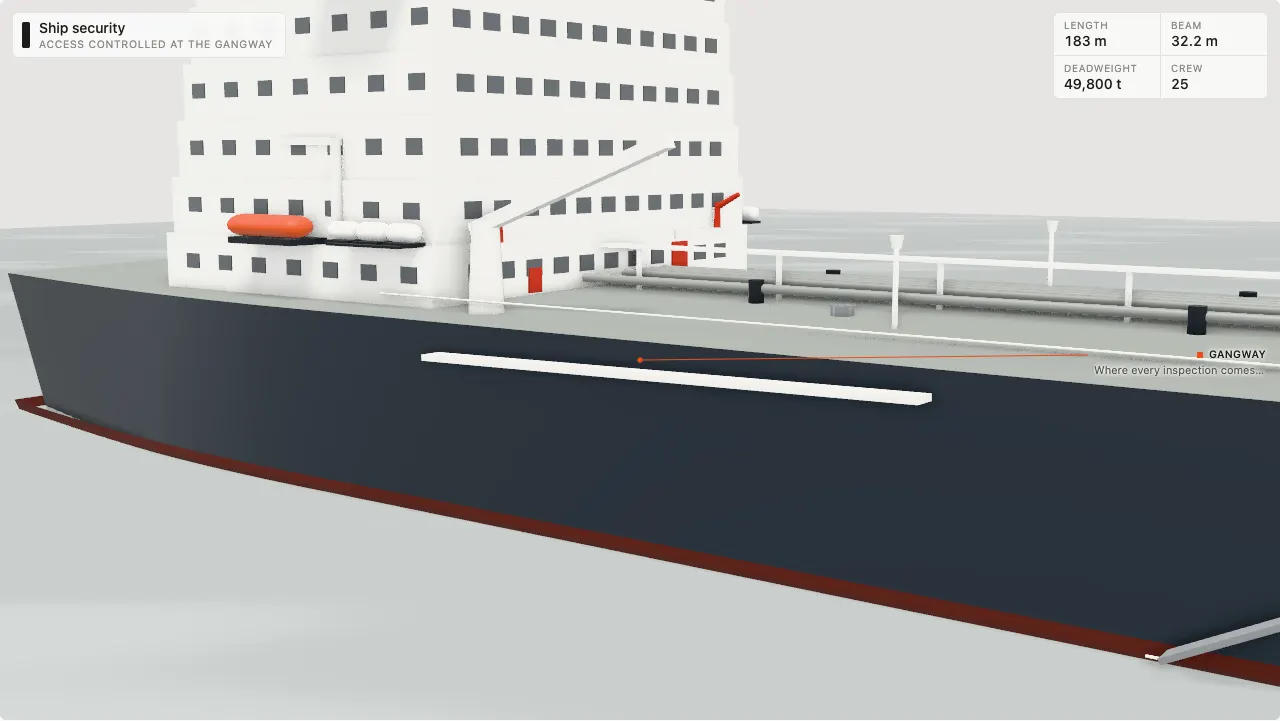
Security on a merchant ship is easy to treat as paperwork: a plan in a locked cabinet, a certificate on the bulkhead, a log of visitors at the gangway. Port State control no longer sees it that way. The Procedures for Port State Control, 2025, resolution A.1206(34), added a new appendix on security, giving inspectors an explicit basis to act where security arrangements are ineffective in practice, not just incomplete on paper. In the Tokyo MOU region alone, PSCOs recorded 1,061 deficiencies under the ISPS Code in 2025.
The International Ship and Port Facility Security (ISPS) Code was adopted in December 2002 together with SOLAS chapter XI-2 and entered into force on 1 July 2004. Part A is mandatory. Part B is guidance, which the Administration and port States use to interpret Part A, and which some States (the European Union among them) have made partly binding in their own law.
Sign in to read the rest of this lesson
Continue reading
Save your progress, open all 115 lessons and get a Course completed card when you finish.
or use your email
In the rest of this lesson
- Try it: A security week on a container ship
- In plain words
- In detail
- What the rules say
- Flag and class notes
- Key numbers
- What inspectors find
- 4 questions people ask
- Quiz: 5 questions
- Ask our engineers about this lesson
Familiarisation training from Al Safwan Academy. Finishing a course shows completion of online familiarisation training: it is not an STCW, flag-approved or manufacturer qualification, and these courses don't replace that training. The manufacturer's manual and your flag's rules always come first.