Lesson 7 · 17 min
Port state control: how to prepare and what gets ships detained
You will understand how a PSC inspection runs from the gangway to the report, what makes an officer detain a ship, and how to prepare a ship that passes.
Start here
The 2-minute primer
New to this? These 6 cards explain the lesson in plain words. Go through them first and the lesson will make sense.
Primer done.
-
1/6Picture this
The ticket inspector on the train
Think of a train ticket. You bought it somewhere else, maybe weeks ago. But the inspector on this train can still check it is valid, and that it really belongs to you. If something is badly wrong, you get off at the next stop.
Ships meet the same kind of check. Their certificates come from their own country, but every port they visit can check them.
-
2/6The big idea
A safety net in every port
A ship’s certificates say it is safe, but they may have been issued months ago, far away. Port State control lets the port’s own inspectors board a foreign ship and check that it still matches its papers.
An inspection starts simply: papers and a walk round. If something looks wrong, the inspector looks deeper. If problems are serious, the ship is detained until they are fixed.
-
3/6Words you'll meet
Six words, in plain English
- Port State control (PSC)
- inspections of foreign ships by officers of the country whose port they are visiting.
- PSCO (port State control officer)
- the inspector who boards the ship and carries out the check.
- Clear grounds
- a real sign that the ship may not meet the rules, which allows a deeper inspection.
- Deficiency
- something found on board that does not meet the rules.
- Detention
- an order keeping the ship in port until serious problems are put right.
- MoU (memorandum of understanding)
- an agreement under which ports in one region share inspection results.
-
4/6Why it matters
Days lost, and a record that follows
A detention costs days in port, often an extra survey, and a mark on the ship’s record. Ports in a region share results, so a ship with a poor record is inspected more often, and repeated detentions can get it banned from a whole region.
Most detentions come from ordinary items, such as fire-fighting systems, lifeboats and fire pumps. The crew can test these before arrival.
-
5/6In this lesson
What you’ll be able to do
- Follow an inspection from the gangway to the final report.
- Know what counts as clear grounds for a deeper look.
- Tell what gets a ship detained and what only needs fixing.
- Prepare a ship and its crew before arrival.
-
6/6Quick check
What is the main purpose of port State control?
Right: the main aim is to prevent a substandard ship from sailing, using checks in every port it visits.
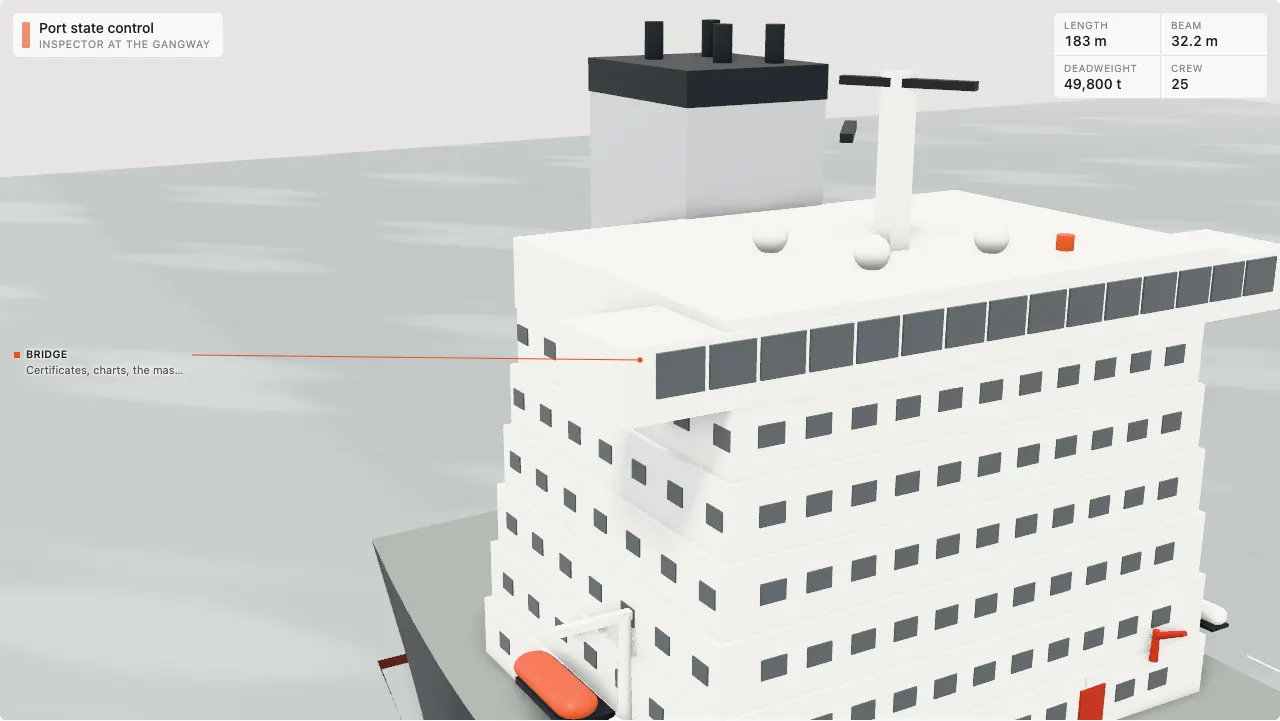
The basics
In 2025 the Paris MoU detained 688 ships after 16,474 inspections, a detention rate of 4.18%, up from 4.03% in 2024. In the Asia-Pacific region the Tokyo MOU detained 1,255 ships. Each detention means days lost, often an extra survey or audit, a black mark on the ship’s risk profile and on the flag’s and RO’s performance records, and sometimes a ban from a whole region’s ports.
Most detentions are not caused by exotic failures. The most frequent detainable deficiencies in the Tokyo MOU region in 2025 were fixed fire-extinguishing installations (215), ISM (200), lifeboats (152), ventilators, air pipes and casings (138) and fire pumps (118). These are items the crew can test, and a service provider can put right, before the ship arrives.
Sign in to read the rest of this lesson
Continue reading
Save your progress, open all 115 lessons and get a Course completed card when you finish.
or use your email
In the rest of this lesson
- Try it: Detention, rectify, or fine?
- In plain words
- In detail
- What the rules say
- Flag and class notes
- Key numbers
- What inspectors find
- 5 questions people ask
- Quiz: 7 questions
- Ask our engineers about this lesson
Familiarisation training from Al Safwan Academy. Finishing a course shows completion of online familiarisation training: it is not an STCW, flag-approved or manufacturer qualification, and these courses don't replace that training. The manufacturer's manual and your flag's rules always come first.