Lesson 4 · 15 min
Hatch cover weathertightness and ultrasonic tightness testing
You will be able to plan and witness a hatch cover tightness test, read ultrasonic results against the open hatch value, and recognise the defects no test will show.
Start here
The 2-minute primer
New to this? These 6 cards explain the lesson in plain words. Go through them first and the lesson will make sense.
Primer done.
-
1/6Picture this
The fridge door and a sheet of paper
Close the fridge door on a sheet of paper and try to pull it out. If it comes out easily, the rubber seal is not pressing hard enough, and warm air is getting in.
A ship’s hatch cover works like that fridge door. A rubber seal pressed firmly onto steel keeps the sea out of the cargo hold.
-
2/6The big idea
A seal needs pressure, not just contact
The rubber gasket on the cover is pressed down onto a steel bar all the way round. Cleats hold the cover down, and drains carry away any water that slips past.
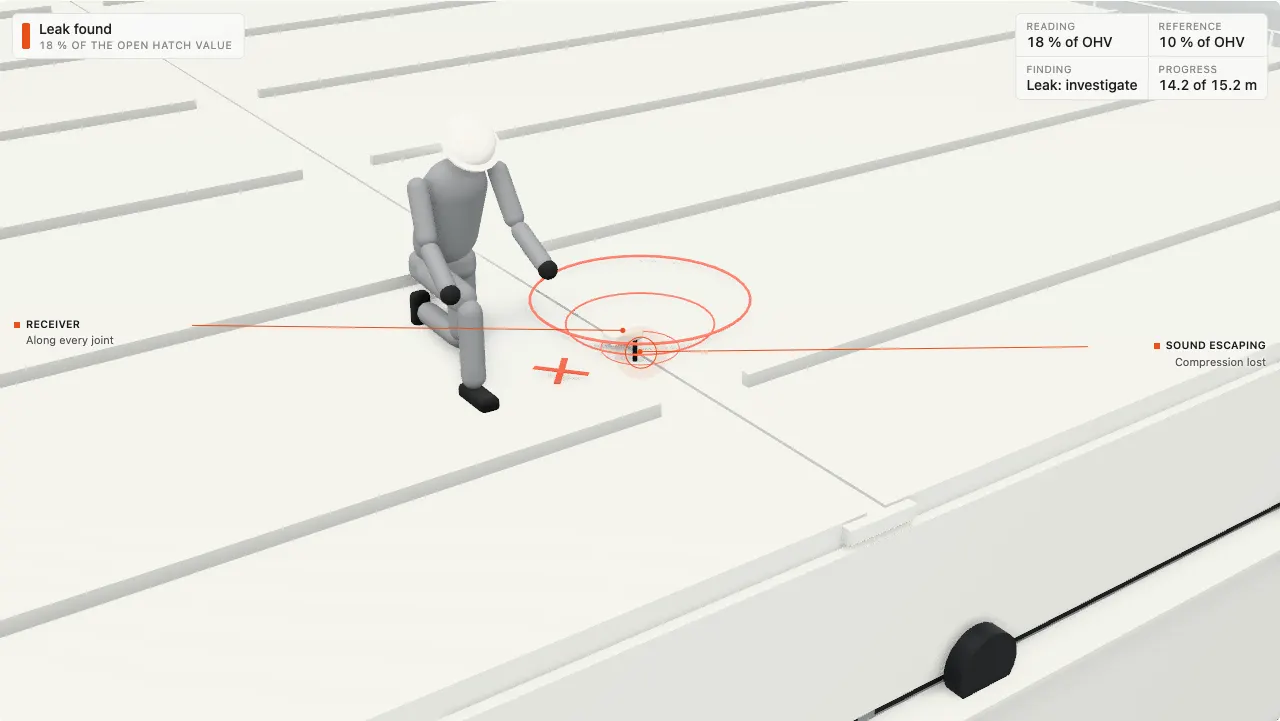
To test it, you can spray water and look for leaks. Or you can put a sound transmitter in the hold and listen outside every joint. Where sound gets out, the seal has lost its squeeze.
-
3/6Words you'll meet
Six words, in plain English
- Hatch cover
- the large steel lid that closes the opening of a cargo hold.
- Gasket
- the rubber strip on the cover that is squeezed to make a watertight seal.
- Cleat
- a clamp that pulls the cover down tight onto its seal.
- Hose test
- spraying a strong jet of water along every joint and looking inside for leaks.
- Ultrasonic test
- filling the hold with high-pitched sound and measuring how much escapes at each joint.
- Open hatch value
- the sound reading with the cover open, used as the full-strength reference.
-
4/6Why it matters
A little water ruins a lot of cargo
A few litres of seawater will not sink a ship, but they can spoil a hold of grain, steel coils or paper and lead to a costly claim.
On bulk carriers, a cover that lifts or leaks at the front of the ship can let waves breaking over the deck flood a hold. Worn seals, blocked drains and loose cleats are found again and again.
-
5/6In this lesson
What you’ll be able to do
- Explain how a hatch cover keeps the sea out.
- Tell the chalk, hose and ultrasonic tests apart.
- Read ultrasonic results against the open hatch value.
- Spot faults that no test will show, such as flattened rubber.
-
6/6Quick check
In an ultrasonic test, what does sound escaping at a joint tell you?
Right: a well-pressed seal blocks the sound. Where sound leaks out, the rubber is not pressing hard enough and water could follow.
The basics
A few litres of seawater through a hatch cover joint will not sink a ship, but they can turn a hold of grain, steel coils or paper into a cargo claim. IACS says it plainly in its guidance to owners: loss of weathertight integrity “continues to be a constant factor leading to cargo damage”, and class and load line survey reports contain “frequent references” to poorly maintained hatch covers. In 2025 Paris MoU inspectors recorded 2,637 deficiencies under the Load Line Convention, the regime that covers hatchways and their covers.
The hatch cover is also structure. On bulk carriers the forward covers take green seas, and a cover that lifts or leaks can flood a forward hold. That is why every special survey requires the sealing of all hatch covers to be proved, by hose test or an equivalent such as an ultrasonic test, and why the firms doing ultrasonic tests for class must be approved. Walk the hatch below and tick what is wrong.
Sign in to read the rest of this lesson
Continue reading
Save your progress, open all 115 lessons and get a Course completed card when you finish.
or use your email
In the rest of this lesson
- Try it: Ultrasonic tightness test of No. 1 hatch cover, bulk carrier
- In plain words
- In detail
- What the rules say
- Flag and class notes
- Key numbers
- What inspectors find
- 4 questions people ask
- Quiz: 6 questions
- Ask our engineers about this lesson
Familiarisation training from Al Safwan Academy. Finishing a course shows completion of online familiarisation training: it is not an STCW, flag-approved or manufacturer qualification, and these courses don't replace that training. The manufacturer's manual and your flag's rules always come first.