Lesson 5 · 15 min
In-water survey in lieu of dry-docking (IWS and UWILD)
You will be able to decide whether an in-water survey can replace a bottom inspection in dry dock, and prepare one that the class surveyor will credit.
Start here
The 2-minute primer
New to this? These 6 cards explain the lesson in plain words. Go through them first and the lesson will make sense.
Primer done.
-
1/6Picture this
The mechanic who comes to your driveway
Normally your car goes to the garage and up on the lift so the mechanic can see underneath. Some checks, though, a mobile mechanic can do on your driveway, lying on a board with a torch.
An in-water survey is that driveway visit. Instead of lifting the ship into dry dock, divers or an underwater robot look at the bottom while it stays afloat.
-
2/6The big idea
A dry-dock check done under water
The ship’s bottom is inspected twice every five years. The one at the five-year renewal is in dry dock. The one in the middle may often be done afloat.
Divers or a remotely operated robot film the hull live, while the surveyor watches on deck and asks for close-ups. It only works with the right ship, clear sheltered water, a clean hull and an approved firm.
-
3/6Words you'll meet
Six words, in plain English
- Dry dock
- a dock pumped dry so the ship’s bottom can be seen and repaired from below.
- In-water survey
- an inspection of the ship’s bottom by divers or a robot while the ship floats.
- ROV
- remotely operated vehicle, an underwater robot with cameras steered from the surface.
- Bottom inspection
- the check of the outside of the hull below the waterline.
- ESP
- the Enhanced Survey Programme, stricter survey rules for bulk carriers and oil tankers.
- UWILD
- underwater inspection in lieu of dry-docking, the name used in the United States for the same idea.
-
4/6Why it matters
A survey that does not count is costly
Dry-docking takes a ship out of service for days or weeks. Doing the middle inspection afloat can save that time.
But a survey in murky water, on a fouled hull or by an unapproved team is not credited. The deadline keeps running, and the ship’s certificate can lapse.
-
5/6In this lesson
What you’ll be able to do
- Decide whether a ship may have its bottom inspected afloat.
- Prepare a survey plan that class will accept.
- Check that the diving or robot firm is approved.
- Know how extended dry-docking schemes work.
-
6/6Quick check
Who watches an in-water survey as it happens?
Right: the surveyor watches the live picture on deck and directs the diver. A survey the surveyor did not watch is not credited.
The basics
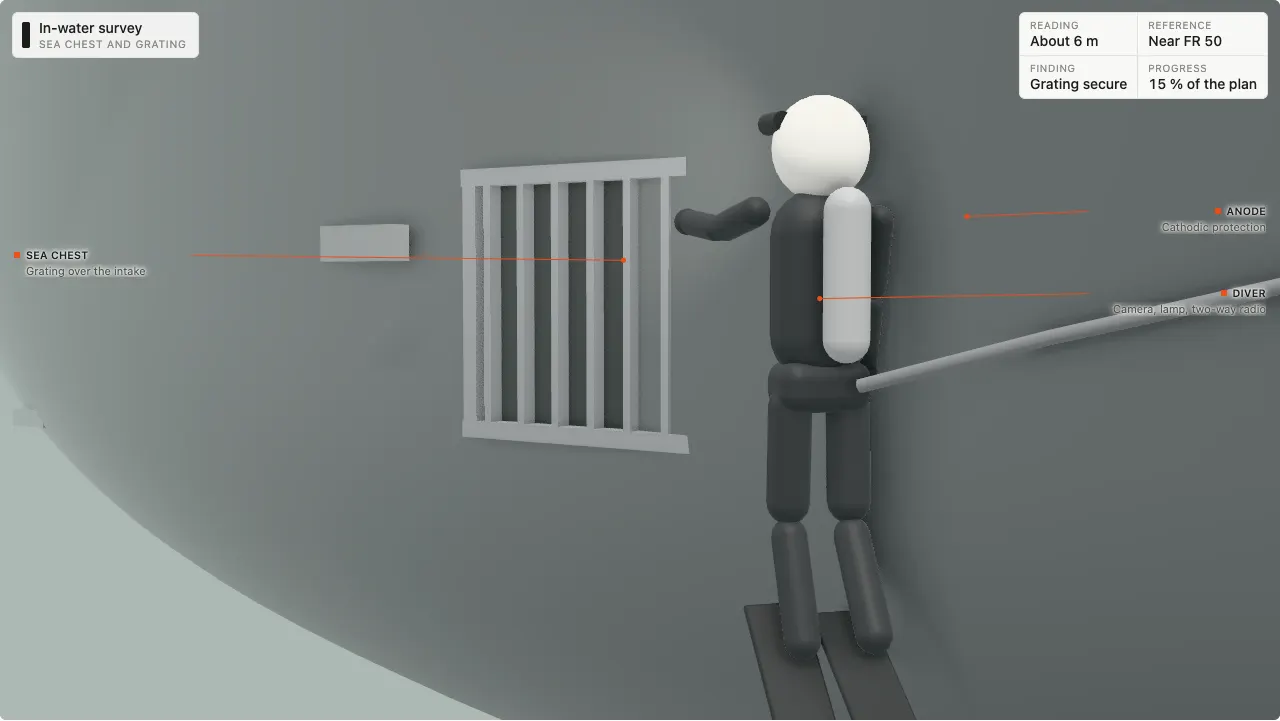
A dry-docking takes a ship out of service for days or weeks, plus the passage to the yard. For the intermediate bottom inspection, the one that falls in the middle of the five-year cycle, many owners ask whether a team of divers or a remotely operated vehicle (ROV) can look at the hull while the ship stays afloat. Often the answer is yes. The international rules have allowed the “alternate” bottom inspection to be done afloat for decades, provided the ship, the water, the equipment and the people are right.
Getting it wrong costs more than a dock. An in-water survey done in murky water by an unapproved team is not credited, the 36-month limit keeps running, and the statutory certificate can lapse. This lesson shows when an in-water survey (IWS, the IACS term) is allowed, how it is run, and how the extended dry-docking schemes work. In US practice the same idea is called underwater inspection in lieu of dry-docking (UWILD). Work through the case first.
Sign in to read the rest of this lesson
Continue reading
Save your progress, open all 115 lessons and get a Course completed card when you finish.
or use your email
In the rest of this lesson
- Try it: An in-water survey for a mid-life container ship
- In plain words
- In detail
- What the rules say
- Flag and class notes
- Key numbers
- What inspectors find
- 4 questions people ask
- Quiz: 6 questions
- Ask our engineers about this lesson
Familiarisation training from Al Safwan Academy. Finishing a course shows completion of online familiarisation training: it is not an STCW, flag-approved or manufacturer qualification, and these courses don't replace that training. The manufacturer's manual and your flag's rules always come first.