Lesson 3 · 14 min
NDT methods for hull welds and cracks, and who may do them
You will be able to pick the right NDT method for a hull weld or a suspected crack and check that the people and the procedure behind the result are acceptable to class.
Start here
The 2-minute primer
New to this? These 6 cards explain the lesson in plain words. Go through them first and the lesson will make sense.
Primer done.
-
1/6Picture this
A doctor’s toolkit for steel
A doctor does not cut you open to find a problem. They look, listen, take an X-ray or do an ultrasound scan, and pick the tool that suits what they suspect.
Steel welds get the same care. Non-destructive testing finds cracks and hidden flaws without damaging the ship, and each method sees a different kind of problem.
-
2/6The big idea
Pick the method that sees the flaw
There are five everyday methods. Looking comes first. Dye and magnetic powder show cracks at the surface. Ultrasound finds flat flaws deep inside a weld. X-rays show round flaws such as gas bubbles.
Who does the test matters as much as how. Testers are certified at three levels, and only someone at Level 2 or above may judge a result that class relies on.
-
3/6Words you'll meet
Six words, in plain English
- NDT
- non-destructive testing, checking a part for flaws without damaging it.
- Penetrant testing
- a coloured liquid soaks into surface cracks, then a white coating draws it out as a line.
- Magnetic particle testing
- the steel is magnetised and fine iron powder gathers along any crack.
- Ultrasonic testing
- sound sent into steel that bounces back from flaws hidden inside.
- Radiographic testing
- X-rays passed through a weld onto film, showing bubbles and slag as dark spots.
- Level 2
- the certification level of a tester allowed to carry out a test and judge the result.
-
4/6Why it matters
A crack found by eye keeps going
A crack often starts under paint and grows each time the ship flexes in waves. If it is traced only by eye, the repair stops short and the crack carries on beyond it.
Results judged by someone without the right certificate, or tests done too soon after welding, can miss the flaw entirely.
-
5/6In this lesson
What you’ll be able to do
- Match a weld problem to the method that finds it.
- Know what each method cannot see.
- Check the tester’s level and whether class will accept the result.
- Know the rules for new ships and for ships in service.
-
6/6Quick check
Which method is useless on aluminium?
Right: magnetic particle testing needs steel that can be magnetised, so aluminium and some stainless steels need penetrant testing instead.
The basics
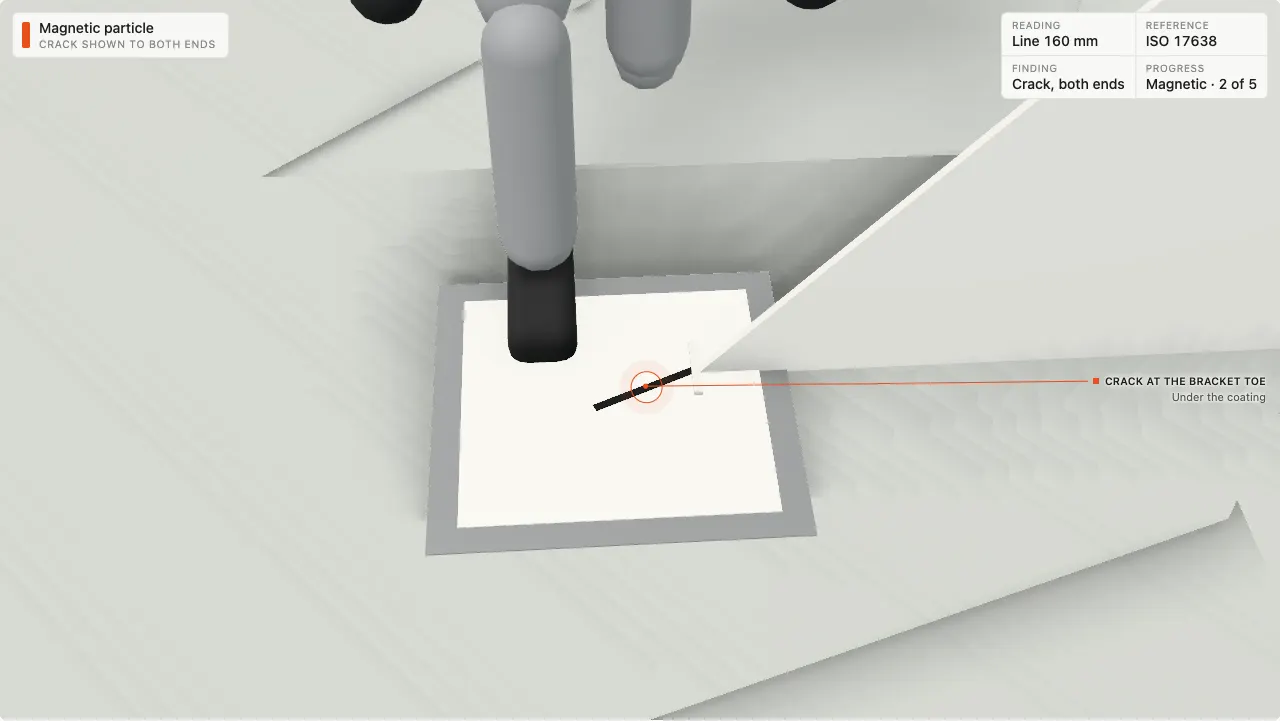
A crack in a hull weld rarely announces itself. It may start at the toe of a bracket under coating, grow a little every time the ship works in a seaway, and show only as a rust line or a weep of ballast water. When the surveyor sees that line, the question is no longer whether to test but how: which non-destructive testing (NDT) method will find the end of the crack, and whose result will class accept?
The answer depends on where the defect sits (surface or inside), the material (magnetic steel or not), the thickness, and who holds the probe. IACS answers the first three for new construction in Unified Requirement (UR) W33, and the last one in UR W33 and UR W35, with a change coming in 2028. Start by sorting the jobs below.
Sign in to read the rest of this lesson
Continue reading
Save your progress, open all 115 lessons and get a Course completed card when you finish.
or use your email
In the rest of this lesson
- Try it: Match each job to the NDT method that suits it best
- In plain words
- In detail
- What the rules say
- Flag and class notes
- Key numbers
- What inspectors find
- 4 questions people ask
- Quiz: 6 questions
- Ask our engineers about this lesson
Familiarisation training from Al Safwan Academy. Finishing a course shows completion of online familiarisation training: it is not an STCW, flag-approved or manufacturer qualification, and these courses don't replace that training. The manufacturer's manual and your flag's rules always come first.