Lesson 2 · 16 min
Ultrasonic thickness measurement and approved firms
You will be able to explain how a thickness reading is made, spot a bad one, work out diminution against the class margin, and check a gauging firm's approval and report.
Start here
The 2-minute primer
New to this? These 6 cards explain the lesson in plain words. Go through them first and the lesson will make sense.
Primer done.
-
1/6Picture this
A bat timing its own echo
A bat flying in the dark squeaks and listens for the echo. The longer the echo takes to come back, the further away the wall is.
An ultrasonic gauge does the same inside a steel plate. It sends a tiny burst of sound in, times the echo from the far side, and turns that time into millimetres of steel.
-
2/6The big idea
Good readings need the right gauge and people
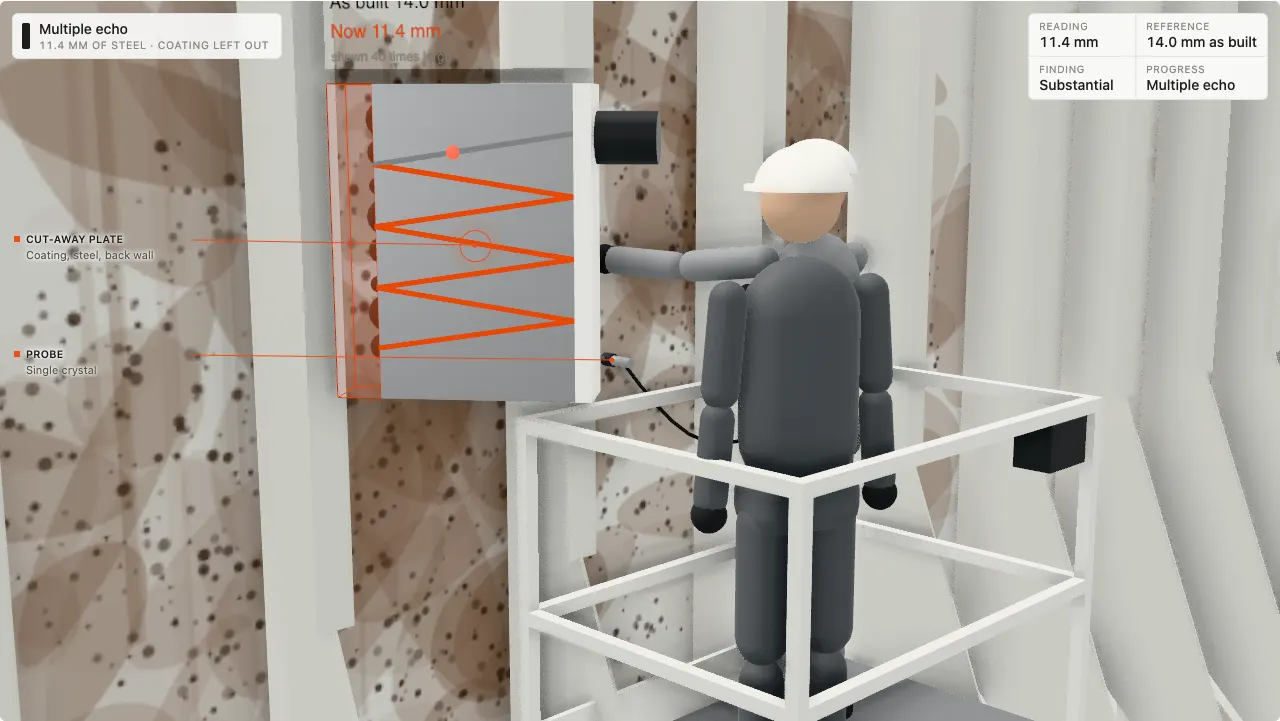
Ships are painted, and paint fools a simple gauge into reading too thick. A multiple-echo gauge times the bounces inside the steel only, so the paint is left out.
Readings also depend on where the probe goes. So the firm doing the work must be approved by the class society, with certified operators, and a surveyor on board to direct and sign the job.
-
3/6Words you'll meet
Six words, in plain English
- Ultrasonic gauge
- a hand-held tool that measures steel thickness with sound too high to hear.
- Probe
- the part pressed on the steel that sends the sound in and picks up the echo.
- Couplant
- a gel between probe and steel, because sound will not cross a gap of air.
- Multiple-echo
- a method that times bounces inside the steel only, so paint does not spoil the reading.
- Diminution
- how much thinner the steel is now than when the ship was built.
- NDT
- non-destructive testing, checking material without cutting or damaging it.
-
4/6Why it matters
Wrong numbers become wrong steel
A thickness report decides how many tonnes of steel are renewed in dock, and sometimes whether the ship keeps its class.
If the gauge read the paint, or the operator picked the one clean spot on a rusty plate, the report looks fine but is wrong. Weak steel stays in, or good steel is cut out for nothing.
-
5/6In this lesson
What you’ll be able to do
- Explain how a thickness reading is made.
- Spot readings that are likely to be wrong.
- Work out diminution and tell when rust counts as substantial.
- Check a gauging firm’s approval and its report.
-
6/6Quick check
Why is a multiple-echo gauge used on painted steel?
Right: it times the echoes bouncing inside the steel, so the slower paint layer is not counted as steel.
The basics
A thickness report decides how much steel a ship renews in dock, and sometimes whether the ship keeps its class. Thousands of numbers, each one a fraction of a second of sound bouncing inside a plate, end up as tonnes of steel and weeks of yard time. If the gauge read the paint instead of the steel, or the operator chose the one clean spot on a pitted plate, the report is wrong in a way nobody can see from the paperwork.
That is why IACS treats thickness measurement as a regulated service. The firm must be approved by the class society under Unified Requirement (UR) Z17, its operators must hold recognised non-destructive testing (NDT) certificates, and a surveyor must be on board while it works. Click the parts of the gauge set-up below to see what each part does and how readings go wrong.
Sign in to read the rest of this lesson
Continue reading
Save your progress, open all 115 lessons and get a Course completed card when you finish.
or use your email
In the rest of this lesson
- Try it: Ultrasonic thickness gauge on a coated hull plate
- In plain words
- In detail
- What the rules say
- Flag and class notes
- Key numbers
- What inspectors find
- 4 questions people ask
- Quiz: 6 questions
- Ask our engineers about this lesson
Familiarisation training from Al Safwan Academy. Finishing a course shows completion of online familiarisation training: it is not an STCW, flag-approved or manufacturer qualification, and these courses don't replace that training. The manufacturer's manual and your flag's rules always come first.