Lesson 3 · 15 min
GMDSS: sea areas, equipment and the radio survey
You will be able to match GMDSS equipment to sea areas under the 2024 SOLAS Chapter IV and follow a radio survey for the Cargo Ship Safety Radio Certificate.
Start here
The 2-minute primer
New to this? These 6 cards explain the lesson in plain words. Go through them first and the lesson will make sense.
Primer done.
-
1/6Picture this
Phone signal fades as you leave town
On your mobile, you have full signal in town. Drive into the hills and it drops. Go far enough and only a satellite phone will reach anyone.
The sea is the same. Near the coast a short-range radio reaches help. Further out, a ship needs longer-range radio, then satellite, and near the poles long-range radio again.
-
2/6The big idea
Always two ways to call for help
The GMDSS is the worldwide system ships use to call for help and talk to rescuers. Its promise: wherever a ship is, it can raise the alarm ashore in at least two separate ways.
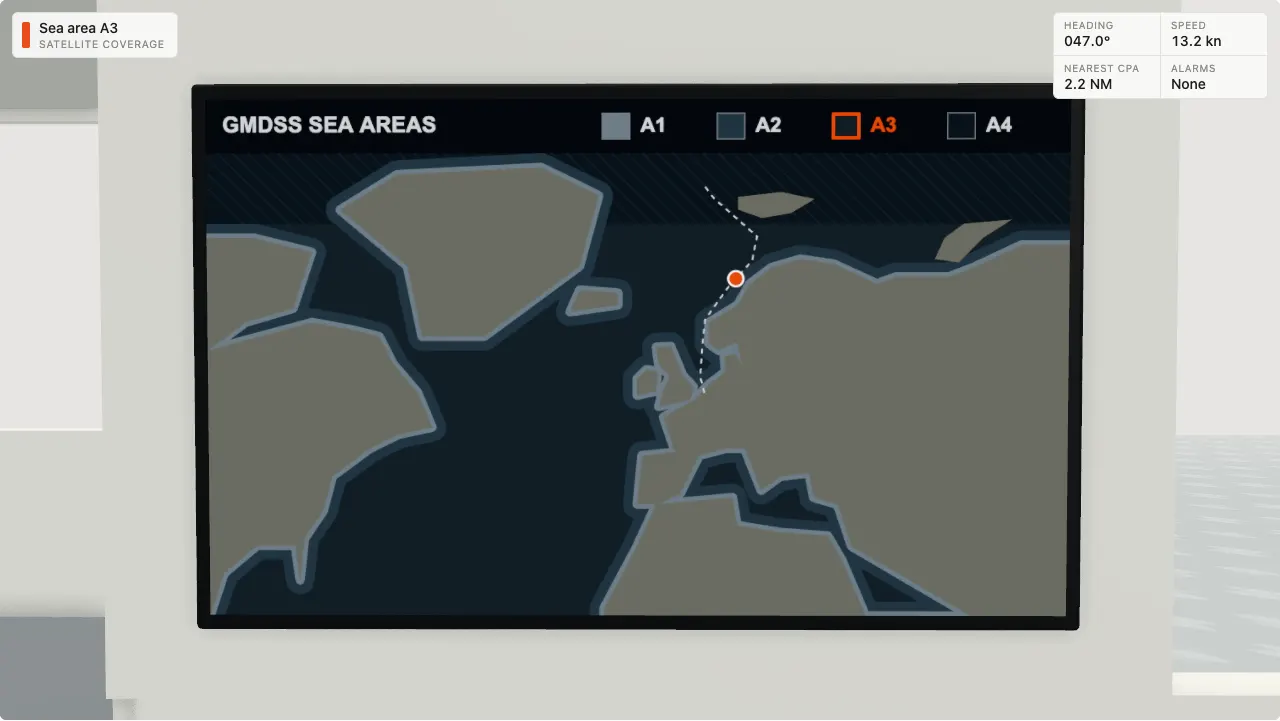
The oceans are split into four sea areas, by which shore stations or satellites can hear the ship. Every ship carries a basic set, then adds radios for its furthest area. A radio surveyor checks it all every year.
-
3/6Words you'll meet
Six words, in plain English
- GMDSS
- Global Maritime Distress and Safety System, the worldwide setup for ship distress alerts and rescue communication.
- Sea area
- one of four zones, A1 to A4, based on which kind of shore station can hear the ship.
- DSC
- digital selective calling, a radio feature that sends coded calls, including a distress alert with the ship’s identity and position.
- EPIRB
- emergency position-indicating radio beacon, which floats free and alerts rescuers by satellite if the ship sinks.
- Reserve source of energy
- the backup batteries that keep the radios working if the ship loses power.
- Radio survey
- the yearly check by a qualified radio surveyor that every radio and beacon works.
-
4/6Why it matters
Quiet radios fail when finally needed
Radio equipment can sit unused on the bridge for years, and that is exactly when it fails. Port inspectors record many radio faults each year.
A radio that can’t send a distress alert is a reason to hold a ship in port. More importantly, it may be the only link to rescue on the worst day.
-
5/6In this lesson
What you’ll be able to do
- Tell the four sea areas apart and what each one needs.
- Know what changed in the rules on 1 January 2024.
- Know how the backup batteries are checked and recharged.
- Follow what the radio surveyor tests during the survey.
-
6/6Quick check
How many separate ways must a ship have to raise the alarm ashore?
Right: the system’s core promise is two separate and independent ways to send a distress alert, wherever the ship is.
The basics
The Global Maritime Distress and Safety System (GMDSS) is built on one promise: wherever a ship is, she can raise the alarm ashore by at least two separate and independent means, and the rescue coordination centre can talk back. Since 1 January 2024 that promise is delivered under a completely new text of SOLAS Chapter IV, adopted by resolution MSC.496(105). “Inmarsat” has disappeared from the convention, Iridium can now provide GMDSS services where the flag accepts it, and HF radio telex is no longer a GMDSS requirement.
Radio equipment that sits quietly on the bridge for years is exactly the equipment that fails when it is finally needed. In 2024 the Tokyo MOU recorded 1,244 radio communication deficiencies, and “absence or failure of the proper operation of the radio equipment for distress and safety communication” is on the IMO list of grounds for detention. This lesson explains the sea areas, what each requires, and what happens during the radio survey.
Sign in to read the rest of this lesson
Continue reading
Save your progress, open all 115 lessons and get a Course completed card when you finish.
or use your email
In the rest of this lesson
- Try it: Where does each requirement first appear in SOLAS Chapter IV?
- In plain words
- In detail
- What the rules say
- Flag and class notes
- Key numbers
- What inspectors find
- 3 questions people ask
- Quiz: 5 questions
- Ask our engineers about this lesson
Familiarisation training from Al Safwan Academy. Finishing a course shows completion of online familiarisation training: it is not an STCW, flag-approved or manufacturer qualification, and these courses don't replace that training. The manufacturer's manual and your flag's rules always come first.