Lesson 5 · 14 min
The magnetic compass, compass adjustment and the deviation card
You will know when to call a compass adjuster, how to keep the deviation book and card that surveyors and PSC check, and where flag rules differ.
Start here
The 2-minute primer
New to this? These 6 cards explain the lesson in plain words. Go through them first and the lesson will make sense.
Primer done.
-
1/6Picture this
A fridge magnet pulls the needle
Hold a little hiking compass next to a fridge door and the needle swings away from north. The compass isn’t broken. The steel nearby is pulling it.
A ship is a giant steel box, so its own magnetism pulls the bridge compass off. Someone has to measure that pull and write it down.
-
2/6The big idea
Measure the error, keep the record
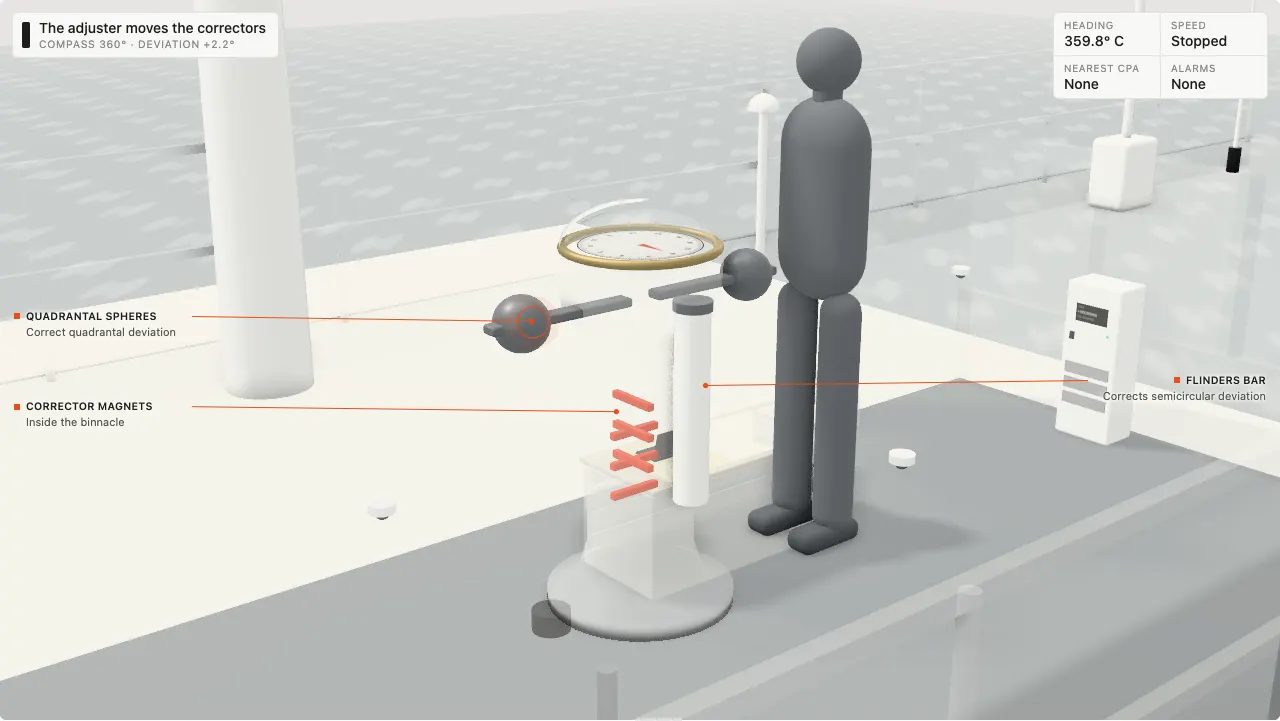
The pull from the ship’s steel is called deviation, and it changes as the ship turns. A compass adjuster reduces it with small magnets and iron pieces around the compass, then writes what is left on a deviation card.
Officers check the compass error every watch and log it in a book. When the readings drift away from the card, it is time to call the adjuster.
-
3/6Words you'll meet
Six words, in plain English
- Deviation
- how far the ship’s own magnetism pulls the compass away from magnetic north, which changes with heading.
- Variation
- the gap between magnetic north and true north at a place, printed on the chart.
- Compass adjuster
- a qualified specialist who corrects the compass and draws up the deviation card.
- Swinging the ship
- turning the ship through every heading to measure the deviation on each.
- Deviation card
- the table or curve posted near the compass showing the leftover error on each heading.
- Compass deviation book
- the log where officers record the compass error they measure each watch.
-
4/6Why it matters
The last compass standing
When every generator stops, the magnetic compass is the only heading the ship has left. If nobody knows its error, the ship can steer the wrong way just when it matters most.
An old card, an empty deviation book, or a new screen fitted too close to the compass are things surveyors and port inspectors find.
-
5/6In this lesson
What you’ll be able to do
- Tell deviation and variation apart.
- Know the usual reasons to have the compass adjusted.
- Keep the deviation book and card the way surveyors expect.
- Know that each flag sets its own adjustment rules.
-
6/6Quick check
What makes the ship’s compass point away from magnetic north?
Right: that pull is deviation, and it changes as the ship turns. Variation is a different thing, set by where on earth the ship is.
The basics
The magnetic compass is the oldest instrument on the bridge and the only heading reference that keeps working when every generator has stopped. That is why SOLAS still requires a “properly adjusted” standard magnetic compass on every ship, and why surveyors and port State control officers still ask to see the deviation card and the compass book.
It is also the instrument most likely to be neglected. Gyros and GNSS do the daily work, the compass gets a glance, and the deviation card on the bulkhead can be years old and drawn for a different ship condition. In 2015 a consultancy circular reported a cargo ship that received the deficiency “magnetic compass not properly adjusted” during a detailed port State control inspection in Canada. This lesson explains when adjustment is needed, who may do it, and how to show that your compass can be trusted.
Sign in to read the rest of this lesson
Continue reading
Save your progress, open all 115 lessons and get a Course completed card when you finish.
or use your email
In the rest of this lesson
- Try it: Should the compass be adjusted?
- In plain words
- In detail
- What the rules say
- Flag and class notes
- Key numbers
- What inspectors find
- Work it out: a calculator
- 3 questions people ask
- Quiz: 6 questions
- Ask our engineers about this lesson
Familiarisation training from Al Safwan Academy. Finishing a course shows completion of online familiarisation training: it is not an STCW, flag-approved or manufacturer qualification, and these courses don't replace that training. The manufacturer's manual and your flag's rules always come first.