Lesson 4 · 14 min
Radar and ARPA: performance checks
You will know what a radar and its tracking functions must achieve under MSC.192(79), how to check them on board and what surveyors and PSC look for.
Start here
The 2-minute primer
New to this? These 6 cards explain the lesson in plain words. Go through them first and the lesson will make sense.
Primer done.
-
1/6Picture this
A clock that runs five minutes fast
A kitchen clock set five minutes fast still ticks perfectly. Its face looks fine. But every time you read it, you are wrong by the same amount.
A radar can be the same. It still shows a clean picture, but the targets sit in slightly the wrong place, or quietly disappear.
-
2/6The big idea
Clean picture, wrong answers
Radar sends out short pulses and listens for echoes to measure how far away and in which direction things are. It is only as good as three things: the radar itself, its alignment with the bow, and the inputs it gets, such as heading and speed.
Each can fail without making the picture look bad. A set of simple checks on the bridge catches most of them early.
-
3/6Words you'll meet
Six words, in plain English
- X-band and S-band
- the two kinds of ship radar. X-band shows finer detail, S-band sees better through rain and rough sea.
- ARPA
- automatic radar plotting aid, which follows other ships and works out their course, speed and closest approach.
- Heading line
- the line on the radar screen showing exactly where the bow points.
- Performance monitor
- a built-in check that shows if the radar has grown weaker since it was fitted.
- CPA
- closest point of approach, how near another ship will pass if nothing changes.
- Shadow sector
- a blind area where the ship’s own masts or funnel block the radar.
-
4/6Why it matters
Officers trust radar most in fog
When visibility closes in, radar is what officers lean on. A heading line two degrees out makes every bearing wrong. A weakened radar can lose small targets.
A frozen heading input with no alarm makes the movement of other ships look wrong. Inspectors also check that officers can actually work the radar, and that the shadow sector diagram is posted.
-
5/6In this lesson
What you’ll be able to do
- Know the accuracy a modern radar must reach.
- Check the heading line, range and performance monitor on board.
- Spot a failed input such as a frozen gyro heading.
- Know what surveyors and service engineers check.
-
6/6Quick check
Alongside, a lighthouse dead ahead shows 2 degrees off on the radar. What does that mean?
Right: bearings must be within 1 degree. A steady offset means the heading line needs realigning by a technician.
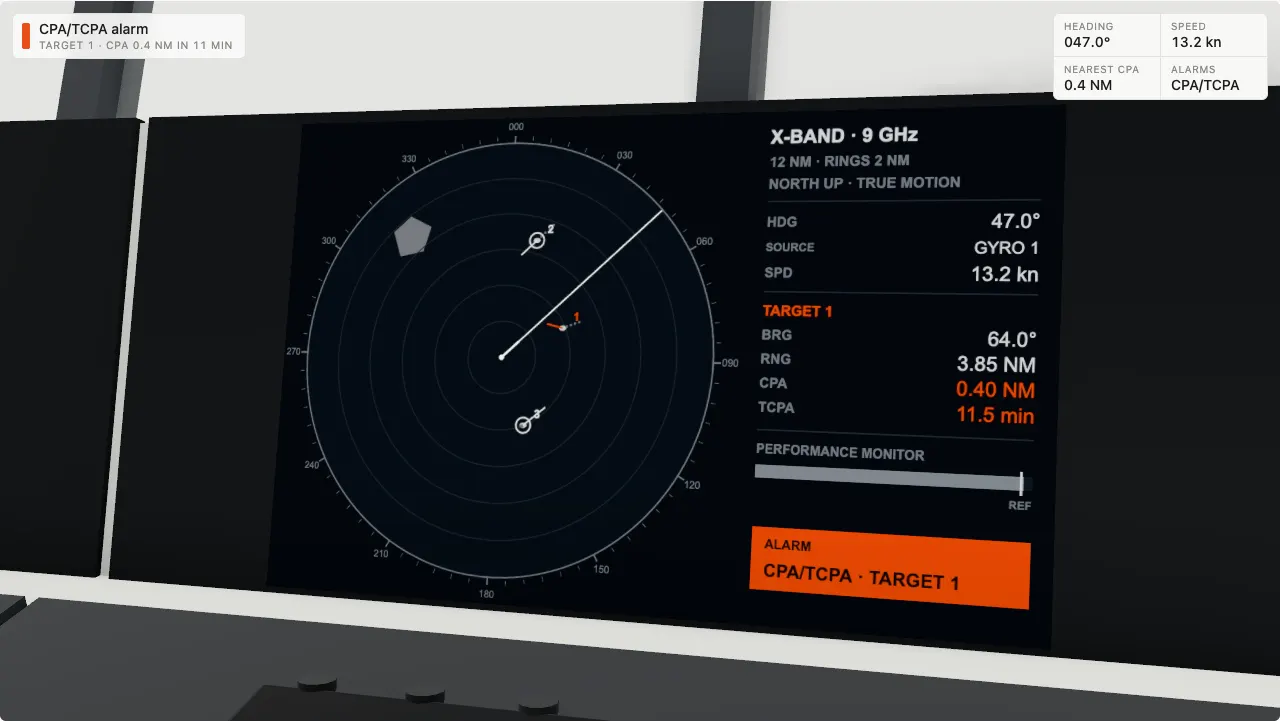
The basics
Radar is the instrument officers trust most when visibility closes in, and it is easy to trust it too much. A heading line a couple of degrees out, a magnetron that has lost half its power, or a gyro input that has silently frozen will all still give a clean-looking picture. The targets are simply in the wrong place, or missing.
The IMO performance standard for radar, resolution MSC.192(79), sets measurable limits for accuracy, tracking and alarms, and SOLAS requires radar installed from 1 July 2008 to meet it. This lesson turns those limits into checks you can do on the bridge and that a service engineer or surveyor will do with test equipment.
Sign in to read the rest of this lesson
Continue reading
Save your progress, open all 115 lessons and get a Course completed card when you finish.
or use your email
In the rest of this lesson
- Try it: Pre-departure check of the radars on a 12,000 GT bulk carrier
- In plain words
- In detail
- What the rules say
- Flag and class notes
- Key numbers
- What inspectors find
- 4 questions people ask
- Quiz: 6 questions
- Ask our engineers about this lesson
Familiarisation training from Al Safwan Academy. Finishing a course shows completion of online familiarisation training: it is not an STCW, flag-approved or manufacturer qualification, and these courses don't replace that training. The manufacturer's manual and your flag's rules always come first.