Lesson 7 · 13 min
Navigation and radio equipment at port state control
You will know how a PSC officer inspects navigation and radio equipment, which findings can detain a ship, and how to handle a failure honestly and lawfully.
Start here
The 2-minute primer
New to this? These 6 cards explain the lesson in plain words. Go through them first and the lesson will make sense.
Primer done.
-
1/6Picture this
The food inspector walks into the kitchen
A food safety inspector visits a restaurant. First they check the paperwork. Then they look around the kitchen. If something looks wrong, they dig deeper, and if it is serious, they can close the kitchen until it is fixed.
Port State control works the same way, with a ship’s bridge as the kitchen.
-
2/6The big idea
Papers first, then a closer look
Any country can inspect foreign ships in its ports. The inspector usually starts on the bridge: certificates, charts, the radars, the radio log and the test papers for the voyage recorder and AIS.
If they find clear signs of a problem, the inspection gets more detailed. Findings are listed as deficiencies to fix, and serious ones can lead to the ship being held in port.
-
3/6Words you'll meet
Six words, in plain English
- Port State control (PSC)
- the right of a country to inspect foreign ships in its ports against international rules.
- PSCO
- port State control officer, the inspector who comes aboard.
- Clear grounds
- solid signs of a problem that lead the inspector to look more closely.
- Deficiency
- a recorded fault, with a deadline to fix it.
- Detention
- the ship is not allowed to sail until a serious fault is fixed.
- Record of Equipment
- the list attached to a safety certificate showing what equipment the ship carries.
-
4/6Why it matters
Detentions follow the ship
A detention costs time and money, and it is published. It makes the ship more likely to be inspected again, and it counts against its flag and class.
Many findings are simple: a missing test report, out-of-date charts, or an officer who can’t show how to use the equipment. Most can be avoided with a little preparation.
-
5/6In this lesson
What you’ll be able to do
- Know what an inspector checks on the bridge and in the radio room.
- Tell which faults can lead to a detention.
- Know when a broken item at sea does not stop the ship.
- Prepare the bridge with a simple checklist before arrival.
-
6/6Quick check
Your radar broke at sea and is logged. An inspector boards. What do you do?
Right: being open, with evidence of what you have done, is what the rules expect. Hiding a fault turns it into a serious finding.
The basics
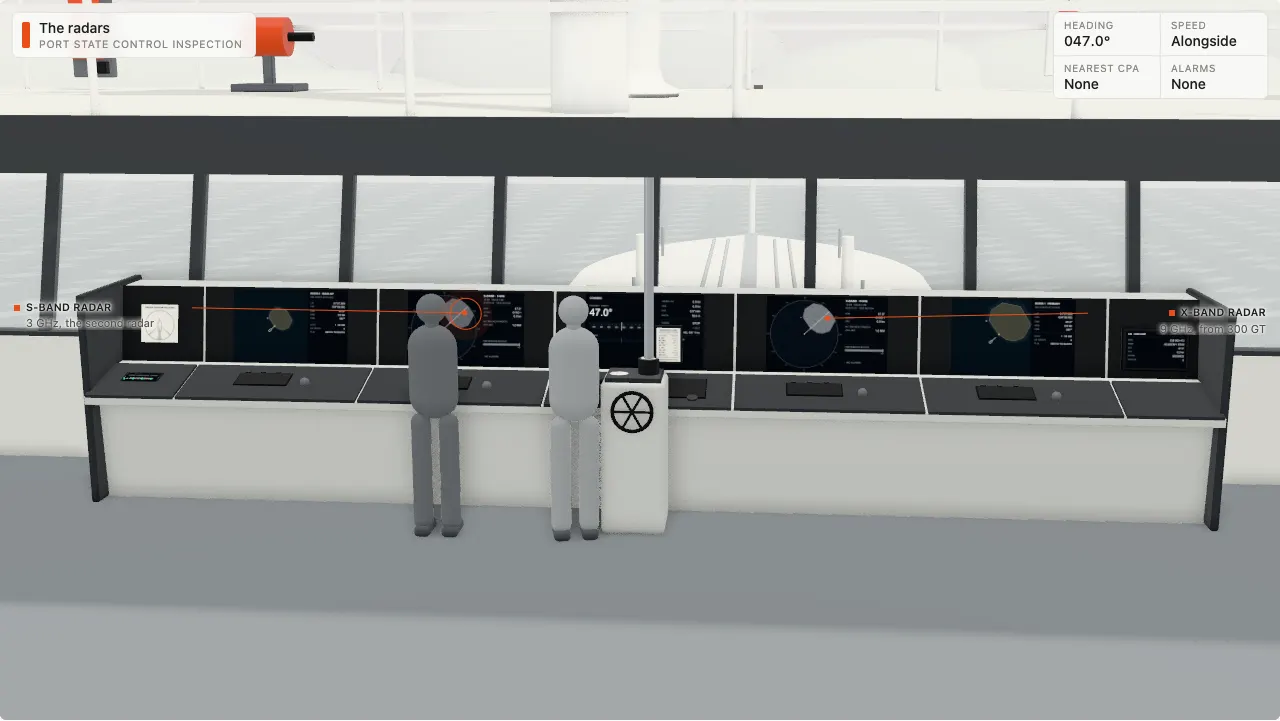
A port State control officer (PSCO) usually starts on the bridge. In a few minutes they can see whether the radars are running and the ECDIS charts are up to date, check the GMDSS log, ask the officer of the watch to show a test, and read the VDR and AIS certificates. If something important is missing or not working, the inspection can turn into a detailed one, and sometimes into a detention.
In 2024 the Tokyo MOU recorded 8,066 safety of navigation deficiencies and 1,244 radio communication deficiencies. The IMO Procedures for port State control, 2025, adopted by resolution A.1206(34) in December 2025 to replace the 2023 version, set out what PSCOs look for. This lesson walks through a bridge inspection and the decisions the master and officers make along the way.
Sign in to read the rest of this lesson
Continue reading
Save your progress, open all 115 lessons and get a Course completed card when you finish.
or use your email
In the rest of this lesson
- Try it: A port State control officer on the bridge
- In plain words
- In detail
- What the rules say
- Flag and class notes
- Key numbers
- What inspectors find
- 4 questions people ask
- Quiz: 6 questions
- Ask our engineers about this lesson
Familiarisation training from Al Safwan Academy. Finishing a course shows completion of online familiarisation training: it is not an STCW, flag-approved or manufacturer qualification, and these courses don't replace that training. The manufacturer's manual and your flag's rules always come first.