Lesson 5 · 14 min
Commissioning testing and annual checks of ballast water systems
You will be able to plan a BWMS commissioning test, keep the system ready for its annual survey, and know what will change when the 2026 amendments enter into force.
Start here
The 2-minute primer
New to this? These 6 cards explain the lesson in plain words. Go through them first and the lesson will make sense.
Primer done.
-
1/6Picture this
Test the new boiler in your own house
Think of a new boiler. The model passed tests in the factory. But the fitter still runs it in your house, with your pipes and your water, before signing it off. Then it gets a yearly service.
A ballast water treatment system works the same way. It is tested once on the ship where it was fitted, then checked again and again for the rest of its life.
-
2/6The big idea
Prove it works here, then keep it working
Approval proves a design works on a test rig. The commissioning test proves this particular unit, in this ship, cleans real harbour water.
An independent tester takes a large sample of the treated water and counts the living organisms left. The system’s own sensors are checked too. After that come regular surveys, careful maintenance and good records, so the system still works years later.
-
3/6Words you'll meet
Five words, in plain English
- Commissioning test
- a one-off test after fitting, proving this installation really cleans the water.
- Indicative analysis
- a quick count of living organisms, done to show whether the water likely passes.
- Sampling point
- a fitting on the discharge pipe where testers draw off treated water.
- IBWM Certificate (International Ballast Water Management Certificate)
- the ship’s certificate showing its ballast water arrangements have been surveyed.
- OMSM (operation, maintenance and safety manual)
- the maker’s manual, which sets how and when the system is serviced.
-
4/6Why it matters
About one in five tests fail
Testing laboratories have reported that about one in five commissioning tests they carried out did not pass. Dirty tanks and pipes left over from the installation are a common cause.
Later, a system that is not working was the most common problem inspectors found in a recent campaign, and the main reason ships were held. Good maintenance records are also what protect a ship if a sample ever fails.
-
5/6In this lesson
What you’ll be able to do
- Plan a commissioning test so it passes first time.
- Know what each survey checks, from yearly to five-yearly.
- Keep the records and maintenance an inspector will ask for.
- Know what the rule changes approved in 2026 will add.
-
6/6Quick check
What does the commissioning test prove?
Right: approval covers the design. The commissioning test checks the unit actually fitted, with the ship’s own pipes and local water.
The basics
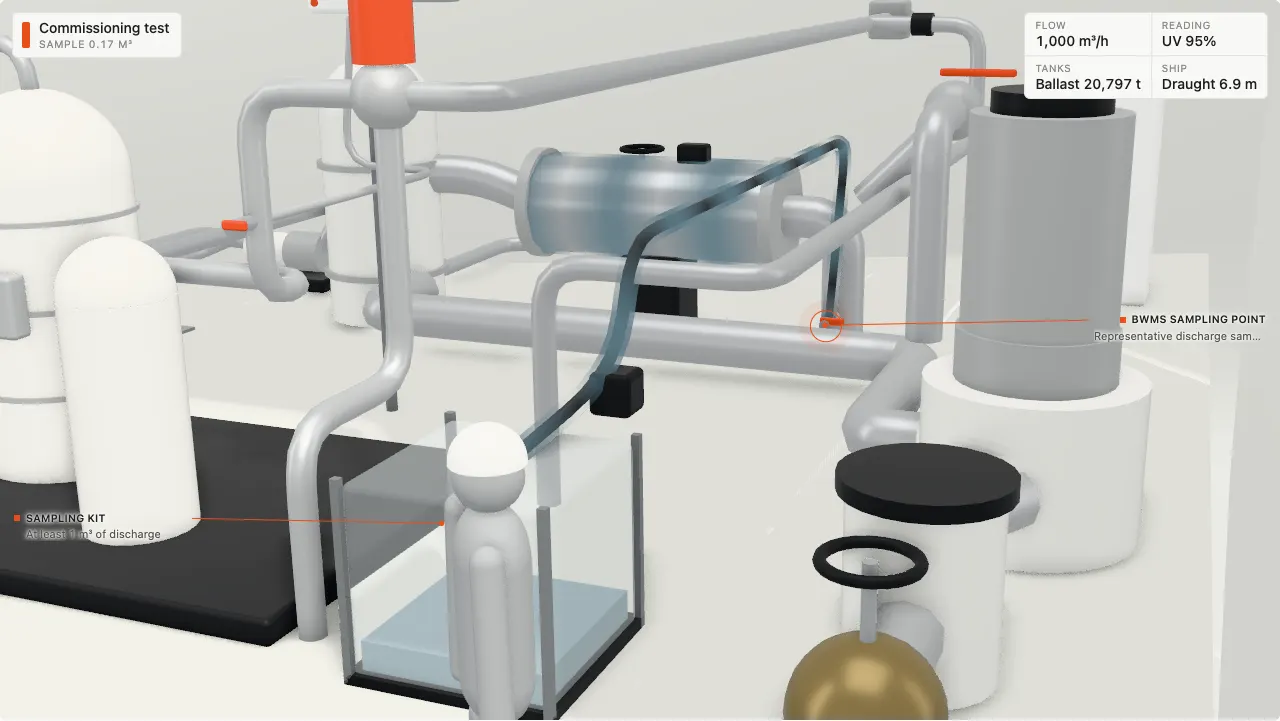
Type approval proves that a treatment design works on a test rig. It does not prove that the unit bolted into your engine room, with your pipework, your sampling point and your harbour water, works. That is what the commissioning test is for, and it has been mandatory since 1 June 2022.1 It is not a formality: members of the Global TestNet reported to IMO that about one in five commissioning tests they had carried out was non-compliant, mostly on the largest organisms (50 micrometres and above), although detailed analysis after a failed indicative test often showed the discharge was in fact compliant.8
After commissioning, the system has to keep working for the rest of the ship’s life. In the 2025 port state control campaign the most common deficiency, and the main cause of detentions, was a BWMS that was not operational.10 This lesson follows a BWMS from installation to renewal: the commissioning test, the surveys, the records and maintenance, and what the review approved in 2026 will add.
Sign in to read the rest of this lesson
Continue reading
Save your progress, open all 115 lessons and get a Course completed card when you finish.
or use your email
In the rest of this lesson
- Try it: A BWMS from installation to renewal
- In plain words
- In detail
- What the rules say
- Flag and class notes
- Key numbers
- What inspectors find
- 3 questions people ask
- Quiz: 6 questions
- Ask our engineers about this lesson
Familiarisation training from Al Safwan Academy. Finishing a course shows completion of online familiarisation training: it is not an STCW, flag-approved or manufacturer qualification, and these courses don't replace that training. The manufacturer's manual and your flag's rules always come first.