Lesson 2 · 16 min
The oily water separator and 15 ppm bilge alarm: tests and calibration
You will be able to trace an OWS system part by part, test it the way an inspector does, and keep its calibration and records in date.
Start here
The 2-minute primer
New to this? These 6 cards explain the lesson in plain words. Go through them first and the lesson will make sense.
Primer done.
-
1/6Picture this
A doorman who checks everyone
Think of a doorman at a busy door. He looks at every person, turns away anyone who breaks the rules, and writes down who came and went.
On a ship, a small instrument plays doorman for the cleaned bilge water. It checks every drop before it leaves, sends dirty water back inside, and keeps a written log of everything.
-
2/6The big idea
Clean it, check it, stop it
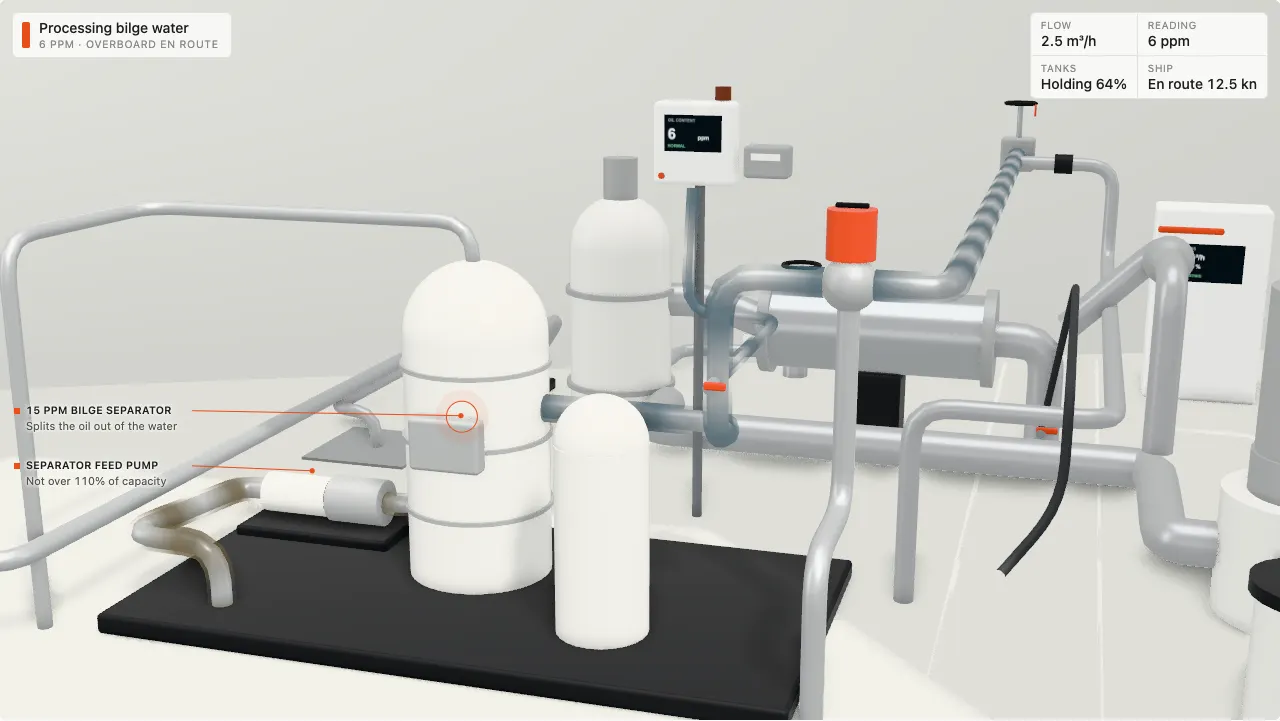
Three machines work as a team. The separator splits oil from bilge water. The 15 ppm alarm measures the oil left in the water. If it reads too high, a three-way valve turns the flow back into the ship.
The alarm only helps if it tells the truth. So it is sealed, it records, and it must be checked by its maker at least every five years.
-
3/6Words you'll meet
Five words, in plain English
- Oily water separator
- the machine that splits oil out of bilge water so cleaner water can leave the ship.
- 15 ppm bilge alarm
- an instrument that measures oil in the outgoing water and sounds above 15 parts per million.
- Three-way valve
- the automatic valve that sends water back inside the ship when the alarm trips.
- Recirculation line
- a pipe loop that lets the crew test everything with the overboard valve shut.
- Calibration certificate
- the paper showing when the alarm’s accuracy was last checked by its maker.
-
4/6Why it matters
A fooled alarm is a crime
People have tricked alarms, for example by flushing the sensor with fresh water so it reads low while oily waste goes over the side. Companies have been fined heavily for it.
The rules expect this: the alarm goes off whenever clean water is used to clean it, and it keeps 18 months of records. An alarm that is in date, sealed and recording is the engineer’s best protection.
-
5/6In this lesson
What you’ll be able to do
- Trace the system part by part, from bilge tank to ship’s side.
- Test the whole system safely with the overboard valve closed.
- Work out when the alarm’s next calibration is due.
- Know what to write down when something breaks.
-
6/6Quick check
Who may check the alarm’s accuracy every five years?
Right: the accuracy check is a job for the manufacturer or its authorised people, at least every five years or sooner if the manual says so.
The basics
In 2019 a tanker operator was convicted in Louisiana and fined US$2 million. Its senior officers had discharged oily waste by flushing the sensor of the ship’s pollution prevention equipment with fresh water, which “tricked the system into detecting a much lower effluent oil content” than was actually going over the side. The Oil Record Book then recorded 87,705 gallons as properly processed.8
The rules saw that trick coming. Since 2003 the IMO specification for the 15 ppm bilge alarm has required the alarm to go off whenever clean water is used for cleaning or zeroing, every access beyond basic checks to need a broken seal, and 18 months of data to stay on board.3 An alarm that is in date, sealed and recording is the engineer’s best defence in a port state control inspection. This lesson takes the system apart, explains each requirement, and sets out the five-yearly calibration rule that the class surveyor checks every year.
Sign in to read the rest of this lesson
Continue reading
Save your progress, open all 115 lessons and get a Course completed card when you finish.
or use your email
In the rest of this lesson
- Try it: Parts of a 15 ppm bilge separator system
- In plain words
- In detail
- What the rules say
- Flag and class notes
- Key numbers
- What inspectors find
- 3 questions people ask
- Quiz: 6 questions
- Ask our engineers about this lesson
Familiarisation training from Al Safwan Academy. Finishing a course shows completion of online familiarisation training: it is not an STCW, flag-approved or manufacturer qualification, and these courses don't replace that training. The manufacturer's manual and your flag's rules always come first.