Lesson 3 · 15 min
The Oil Record Book and magic pipe cases
You will be able to write and check Oil Record Book entries with the right codes, and spot the inconsistencies that turn an inspection into a prosecution.
Start here
The 2-minute primer
New to this? These 6 cards explain the lesson in plain words. Go through them first and the lesson will make sense.
Primer done.
-
1/6Picture this
Every penny on the statement
Think of a bank statement. Every payment in and out is listed with a date. If money vanishes with no line to explain it, someone will ask where it went.
The engine room keeps the same kind of statement for oil. Every litre that moves is written down, and the entries must add up with the machines’ own records.
-
2/6The big idea
Write it down, honestly, every time
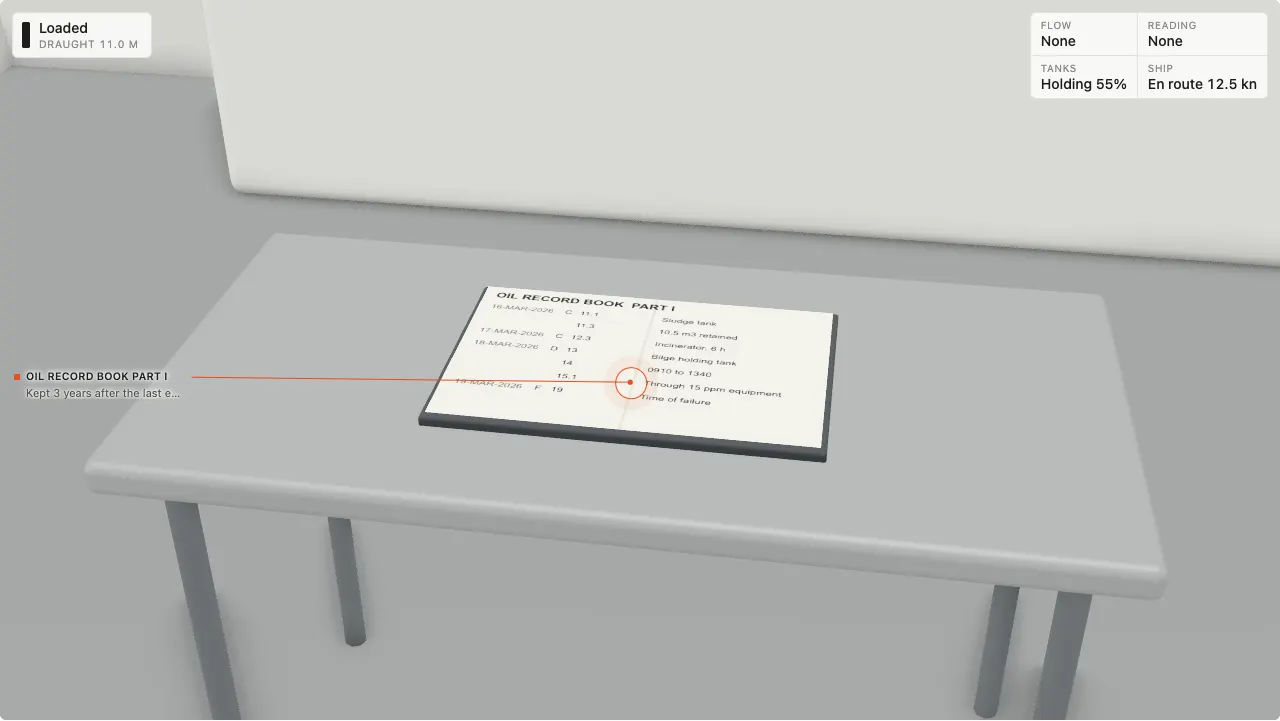
The Oil Record Book is the engine room’s diary for oil. Fuel loaded, sludge burned or sent ashore, bilge water pumped: each gets a coded entry and a signature.
A magic pipe is any hidden hose or pipe that sends oily water overboard without passing the cleaning equipment. In the United States such cases are usually proven through the book, because handing an inspector a false book is a crime there in itself.
-
3/6Words you'll meet
Five words, in plain English
- Oil Record Book Part I
- the official diary where engineers record every movement of oil and oily water.
- Code
- a letter, such as C or D, that tells which kind of operation an entry describes.
- Magic pipe
- any secret hose or pipe that lets oily water skip the separator and go overboard.
- Electronic record book
- a computer version of the book, allowed only if the country whose flag the ship flies has approved it.
- Reception facility
- a shore tank, barge or truck in port that takes the ship’s oily waste.
-
4/6Why it matters
The book is the evidence
Inspectors rarely catch a discharge as it happens. Instead they compare the book with the alarm’s memory, the incinerator hours and shore receipts. Gaps and mismatches give the game away.
When a book is false, companies pay large fines and can be banned from a country’s ports. Engineers and masters can be charged too. Kept honestly, the same book protects the ship if it is wrongly blamed for a slick.
-
5/6In this lesson
What you’ll be able to do
- Write entries with the right code and in the right order.
- Correct a mistake the proper way, so it stays readable.
- Know what an approved electronic record book must do.
- Spot the mismatches that tell an inspector something is wrong.
-
6/6Quick check
You spot a wrong figure in yesterday’s entry. What do you do?
Right: the wrong entry must stay readable, with your signature and the date, and the correct entry written after it.
The basics
Almost every “magic pipe” prosecution is, in law, a records case. The discharge happened far out at sea, often in another country’s waters; what the prosecutor can prove is that the Oil Record Book presented to the inspector in port was false. In February 2025 the owner and operator of the bulk carrier ASL Singapore pleaded guilty in New Orleans to violating the US Act to Prevent Pollution from Ships (APPS) and to obstruction of justice. A routine Coast Guard inspection had found a portable pump and flexible hose used to dump oily bilge water straight from the holding tank since at least June 2023. The crew had handed over Oil Record Books “knowing they contained fraudulent entries”. The companies paid US$1.85 million and are banned from operating in the United States.5
The same book, kept honestly, is what protects a ship when a slick appears nearby or a disgruntled crew member makes an allegation. This lesson shows how to keep Part I to the IMO guidance, what an electronic record book must do, and which inconsistencies inspectors look for.
Sign in to read the rest of this lesson
Continue reading
Save your progress, open all 115 lessons and get a Course completed card when you finish.
or use your email
In the rest of this lesson
- Try it: Engine-room records check before a US port call
- In plain words
- In detail
- What the rules say
- Flag and class notes
- Key numbers
- What inspectors find
- 3 questions people ask
- Quiz: 6 questions
- Ask our engineers about this lesson
Familiarisation training from Al Safwan Academy. Finishing a course shows completion of online familiarisation training: it is not an STCW, flag-approved or manufacturer qualification, and these courses don't replace that training. The manufacturer's manual and your flag's rules always come first.