Lesson 6 · 15 min
Inventory of Hazardous Materials: Hong Kong Convention and EU SRR
You will be able to tell which list an item belongs in, keep Part I of the IHM valid through every repair, and know which certificate your ship needs where.
Start here
The 2-minute primer
New to this? These 6 cards explain the lesson in plain words. Go through them first and the lesson will make sense.
Primer done.
-
1/6Picture this
The ingredients label on a packet
Think of the label on a food packet. It tells you what is inside, so someone with an allergy can stay safe. If the maker changes the recipe, the label has to change too.
A ship carries its own label, a list of the harmful materials built into it. Every time parts are swapped, the list must be brought up to date.
-
2/6The big idea
A map for the people who cut it up
At the end of its life a ship is cut up for scrap, often by hand. Inside are materials that can harm workers and nature, such as asbestos, toxic paints and certain gases.
The Inventory of Hazardous Materials is a map of where they are and roughly how much. Part I is made at build, or by survey on an older ship, then kept up to date for life.
-
3/6Words you'll meet
Six words, in plain English
- IHM (Inventory of Hazardous Materials)
- the ship’s list of harmful materials, where they are and roughly how much.
- Part I
- the section listing harmful materials built into the ship’s structure and equipment.
- Hong Kong Convention
- the worldwide agreement on safe ship recycling, in force since June 2025.
- EU SRR (EU Ship Recycling Regulation)
- the European law that also requires an inventory, even on foreign ships calling at EU ports.
- Material Declaration
- a supplier’s statement saying whether a part contains listed harmful materials, and how much.
- Designated person
- the person the owner names to keep the inventory up to date.
-
4/6Why it matters
An out-of-date list is no list
Recycling workers can only handle harmful materials safely if they know where they are. A wrong list puts them at risk.
For the ship, the first survey is the easy part. The hard part is the years after: every pump, cable or coating that is not identical to the old one must be checked and recorded. If Part I is not kept up to date, the ship’s certificate stops being valid.
-
5/6In this lesson
What you’ll be able to do
- Tell which part of the inventory an item belongs in.
- Know how an older ship builds its first inventory.
- Keep Part I up to date through repairs and new equipment.
- Know which certificate a ship needs, and where.
-
6/6Quick check
The hull gets a new type of paint in dry dock. What happens?
Right: a new coating counts as a change, so Part I is updated from the paint supplier’s Material Declaration.
The basics
The Hong Kong International Convention for the Safe and Environmentally Sound Recycling of Ships entered into force on 26 June 2025, sixteen years after it was adopted, with 24 Parties covering 57.15% of world shipping by tonnage.5 From that date every new ship under the Convention needs a verified Inventory of Hazardous Materials (IHM) and an International Certificate on Inventory of Hazardous Materials; existing ships have until 26 June 2030, or until they go for recycling if that is sooner.16 DNV estimated in 2023 that about 30,000 ships already held an IHM certificate or EU statement of compliance and roughly 23,000 more would need one.6
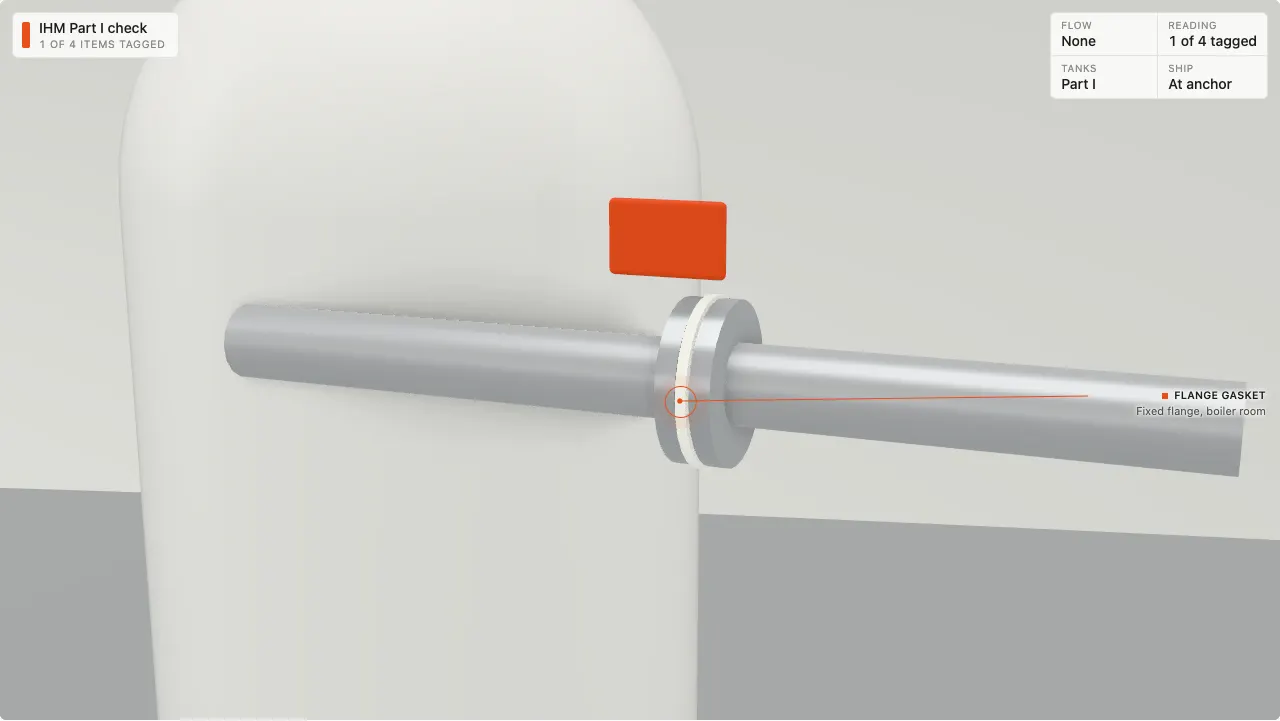
For most ships the hard part is not the first survey but the years after it. Part I of the IHM has to follow every pump, cable run, gasket and coating that comes on or off the ship. Under the Convention, the certificate stops being valid if Part I is not properly maintained and updated.3 This lesson shows what goes in each part of the inventory, how existing ships build one, and how to keep it alive.
Sign in to read the rest of this lesson
Continue reading
Save your progress, open all 115 lessons and get a Course completed card when you finish.
or use your email
In the rest of this lesson
- Try it: Which part of the IHM?
- In plain words
- In detail
- What the rules say
- Flag and class notes
- Key numbers
- What inspectors find
- 3 questions people ask
- Quiz: 6 questions
- Ask our engineers about this lesson
Familiarisation training from Al Safwan Academy. Finishing a course shows completion of online familiarisation training: it is not an STCW, flag-approved or manufacturer qualification, and these courses don't replace that training. The manufacturer's manual and your flag's rules always come first.