Lesson 3 · 15 min
Bump tests, calibration and calibration certificates
You will be able to tell a bump test from a calibration, run both correctly, and check a gas detector's certificate and log the way a port state inspector would.
Start here
The 2-minute primer
New to this? These 6 cards explain the lesson in plain words. Go through them first and the lesson will make sense.
Primer done.
-
1/6Picture this
Checking the kitchen scales with a bag of sugar
Put a sealed 1 kg bag of sugar on your kitchen scales. If they show 1 kg, good. If they show 850 g, the scales have drifted, and every recipe will come out wrong until someone adjusts them.
A gas meter drifts the same way. Its screen still shows a confident number, even when that number is no longer true.
-
2/6The big idea
Does it work, and is it right?
A bump test puffs a gas of known strength over the sensors to prove they react and the alarms go off. It takes a minute and changes nothing inside.
A calibration adjusts the meter so it reads correctly again, and ends with a certificate. The rules ask for real calibration, to the maker’s instructions. A daily bump test alone is not enough.
-
3/6Words you'll meet
Five words, in plain English
- Bump test
- a quick check with test gas that the sensors respond and the alarms sound.
- Calibration
- adjusting the meter against a gas of known strength so its readings are accurate again.
- Span gas
- a small cylinder of test gas of a known, printed strength.
- Drift
- the slow way a sensor’s readings wander away from the truth as it ages.
- Calibration certificate
- the paper showing when, how and by whom a meter was calibrated, and its serial number.
-
4/6Why it matters
A drifting meter gives false comfort
Sensors age and can be damaged by sprays, heat or water. A meter that reads oxygen as normal when it is not can send someone into air that kills.
Inspectors check this first: an out-of-date certificate, expired test gas or a meter with a dead sensor are easy to spot and count as faults.
-
5/6In this lesson
What you’ll be able to do
- Tell a bump test, a calibration check and a full calibration apart.
- Run a bump test properly and log it.
- Read a calibration certificate the way an inspector would.
- Know what to do when a meter fails or goes ashore.
-
6/6Quick check
What does a bump test prove?
Right: a bump test only shows the meter reacts to gas. Accuracy comes from regular calibration, which leaves a certificate.
The basics
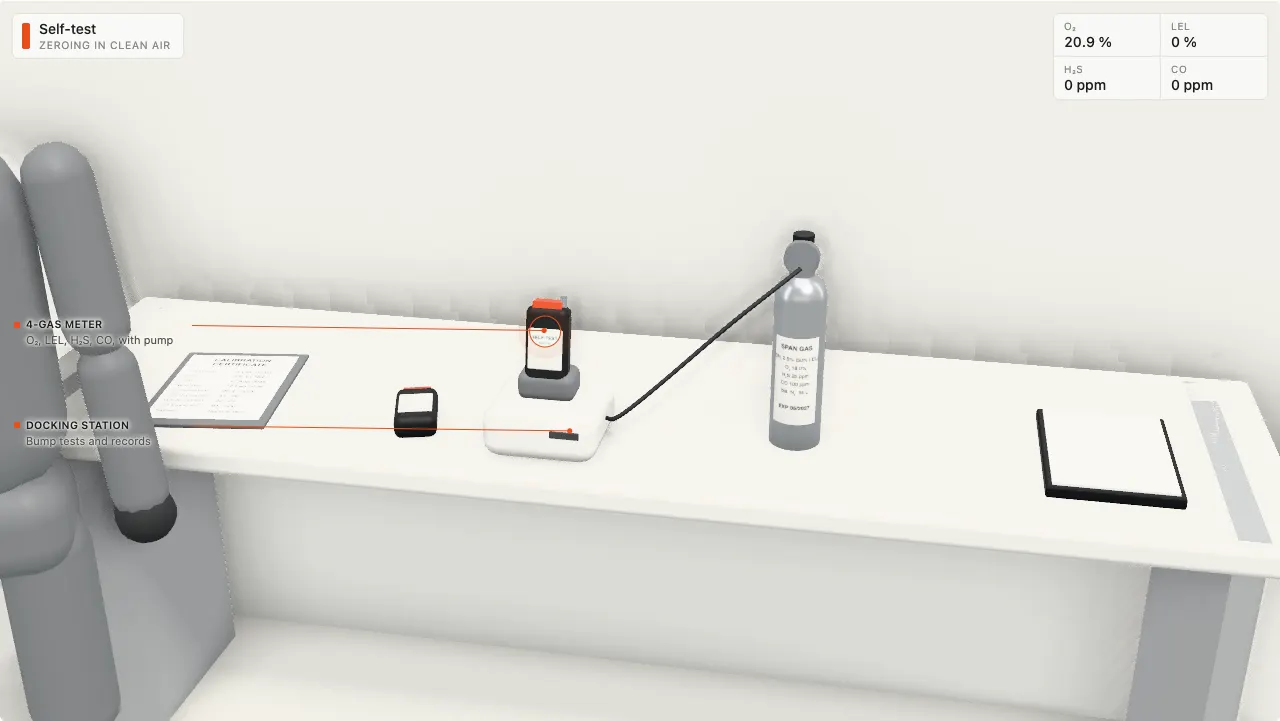
A gas detector drifts. Sensors age, get poisoned by silicone sprays or exhaust, dry out in heat or get wet. The display still shows a confident number. The only ways to know whether that number is true are to expose the sensors to a gas of known strength (a bump test or calibration check), and to adjust them when they are off (a calibration).
SOLAS has required “suitable means” for calibrating every ship’s portable atmosphere testing instrument since 1 July 2016, and the IMO has had to explain twice (once for this meter, once for the tanker instruments of SOLAS II-2/4.5.7.1) that a quick test with span gas before use is not what the rule means. Calibration is also where port state inspectors look first: an out-of-date certificate is easy to spot, and the Marshall Islands Administrator has warned owners about a rise in US Coast Guard deficiencies for poorly calibrated instruments.9
Sign in to read the rest of this lesson
Continue reading
Save your progress, open all 115 lessons and get a Course completed card when you finish.
or use your email
In the rest of this lesson
- Try it: Gas detection locker check before a port state inspection
- In plain words
- In detail
- What the rules say
- Flag and class notes
- Key numbers
- What inspectors find
- 4 questions people ask
- Quiz: 6 questions
- Ask our engineers about this lesson
Familiarisation training from Al Safwan Academy. Finishing a course shows completion of online familiarisation training: it is not an STCW, flag-approved or manufacturer qualification, and these courses don't replace that training. The manufacturer's manual and your flag's rules always come first.