Lesson 4 · 15 min
Fixed gas detection on tankers, gas carriers and in pump-rooms
You will know which fixed gas detection each tanker type must have, where it samples, when it must alarm, and how it is tested and kept in service.
Start here
The 2-minute primer
New to this? These 6 cards explain the lesson in plain words. Go through them first and the lesson will make sense.
Primer done.
-
1/6Picture this
A burglar alarm for empty rooms
When you go on holiday, the burglar alarm keeps watch over rooms nobody is in. If something happens, it tells someone straight away.
Fixed gas detection does that on tankers. It watches the pump-room deep in the ship and the ballast tanks and empty spaces wrapped around the cargo, all day and night.
-
2/6The big idea
Sensors that never stop watching
A portable meter protects the person about to go in. A fixed system watches spaces where nobody is, and sounds an alarm when gas starts to leak in.
It is built into the ship: sensors, or pipes that suck air from each space to an analyser. It alarms long before the gas could burn. Each tanker type has its own rules for where it must look.
-
3/6Words you'll meet
Six words, in plain English
- Fixed gas detection
- permanent sensors or sampling pipes that keep checking a space and raise an alarm.
- Pump-room
- the room low in a tanker where pumps move the cargo, and where leaks can collect.
- Double hull
- the ballast tanks and empty spaces between the cargo tanks and the sea.
- LFL
- lower flammable limit, the weakest mix of gas and air that can catch fire.
- Sampling line
- a small pipe that carries air from a space to the analyser.
- Gas carrier
- a ship that carries gas turned into a liquid, in special tanks.
-
4/6Why it matters
A leak nobody sees can explode
A cargo leak in a pump-room or ballast tank gives no warning. The vapour builds up until it finds a spark, or until someone opens the door.
A fixed system only protects the ship if it works. Sensors switched off after a fault, blocked pipes or alarms that only sound in one place leave the space unwatched.
-
5/6In this lesson
What you’ll be able to do
- Know which fixed detection oil tankers, chemical tankers and gas carriers need.
- Know when and where the alarms must sound.
- Tell how sampling systems work and what blocks them.
- Know what to do when the fixed system fails.
-
6/6Quick check
What is a fixed gas detection system for?
Right: it keeps watch over empty spaces all the time. The test before entry is still done separately.
The basics
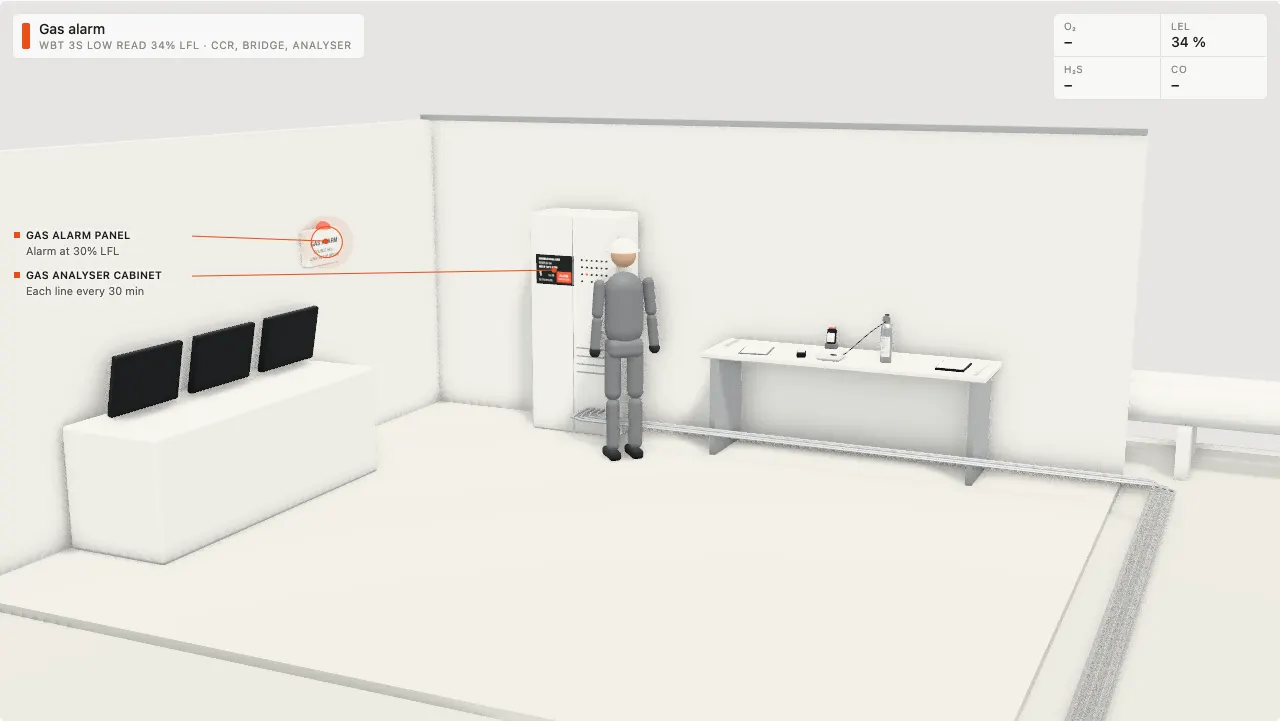
Portable meters protect the person about to enter a space. Fixed systems watch spaces nobody is in: the cargo pump-room at the bottom of the ship, the ballast tanks and voids wrapped around the cargo, the hold spaces and interbarrier spaces of a gas carrier. A leak there gives no warning until vapour finds an ignition source or a crew member opens the door.
SOLAS answered these risks in two steps: continuous hydrocarbon monitoring for tanker cargo pump-rooms came with the revised chapter II-2 in force from 1 July 2002 (and was required on older tankers by 1 July 2005 at the latest), and fixed detection in the double hulls of new large oil tankers from 1 January 2012. This lesson sets out what each tanker type must have, how it must alarm, and how the crew and service technicians keep it honest.
Sign in to read the rest of this lesson
Continue reading
Save your progress, open all 115 lessons and get a Course completed card when you finish.
or use your email
In the rest of this lesson
- Try it: Which rule does each requirement come from?
- In plain words
- In detail
- What the rules say
- Flag and class notes
- Key numbers
- What inspectors find
- 3 questions people ask
- Quiz: 5 questions
- Ask our engineers about this lesson
Familiarisation training from Al Safwan Academy. Finishing a course shows completion of online familiarisation training: it is not an STCW, flag-approved or manufacturer qualification, and these courses don't replace that training. The manufacturer's manual and your flag's rules always come first.