Lesson 2 · 16 min
Portable atmosphere testing instruments under SOLAS XI-1/7
You will be able to choose, check and use a portable gas meter that meets SOLAS XI-1/7, and recognise the situations where its reading cannot be trusted.
Start here
The 2-minute primer
New to this? These 6 cards explain the lesson in plain words. Go through them first and the lesson will make sense.
Primer done.
-
1/6Picture this
Testing the bath before a toddler gets in
Before a toddler climbs into the bath, a parent tests the water. A careful parent also stirs it and checks lower down, because the top can be hot while the bottom is cold.
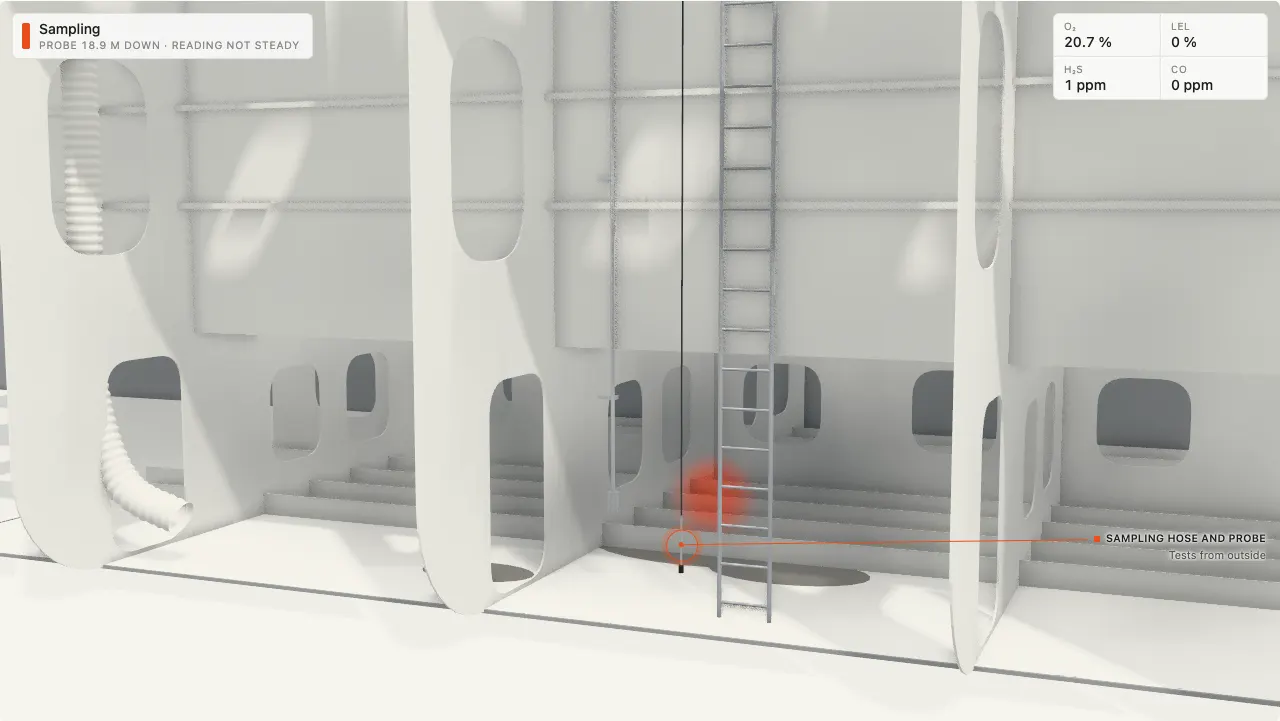
Testing the air in a tank is the same. You test before anyone goes in, and at several depths, because heavy gases sink and light ones rise.
-
2/6The big idea
A gas meter you can trust
Every ship must carry a portable meter that checks four things before anyone enters a closed space: oxygen, gas that can burn, and two poisons, hydrogen sulphide and carbon monoxide.
The meter has blind spots. It does not measure carbon dioxide, and the usual burnable gas sensor can read zero in air with too little oxygen. Knowing when it might be wrong matters as much as reading it.
-
3/6Words you'll meet
Six words, in plain English
- Four-gas meter
- a hand-held instrument that measures oxygen, flammable gas, hydrogen sulphide and carbon monoxide.
- LFL
- lower flammable limit, the weakest mix of gas and air that can catch fire.
- Hydrogen sulphide
- H2S, a poison gas from crude oil, sewage and some cargoes.
- Sampling hose
- a long tube that lets the meter suck air from inside the space while you stay outside.
- Personal detector
- a small alarm clipped to the person inside, separate from the meter used for testing.
- Detector tube
- a glass tube that changes colour when air with one particular gas is pumped through it.
-
4/6Why it matters
A meter can say safe when it is not
A meter held at the manhole tells you about the top of a tank, not the bottom where a person would fall. A four-gas meter says nothing about carbon dioxide from timber or grain.
People have died in spaces where the air was not tested properly before anyone went in.
-
5/6In this lesson
What you’ll be able to do
- Know what the rules ask a ship’s gas meter to measure.
- Tell where each kind of sensor gives a false reading.
- Know when you need extra instruments, such as for carbon dioxide.
- Take a reading you can trust, step by step.
-
6/6Quick check
Where should you test the air in a deep tank?
Right: gases settle at different heights, so you test at several levels through a hose, before anyone goes in.
The basics
Every ship has a gas meter. Far fewer have a crew who know when it is lying. A catalytic flammable gas sensor can read zero in a nitrogen-filled tank full of hydrocarbon vapour. A four-gas meter that meets SOLAS perfectly says nothing about the carbon dioxide that investigators found, alongside 3.5% oxygen, in the hold access where the officers of Sally Ann C died. A two-metre hose held at the manhole tells you about the top of a tank, not the bottom where the casualty will lie.
This lesson is about the instrument that stands between the crew and those spaces: what the rule requires, what the IMO guidelines expect of it, how its sensors work, and how to take a reading you can trust.
Sign in to read the rest of this lesson
Continue reading
Save your progress, open all 115 lessons and get a Course completed card when you finish.
or use your email
In the rest of this lesson
- Try it: Testing before entry on a bulk carrier and a product tanker
- In plain words
- In detail
- What the rules say
- Flag and class notes
- Key numbers
- What inspectors find
- 4 questions people ask
- Quiz: 5 questions
- Ask our engineers about this lesson
Familiarisation training from Al Safwan Academy. Finishing a course shows completion of online familiarisation training: it is not an STCW, flag-approved or manufacturer qualification, and these courses don't replace that training. The manufacturer's manual and your flag's rules always come first.