Lesson 5 · 16 min
Entering an enclosed space step by step: permit, testing and rescue
You will be able to run an enclosed space entry from the register to the permit, the pre-entry test, attendance and a planned rescue, as MSC.581(110) and SOLAS III/19 expect.
Start here
The 2-minute primer
New to this? These 6 cards explain the lesson in plain words. Go through them first and the lesson will make sense.
Primer done.
-
1/6Picture this
A pilot’s checklist before take-off
Before every flight, pilots go through a checklist, item by item, even after thousands of flights. Skipping one line, just once, is how accidents happen.
Going into a tank or hold works the same way. It is a chain of steps in a fixed order. Break one link and people can die.
-
2/6The big idea
A chain of steps, never skipped
Know which spaces are dangerous. Get a signed permit, valid for no more than eight hours. Shut off pipes and power, then blow fresh air in. Stop the fan, wait, and test the air from outside, high and low.
Go in only on the right numbers, never alone, with someone watching at the entrance. If anyone collapses, raise the alarm. Rescuers go in only with breathing apparatus and a plan.
-
3/6Words you'll meet
Six words, in plain English
- Enclosed Space Register
- the ship’s own list of every dangerous space, its hazards and how to make it safe.
- Permit
- the signed paper that allows one entry, after checks, for at most eight hours.
- Attendant
- the trained person who stays at the entrance, keeps in touch and raises the alarm.
- Ventilation
- blowing fresh air through a space to clear out bad air before and during the work.
- SCBA
- self-contained breathing apparatus, a mask fed from an air bottle on the wearer’s back.
- EEBD
- emergency escape breathing device, a short-lasting breathing set for escaping, never for going in.
-
4/6Why it matters
Most accidents happen on planned jobs
Many deaths happen during work that was planned, because one step was missed. The air was tested with the fan still running. A permit from yesterday was reused. The attendant went in to help.
Each missed step looks small. Together they turn a routine job into a rescue, often with more than one casualty.
-
5/6In this lesson
What you’ll be able to do
- Follow an entry from the register to the permit and the air test.
- Know the air readings needed before anyone goes in.
- Know the attendant’s job and why they never go in alone.
- Run a rescue and a drill the way the rules expect.
-
6/6Quick check
Someone collapses inside a tank. What should the attendant do?
Right: the attendant never goes in before help arrives. The rescue team enters with breathing apparatus, following the ship’s plan.
The basics
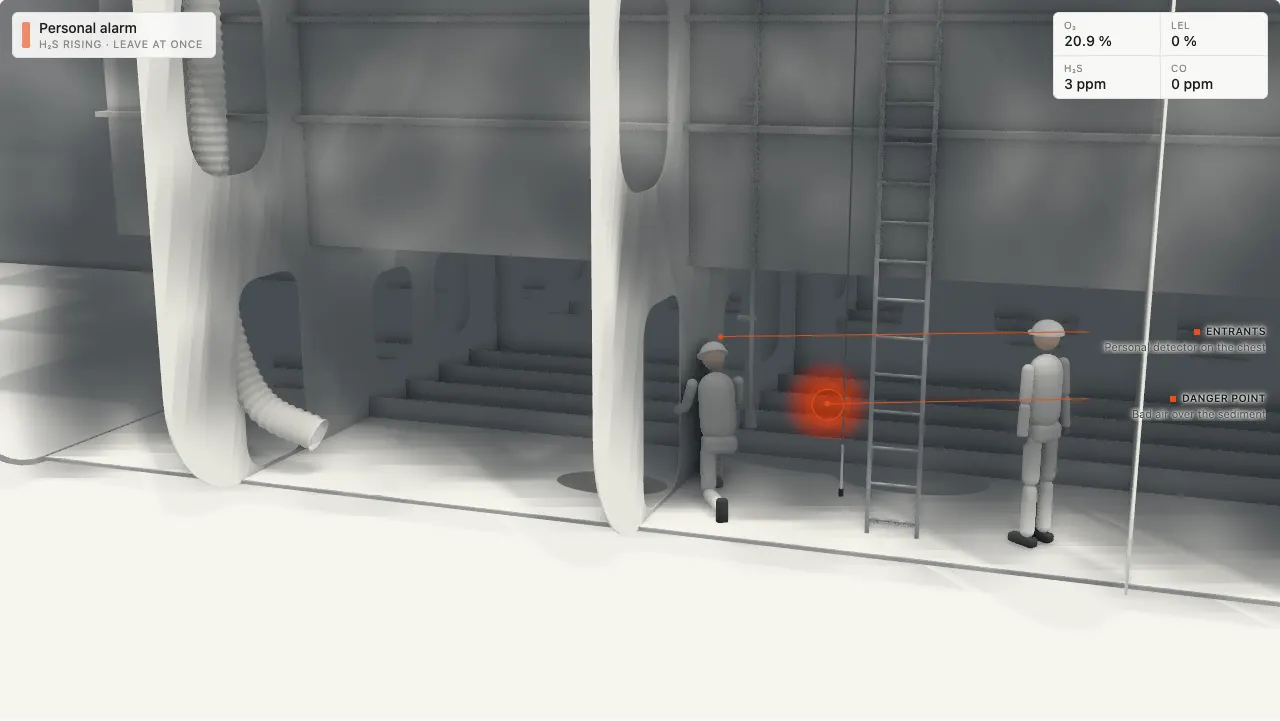
Most enclosed space accidents happen during jobs that were planned.9 What failed was one step in the chain: a test done with the fan still running, an attendant who went in to help, a permit used again the next morning, a hold access nobody had listed as dangerous.
In June 2025 the IMO replaced its 2011 recommendations with resolution MSC.581(110), Revised recommendations for entering enclosed spaces aboard ships. The Maritime Safety Committee invited the 34th IMO Assembly (24 November to 3 December 2025) to revoke the old resolution A.1050(27), and class society notices now treat it as superseded. The new text adds an Enclosed Space Register for every ship, a carbon dioxide limit before entry, a ban on single-person entry and an eight-hour maximum for permits. This lesson walks through the whole chain in order, and shows who does what.
Sign in to read the rest of this lesson
Continue reading
Save your progress, open all 115 lessons and get a Course completed card when you finish.
or use your email
In the rest of this lesson
- Try it: One entry from register to rescue drill
- In plain words
- In detail
- What the rules say
- Flag and class notes
- Key numbers
- What inspectors find
- Work it out: a calculator
- 4 questions people ask
- Quiz: 6 questions
- Ask our engineers about this lesson
Familiarisation training from Al Safwan Academy. Finishing a course shows completion of online familiarisation training: it is not an STCW, flag-approved or manufacturer qualification, and these courses don't replace that training. The manufacturer's manual and your flag's rules always come first.