Lesson 2 · 14 min
Before you touch the boat: records, manuals and safety
The documents to check and the safety arrangements to agree before an annual or five-yearly lifeboat examination starts.
Start here
The 2-minute primer
New to this? These 6 cards explain the lesson in plain words. Go through them first and the lesson will make sense.
Primer done.
-
1/6Picture this
The electrician reads the notes first
A good electrician doesn’t start by opening a socket. They read the notes on past work, show you their ID, and switch the power off at the fuse box before touching a wire.
A lifeboat examination starts the same way: records, papers, and making sure nothing is carrying a load before anyone adjusts it.
-
2/6The big idea
Paperwork and safety come before spanners
Before the work starts, the technician reads the crew’s weekly and monthly records, the last service report and the boat’s approval details. The maker’s manuals must be on board.
The ship checks the technician too: is the firm authorised, and is the technician certified for this equipment? Then everyone agrees how to work safely.
-
3/6Words you'll meet
Five words, in plain English
- Approval plate
- a fixed plate on the boat showing who made it, when, and how many people it may carry.
- Maintenance manual
- the maker’s book on how to look after and test each part. Every step follows it.
- Under load
- when the hooks are carrying the boat’s weight.
- Hanging off
- holding the boat by another means, so its weight comes off the hooks.
- HSE procedures
- the company’s health, safety and environment rules for the work.
-
4/6Why it matters
Records tell the technician where to look
An engine that is hard to start, or a hook that was reported unclear, shows up in the records first. They tell the technician where to look.
Lifeboats have also hurt many people during tests and maintenance. One rule matters above all: nobody adjusts the release gear while the hooks carry the boat’s weight.
-
5/6In this lesson
What you’ll be able to do
- Know which ship records to review before the work.
- Check the manuals, the approval plate and the hook history.
- Check the service firm’s authorisation and the technician’s certificate.
- Agree the safety arrangements before anyone starts.
-
6/6Quick check
When may release gear be adjusted?
Right: nobody adjusts or works on release gear while the hooks carry the boat’s weight, so the weight is taken off first.
In plain words
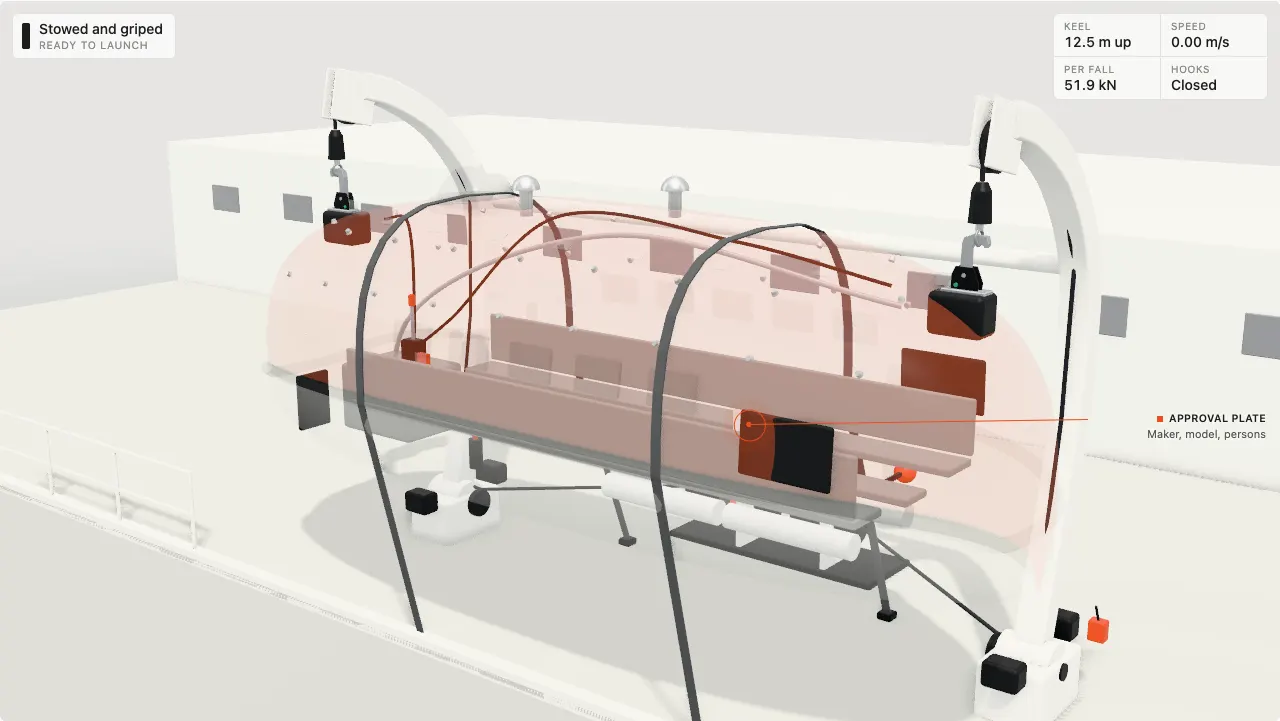
A good lifeboat examination starts at a desk, not at the davit. Before anyone touches the boat, the technician reads what has happened to it since the last visit: the crew’s weekly and monthly records, the last service report, any repairs, and the boat’s approval details. The manufacturer’s manuals must be on board, because every step of the work follows them.
The ship also checks the technician. Is the company authorised for this make and type of equipment? Is the technician’s own qualification valid and does it cover this equipment?
Then everyone agrees how the work will be done safely. Lifeboats have hurt many people during tests and maintenance. One rule matters above all: nobody adjusts or repairs the release gear while the hooks are carrying the boat’s weight.
Key points
- Records of the crew’s inspections and maintenance, and the equipment certificates, are reviewed as part of the annual examination (MSC.402(96) §6.2.2).
- A full set of the manufacturer’s maintenance manuals and technical documentation must be on board, and the Company keeps it up to date (MSC.402(96) §6.1.2, §6.1.3).
- Service records are kept on board for the service life of the equipment (MSC.402(96) §5.2).
- The service provider’s authorisation states the makes and types it covers and an expiry date (MSC.402(96) §7.4.1).
- A technician’s certificate covers named makes and types and expires three years after issue (MSC.402(96) §8.3.1).
- The Company must have health, safety and environment procedures for all of this work (MSC.402(96) §1.4).
- “No maintenance or adjustment of the release gear shall be undertaken while the hooks are under load” (MSC.402(96) §6.2.4, note 2).
Sign in to read the rest of this lesson
Continue reading
Save your progress, open all 115 lessons and get a Course completed card when you finish.
or use your email
In the rest of this lesson
- The detail
- Deep dive
- Try it: Check a document pack for gaps
- Quiz: 5 questions
- Ask our engineers about this lesson
Familiarisation training from Al Safwan Academy. Finishing a course shows completion of online familiarisation training: it is not an STCW, flag-approved or manufacturer qualification, and these courses don't replace that training. The manufacturer's manual and your flag's rules always come first.