Lesson 8 · 14 min
Free-fall, rescue boats and what's coming
How free-fall release systems and rescue boats are tested, and which new rules from 2026 to 2031 apply to which boats.
Start here
The 2-minute primer
New to this? These 6 cards explain the lesson in plain words. Go through them first and the lesson will make sense.
Primer done.
-
1/6Picture this
New windows, new rules
When building rules change, an old house doesn’t have to be rebuilt. But if you fit new windows, the new windows must meet today’s rules.
Lifeboat rules work like that. Many new rules apply only to equipment installed after a set date, so two sister ships can follow different rules.
-
2/6The big idea
Special boats, and rules that arrive by date
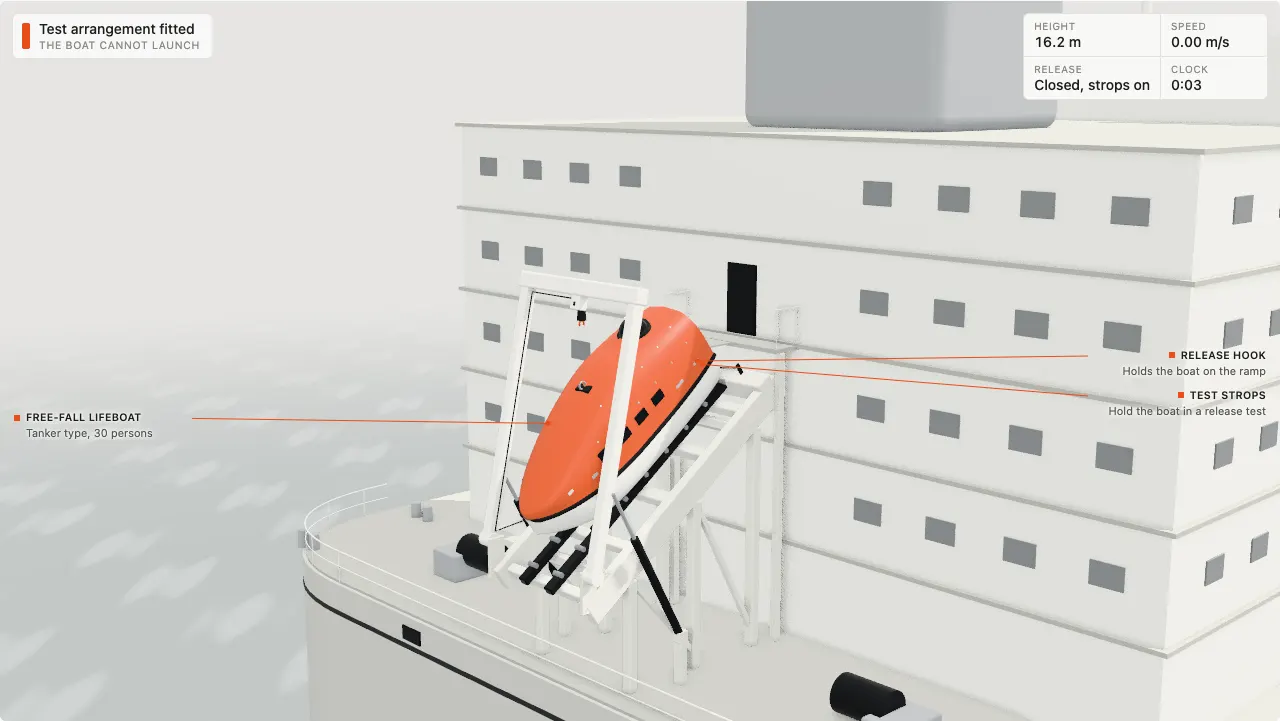
A free-fall lifeboat sits on a sloping ramp and drops into the sea. Its release is tested with an arrangement that holds it back, so it isn’t dropped.
A rescue boat is a smaller, fast boat for picking people out of the water. Both have their own tests, and new rules arrive between 2026 and 2031.
-
3/6Words you'll meet
Five words, in plain English
- Free-fall lifeboat
- a boat on a sloping ramp that drops straight into the sea when released from inside.
- Test arrangement
- a device that holds a free-fall boat back so its release can be tested in place.
- Rescue boat
- a smaller, fast boat used to pick people out of the water and gather liferafts.
- Headway
- the ship moving forwards through the water.
- Installed on or after
- the wording that makes a new rule apply only to equipment fitted from a set date.
-
4/6Why it matters
One forgotten step blocks the launch
A free-fall boat left with its test arrangement still fitted cannot launch in an emergency. Removing it and checking the boat is ready matters as much as the test.
And a replacement boat or davit on an old ship can fall under the new rules. Knowing the dates tells you which rules your own boat must meet.
-
5/6In this lesson
What you’ll be able to do
- Follow the free-fall release test without dropping the boat.
- Know how often free-fall boats and rescue boats are drilled.
- Know what a rescue boat must be able to do.
- Tell which new rules from 2026 to 2031 apply to which boats.
-
6/6Quick check
What must happen after the free-fall release test?
Right: a boat left with the test arrangement fitted cannot launch in an emergency, so it is removed and the boat checked ready to go.
In plain words
Not every boat hangs from two wires. A free-fall lifeboat sits on a sloping ramp at the stern. When the crew release it from inside, it slides off and drops into the sea. Testing that release without actually dropping the boat needs a special arrangement that holds it back.
A rescue boat is a smaller, fast boat used to pick people out of the water or to round up liferafts. It must be ready in minutes and be launched while the ship is still moving.
The rules for both keep changing. Some new rules apply only to equipment installed after a certain date, so two sister ships can follow different rules. This lesson explains how these boats are tested and which changes from 2026 to 2031 apply to which boats.
Key points
- The annual free-fall release test uses the arrangement for testing without launching, and is repeated with the back-up release where fitted (MSC.402(96) §6.2.7).
- Every three months the crew board a free-fall lifeboat and go through the launch procedure up to, but not including, release; at least every six months the boat is free-fall launched with only the operating crew, or a simulated launch is done (SOLAS III/19.3.4.4).
- Rescue boats are launched with their crew each month where reasonable and practicable, and at least every three months (SOLAS III/19.3.4.6).
- A rescue boat must be launchable with the ship making up to 5 knots headway, and recovered in not more than 5 minutes with its full complement (SOLAS III/17).
- Lifeboats installed on or after 1 January 2026: a hook must not support any load unless completely reset (LSA Code 4.4.7.6.8, MSC.554(108)).
- Totally enclosed lifeboats installed on or after 1 January 2029 need ventilation of at least 5 m³/h per person for at least 24 hours (LSA Code 4.6.6, MSC.535(107)).
- Free-fall lifeboats installed on or after 1 January 2031 need an arrangement to test the release under load without launching (LSA Code 4.7.7, MSC.589(111), as reported by ABS).
Sign in to read the rest of this lesson
Continue reading
Save your progress, open all 115 lessons and get a Course completed card when you finish.
or use your email
In the rest of this lesson
- The detail
- Deep dive
- Try it: See which new rules apply to your boat
- Quiz: 5 questions
- Ask our engineers about this lesson
Familiarisation training from Al Safwan Academy. Finishing a course shows completion of online familiarisation training: it is not an STCW, flag-approved or manufacturer qualification, and these courses don't replace that training. The manufacturer's manual and your flag's rules always come first.