Lesson 4 · 16 min
Release gear and the release tests
How release gear is examined each year, and how the on-load, off-load, free-fall and davit-launched liferaft release tests are carried out.
Start here
The 2-minute primer
New to this? These 6 cards explain the lesson in plain words. Go through them first and the lesson will make sense.
Primer done.
-
1/6Picture this
The clip on a dog’s lead
The clip on a dog’s lead must stay shut while the dog pulls hard, open when you squeeze it, and snap fully shut again afterwards. You check it clicked closed before the next walk.
Lifeboat release gear is tested the same way. Does it hold, does it let go when asked, and is it fully closed again?
-
2/6The big idea
Examine first, then test for real
At the annual examination a certified technician looks at the release gear: the handle and linkages, how much play there is, the hydrostatic interlock, the cables and how each hook is fixed to the boat.
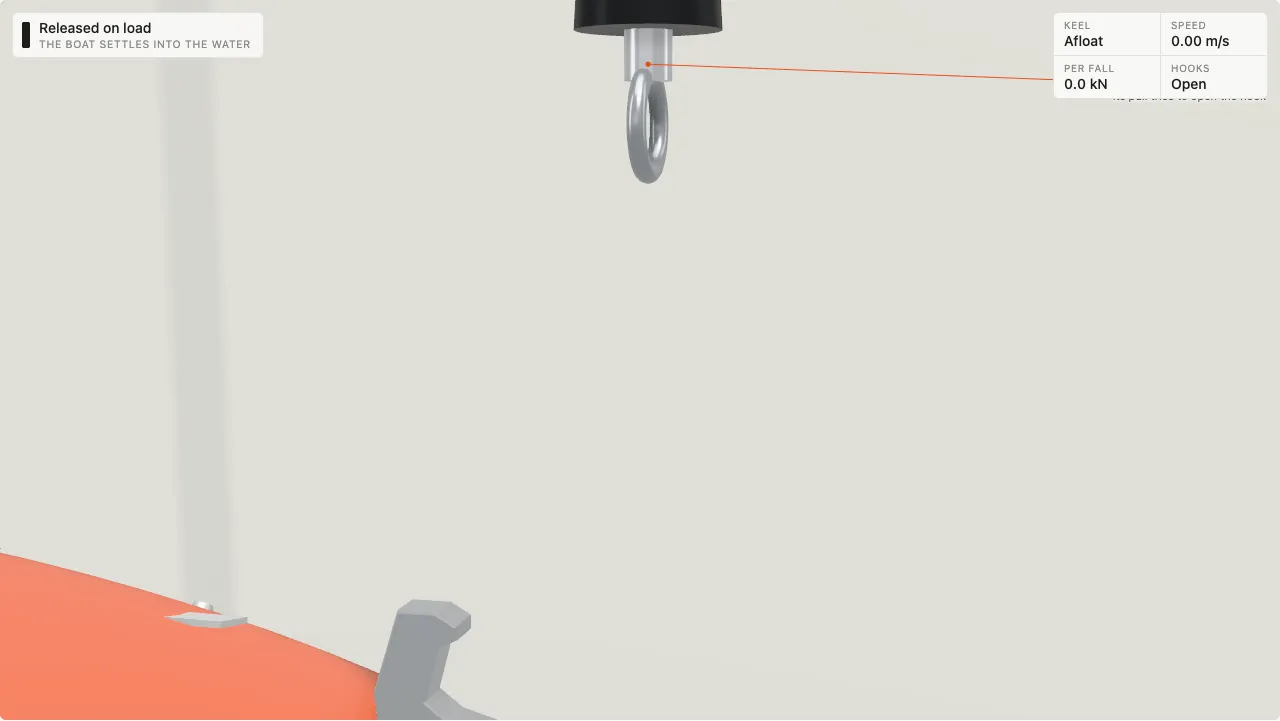
Then the gear is tested: on-load with the boat just touching the water, off-load with it fully afloat. After every release, each hook is checked completely reset.
-
3/6Words you'll meet
Six words, in plain English
- Free play
- loose movement in worn parts, measured against the maker’s limits.
- Hydrostatic interlock
- a device that senses water and only then allows the on-load release to work.
- On-load release test
- opening the hooks while they still carry most of the boat’s weight.
- Off-load release test
- opening the hooks once the boat floats and no weight hangs on them.
- Test arrangement
- a device that holds a free-fall boat back so its release can be tested without dropping it.
- Davit-launched liferaft
- an inflatable raft lowered from a crane arm and let go by an automatic hook.
-
4/6Why it matters
Hooks cause the most deadly accidents
Failures of release hooks have caused more deadly lifeboat accidents than any other part. A hook that opens too early drops the boat. One left half closed can open later, when nobody expects it.
And a test arrangement left in place on a free-fall boat can stop it launching in a real emergency.
-
5/6In this lesson
What you’ll be able to do
- Know what the examiner looks at on release gear.
- Follow the steps of the on-load and off-load tests.
- Test a free-fall release without dropping the boat.
- Test a liferaft hook with fixed weights.
-
6/6Quick check
Where is the boat for the on-load test?
Right: the hooks still carry the weight, but if anything goes wrong the boat has almost no distance to fall.
In plain words
The release gear is what lets go of the boat once it is in the water. Failures of release hooks have caused more deadly lifeboat accidents than any other part of the system. If a hook opens too early, the boat falls. If a hook is not fully closed after use, it can open later when nobody expects it.
At the annual examination, a certified technician first examines the gear: the handle and its linkages, how much play there is in the moving parts, the hydrostatic interlock that senses when the boat is afloat, the cables, and the way each hook is fixed to the boat. Then the gear is tested for real. The on-load release is tried with the boat just touching the water, so the hooks still carry its weight. The off-load release is tried with the boat fully afloat. Free-fall boats and liferaft hooks have their own tests. After every release, the technician checks that each hook is completely reset.
Key points
- Release gear is examined after the annual winch brake test with the empty boat (MSC.402(96) §6.2.4).
- The examination covers activation devices, excessive free play, the hydrostatic interlock, control and release cables, and hook fastening (MSC.402(96) §6.2.4.1–.5).
- The on-load test is done with the boat partly in the water, its mass substantially supported by the falls, without triggering the hydrostatic interlock (MSC.402(96) §6.2.5).
- The off-load test is done with the boat fully waterborne, and the final turning-in is done with nobody on board (MSC.402(96) §6.2.6).
- Free-fall release gear is tested with the test arrangement, without launching, and the test is repeated with the back-up release (MSC.402(96) §6.2.7; LSA Code 4.7.6.4).
- A davit-launched liferaft hook is released manually with 150 kg and automatically with a 200 kg dummy weight (MSC.402(96) §6.2.8).
Sign in to read the rest of this lesson
Continue reading
Save your progress, open all 115 lessons and get a Course completed card when you finish.
or use your email
In the rest of this lesson
- The detail
- Deep dive
- Try it: Put the release test steps in order
- Quiz: 5 questions
- Ask our engineers about this lesson
Familiarisation training from Al Safwan Academy. Finishing a course shows completion of online familiarisation training: it is not an STCW, flag-approved or manufacturer qualification, and these courses don't replace that training. The manufacturer's manual and your flag's rules always come first.