Lesson 7 · 14 min
The five-yearly: proof load and hook overhaul
The 1.1 × full-load winch test, how the test load is made up, and what a release gear overhaul involves.
Start here
The 2-minute primer
New to this? These 6 cards explain the lesson in plain words. Go through them first and the lesson will make sense.
Primer done.
-
1/6Picture this
Test the shelf with extra books
Before you trust a new shelf, you might load it with a few more books than you will ever put on it. If it holds that, it will hold the everyday load with room to spare.
The five-yearly lifeboat test works on the same idea, with a load heavier than the boat full of people.
-
2/6The big idea
Ten per cent more than the worst day
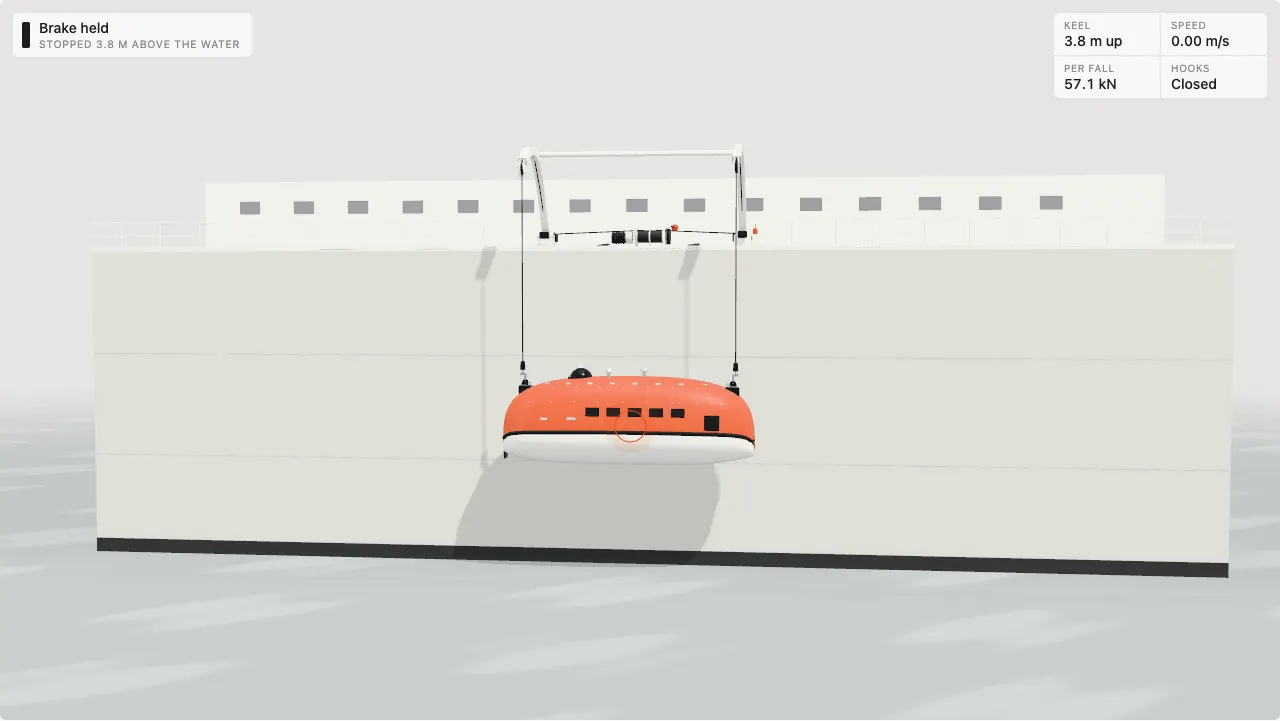
At least once every five years, the winch must lower and stop a load 10% heavier than the boat full of people and equipment. The weight comes from water bags or test weights, not people.
The hooks are taken apart, measured, checked for cracks, rebuilt and tested with the same heavy load.
-
3/6Words you'll meet
Five words, in plain English
- Proof load
- the test weight, 1.1 times the boat with its full number of people and equipment.
- Water bags
- bags filled with a measured amount of water, used as test weight inside the boat.
- Overhaul
- taking a part apart, checking it against the maker’s limits, then rebuilding and adjusting it.
- Tolerances
- the maker’s limits on how much wear a part may show.
- Class surveyor
- an inspector from a classification society, which surveys ships for many flag countries.
-
4/6Why it matters
The one day it must work, fully loaded
A real abandon ship is the one day the boat must work first time, full of people. The five-yearly test proves it can, with a margin.
It is easy to mix up with the annual test, but the heavy load belongs to the five-yearly test only. Nobody rides in the boat while it is lowered and braked.
-
5/6In this lesson
What you’ll be able to do
- Work out the proof load for a boat.
- Follow how the five-yearly brake test is run.
- Know what a hook overhaul involves.
- Know who does the work and who may need to watch.
-
6/6Quick check
Who rides in the boat during the brake test?
Right: the extra weight comes from water bags or test weights, and nobody is in the boat while it is lowered and braked.
In plain words
Once every five years, the lifeboat system gets its hardest test. The winch must lower and stop a load 10% heavier than the boat full of people and equipment. The hooks are taken apart, measured and checked for cracks, then put back together and tested with the same heavy load.
Nobody rides in the boat while it is lowered and braked. The weight comes from water bags or test weights placed in the boat. The work must be done by technicians certified for that make of equipment, working for the manufacturer or an authorised service firm. Many flags also want a class surveyor to watch.
The point is simple. A real abandon-ship is the one day the boat must work first time, fully loaded. The five-yearly test proves it can, with a margin.
Key points
- At least every five years, the winch brake is tested with a proof load of 1.1 × the boat plus its full complement of persons and equipment (SOLAS III/20.11.1.2).
- The brake is applied abruptly once the proof load reaches maximum lowering speed (MSC.402(96) §6.3.1).
- On-load release gear is overhauled and then tested under 1.1 × the fully loaded mass at least once every five years (SOLAS III/20.11.2.2).
- Overhaul means dismantling the hook units, checking tolerances and looking for cracks (MSC.402(96) §6.3.3).
- Only certified personnel of the manufacturer or an authorised service provider may do this work (MSC.402(96) §4.3).
- Persons count as 82.5 kg in lifeboats on cargo ships, free-fall lifeboats and all rescue boats; other lifeboats on passenger ships still use 75 kg (LSA Code 4.4.2.2.1, 4.7.2.1, 5.1.1.1, as amended by MSC.272(85)).
Sign in to read the rest of this lesson
Continue reading
Save your progress, open all 115 lessons and get a Course completed card when you finish.
or use your email
In the rest of this lesson
- The detail
- Deep dive
- Try it: Work out a five-yearly proof load
- Quiz: 5 questions
- Ask our engineers about this lesson
Familiarisation training from Al Safwan Academy. Finishing a course shows completion of online familiarisation training: it is not an STCW, flag-approved or manufacturer qualification, and these courses don't replace that training. The manufacturer's manual and your flag's rules always come first.