Lesson 3 · 16 min
Examining the boat: hull, engine, systems and equipment
The ten boat items of the annual thorough examination, what the LSA Code requires of each, and what a careful examiner looks at.
Start here
The 2-minute primer
New to this? These 6 cards explain the lesson in plain words. Go through them first and the lesson will make sense.
Primer done.
-
1/6Picture this
Checking the camper van before a long trip
Before a long trip in a camper van, you check the body for damage, start the engine, fill the tank and test the lights. Then you open the cupboards: water, food, torch, first aid kit, all in date.
The annual check of a lifeboat is the same, from the bottom of the hull to the roof, then the lockers.
-
2/6The big idea
Good condition and in working order
Since 2020 the annual examination covers the lifeboat itself, not just its davit and hooks. There are ten boat items, from the hull to the ventilation.
The technician checks the hull and its hidden buoyancy spaces, the engine and fuel, steering, batteries, bailing, skates and any special systems. Then every piece of equipment, expiry dates included.
-
3/6Words you'll meet
Six words, in plain English
- Void spaces
- closed spaces between the inner and outer hull that keep the boat afloat.
- Skates
- runners on the hull that help the boat slide down the ship’s side without damage.
- Bailing system
- the boat’s means of getting water out, such as a pump, a bailer and buckets.
- Sprinkler system
- a water spray over a fire-protected boat so it can pass through burning oil.
- Air supply
- bottled air that keeps the people inside breathing when all openings are closed.
- Ventilation system
- fans or vents that bring fresh air into an enclosed boat. Examined yearly since 2026.
-
4/6Why it matters
Hidden water and flat batteries
If water gets into the void spaces, the boat is heavier and less stable than designed, and it puts more load on the hooks and wires.
A flat battery, poor fuel or out-of-date flares stay just as quiet until the day they are needed. The annual check finds them while there is still time.
-
5/6In this lesson
What you’ll be able to do
- Know the ten boat items of the annual examination.
- Check the hull, void spaces, engine, fuel and batteries.
- Know what fire-protected and air-supported boats need.
- Check the boat’s equipment against the list.
-
6/6Quick check
Why do the hidden void spaces matter?
Right: the void spaces give the boat its buoyancy, so water inside them makes it heavier and less stable.
In plain words
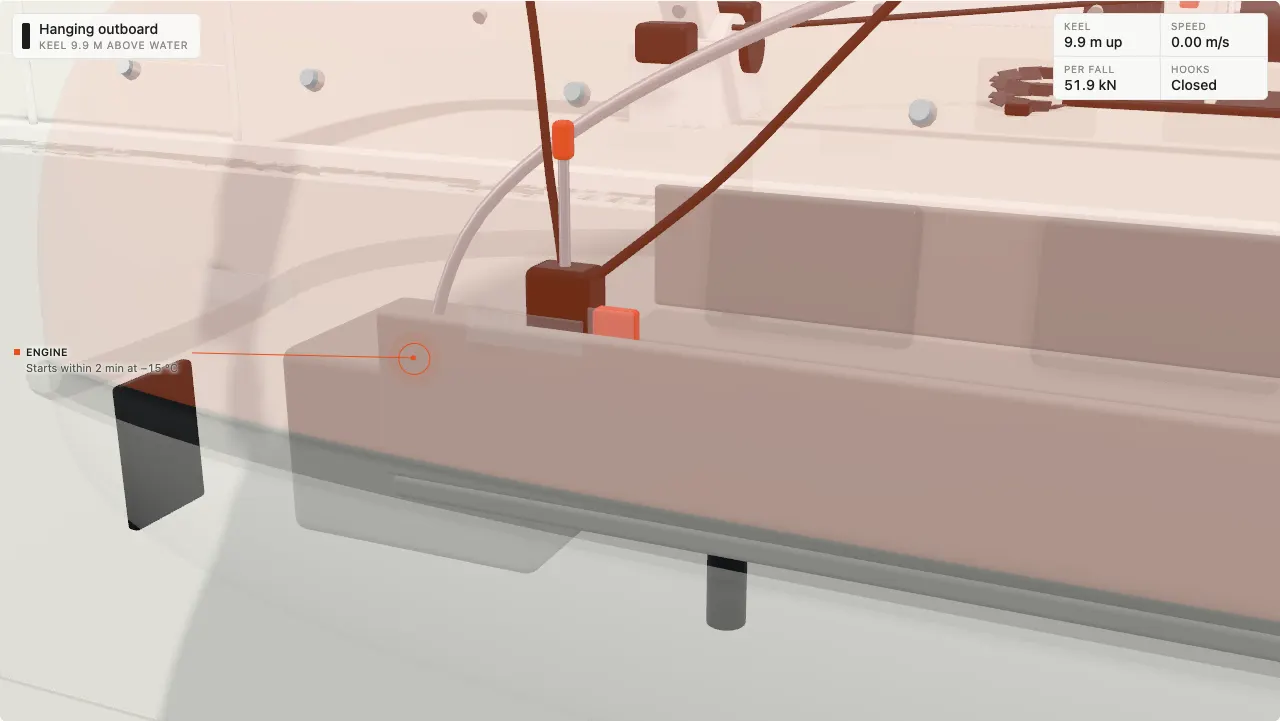
Since 2020 the annual examination covers the lifeboat itself, not just its davit and hooks. The technician goes over the boat from keel to roof: the hull and its hidden buoyancy spaces, the engine and fuel, the steering, the batteries, the bilge pump, the skates that let it slide down the ship’s side, and any special systems such as the water spray of a fire-protected boat or its air supply.
Then comes the equipment inside: water, food rations, flares, first aid, torch, searchlight and the rest. Items with an expiry date are checked one by one.
The standard for every item is the same: is it in good condition, and does it work? The manufacturer’s manual says how to check each part. The LSA Code says what each part must be able to do when the boat is needed for real.
Key points
- The annual examination of the boat covers ten items, from structure to ventilation (MSC.402(96) §6.2.3.1–.10).
- The structure check includes a visual examination of the external boundaries of the void spaces, as far as practicable (MSC.402(96) §6.2.3.1).
- A lifeboat must carry fuel for 24 hours at 6 knots, fully loaded (LSA Code 4.4.6.8).
- Radio batteries must not be used to start the engine (LSA Code 4.4.6.11).
- The ventilation system, where fitted, has been part of the annual examination since 1 January 2026 (MSC.402(96) §6.2.3.10, added by MSC.559(108)).
- Lifeboat equipment is listed in LSA Code 4.4.8, and the crew check it monthly against the SOLAS III/36 checklist (SOLAS III/20.7.2).
Sign in to read the rest of this lesson
Continue reading
Save your progress, open all 115 lessons and get a Course completed card when you finish.
or use your email
In the rest of this lesson
- The detail
- Deep dive
- Try it: Find the defects on the boat
- Quiz: 5 questions
- Ask our engineers about this lesson
Familiarisation training from Al Safwan Academy. Finishing a course shows completion of online familiarisation training: it is not an STCW, flag-approved or manufacturer qualification, and these courses don't replace that training. The manufacturer's manual and your flag's rules always come first.