Lesson 5 · 13 min
Davits, winches and the brake test
What the annual examination checks on davits and winches, how fast a boat may be lowered, and how the empty-boat brake test is done.
Start here
The 2-minute primer
New to this? These 6 cards explain the lesson in plain words. Go through them first and the lesson will make sense.
Primer done.
-
1/6Picture this
Freewheel downhill, then squeeze the brakes
On a bicycle, you trust your brakes most on a steep hill. Let it roll to full speed, squeeze hard, and the bike must stop and stay stopped.
The yearly lifeboat brake test is the same. The empty boat is lowered at full speed, the brake goes on hard before it touches the water, and it must hold.
-
2/6The big idea
The machine that puts the boat in the water
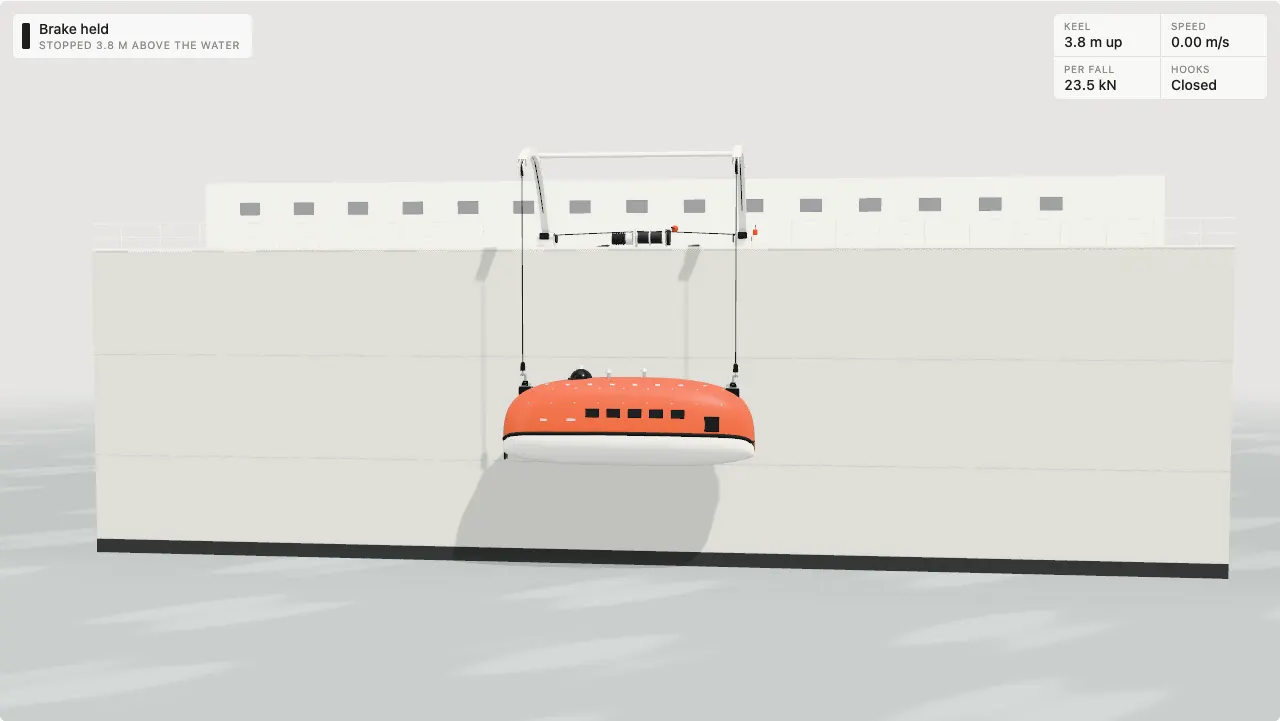
The davit swings the boat out over the side. The winch holds the wires and lets them out. A brake controls the speed and can stop the boat at any point.
Every year a certified technician checks the steel for rust and bending, the wires and wheels, the switches and the brake, then does the brake test.
-
3/6Words you'll meet
Five words, in plain English
- Davit
- the crane arm that swings the boat out over the ship’s side.
- Winch
- the drum and motor that store the wires and let them out or wind them in.
- Sheave
- a grooved wheel that guides the wire on its way to the boat.
- Limit switch
- a switch that cuts the hoisting power before the davit arms hit their stops.
- Dead-man brake
- a brake that is always on unless the operator holds it off, so letting go stops the boat.
-
4/6Why it matters
Too slow or too fast both hurt
A boat lowered too slowly stays too long beside a ship in trouble. A boat lowered too fast can hurt the people inside when it stops. So there are lowering speed limits.
In the accident study, winches had more incidents than any other part. Many came down to neglected or wrong maintenance that made the brake fail.
-
5/6In this lesson
What you’ll be able to do
- Name the main parts of a davit and winch.
- Know what the annual examination checks on them.
- Work out the lowering speed limits for a boat.
- Follow the steps of the annual brake test.
-
6/6Quick check
What happens if the winch operator lets go?
Right: a manual winch brake is always on unless someone holds it off, so letting go stops the boat.
In plain words
The davit and winch are the machine that puts the lifeboat in the water. The davit swings the boat out over the ship’s side. The winch holds the wires, called falls, and lets them out. A brake controls the speed and can stop the boat at any point.
Every year, a certified technician examines this machine. They look at the steel structure for rust, bending and loose joints. They check the wires and the wheels the wires run over. They test the switches that cut the power before the davit arms hit their stops. Then they lower the empty boat, let it reach full speed, and slam the brake on before it touches the water. The boat must stop and hold.
There is also a speed rule. A boat lowered too slowly stays too long beside a ship in trouble. A boat lowered too fast can hurt the people inside when it stops.
Key points
- The annual examination covers the davit structure, wires and sheaves, lubrication, limit switches, stored power, hydraulics and the winch brake, pads and foundation (MSC.402(96) §6.2.9).
- The annual brake test lowers the empty boat, or an equivalent load, and applies the brake abruptly at maximum lowering speed before the boat enters the water (MSC.402(96) §6.2.10).
- A manual brake must always be on unless the operator holds the control in the “off” position (LSA Code 6.1.2.12).
- The minimum lowering speed of a fully loaded boat is S = 0.4 + 0.02H m/s; for appliances installed on or after 1 January 2026 it is that figure or 1.0 m/s, whichever is less (LSA Code 6.1.2.8, MSC.554(108)).
- For appliances installed on or after 1 January 2026, the maximum lowering speed is 1.3 m/s unless the Administration accepts another figure (LSA Code 6.1.2.10, MSC.554(108)).
- Davits recovered by power need limit switches that cut the power before the arms reach the stops (LSA Code 6.1.2.7).
Sign in to read the rest of this lesson
Continue reading
Save your progress, open all 115 lessons and get a Course completed card when you finish.
or use your email
In the rest of this lesson
- The detail
- Deep dive
- Try it: Work out the lowering speed limits
- Quiz: 5 questions
- Ask our engineers about this lesson
Familiarisation training from Al Safwan Academy. Finishing a course shows completion of online familiarisation training: it is not an STCW, flag-approved or manufacturer qualification, and these courses don't replace that training. The manufacturer's manual and your flag's rules always come first.