Lesson 5 · 13 min
EEBDs: what they are for and how they are checked
You will know what an EEBD may and may not be used for, how many a ship needs and where, and how to check, test and replace them.
Start here
The 2-minute primer
New to this? These 6 cards explain the lesson in plain words. Go through them first and the lesson will make sense.
Primer done.
-
1/6Picture this
A torch to find the way out
Think of the small torch you grab in a power cut. It lasts long enough to find the stairs and get out of a dark building. You would never use it to explore a cellar for an hour.
An emergency escape breathing device is like that torch, but for air. It gives you enough to get out of smoke, and nowhere near enough to go in.
-
2/6The big idea
For escape only, never for going in
The device is a hood or mask with at least ten minutes of air or oxygen. You put it on the moment the air turns bad, then you leave.
It is never used to fight a fire or to enter a tank. Those jobs need full breathing apparatus. Ships carry several, near escape routes, plus spares. The crew check the gauges weekly and the whole device yearly.
-
3/6Words you'll meet
Five words, in plain English
- EEBD
- emergency escape breathing device, a hood or mask with a small air supply for escaping smoke or gas.
- SCBA
- self-contained breathing apparatus, the full air set fire-fighters wear to go into danger.
- Shelf life
- how long the device stays usable, printed on it by the maker.
- Fire control plan
- the ship’s drawing showing where all fire equipment is kept.
- Training unit
- a device clearly marked for practice, so the real ones stay ready.
-
4/6Why it matters
The wrong tool for the job
Someone who takes an escape set into a tank with bad air may run out halfway through the job. That is why the rules forbid it.
Inspectors also find expired devices still on their hooks, gauges reading low, devices missing from where the plan shows them, and no spare because it was used in a drill.
-
5/6In this lesson
What you’ll be able to do
- Know what the device may and may not be used for.
- Work out how many a ship needs and where they go.
- Check, test and replace them on the right schedule.
- Keep spares and a training unit ready.
-
6/6Quick check
When may you use an escape breathing device?
Right: it is made only for getting out of a dangerous space. Going in or fighting a fire needs full breathing apparatus.
The basics
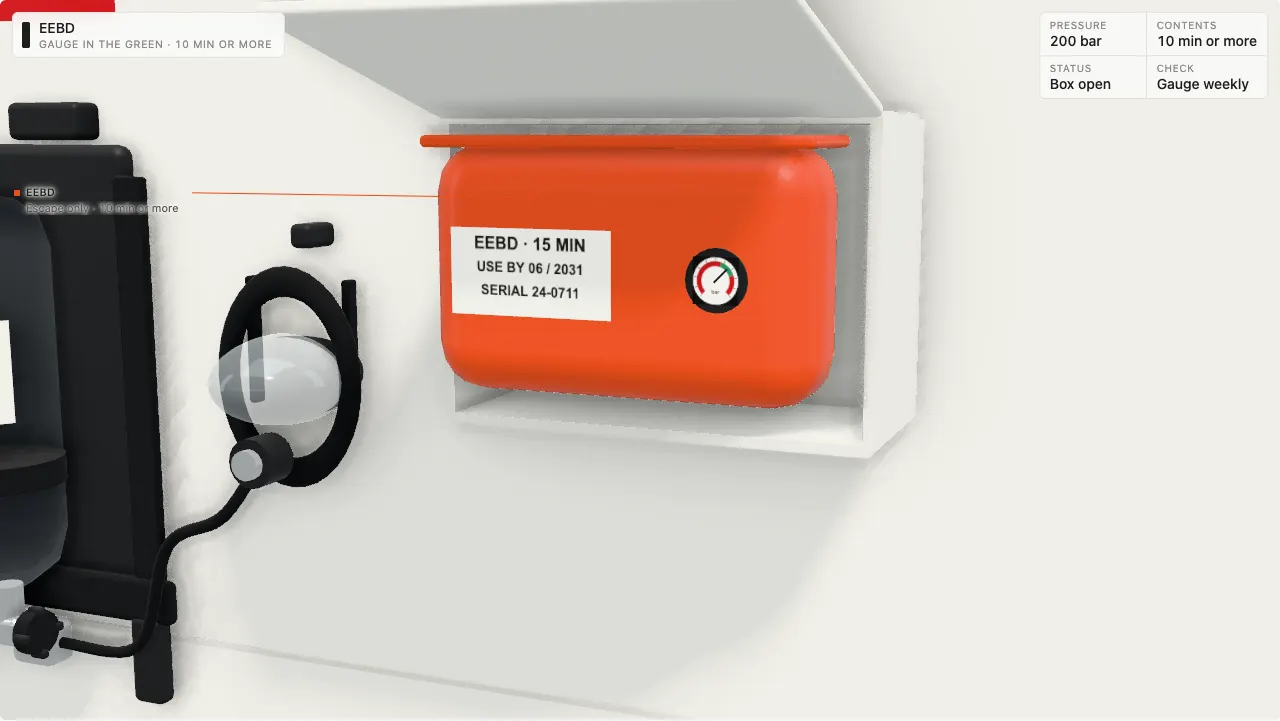
An emergency escape breathing device (EEBD) is a hood or mask with about ten minutes of air or oxygen. It is made for one job: getting out of a space full of smoke or toxic gas. In a machinery space fire, or after an accidental CO2 release, it buys the time to climb an escape ladder and reach fresh air. Ten minutes is plenty to get out and nowhere near enough to go in.
Because EEBDs are small, cheap and hung all over the ship, they are easy to misuse and easy to forget. This lesson covers the rules on what they are, how many the ship needs and where, how they are checked, and four decisions an officer has to get right.
Sign in to read the rest of this lesson
Continue reading
Save your progress, open all 115 lessons and get a Course completed card when you finish.
or use your email
In the rest of this lesson
- Try it: Four EEBD decisions on a product tanker
- In plain words
- In detail
- What the rules say
- Flag and class notes
- Key numbers
- What inspectors find
- 4 questions people ask
- Quiz: 6 questions
- Ask our engineers about this lesson
Familiarisation training from Al Safwan Academy. Finishing a course shows completion of online familiarisation training: it is not an STCW, flag-approved or manufacturer qualification, and these courses don't replace that training. The manufacturer's manual and your flag's rules always come first.