Lesson 6 · 14 min
Fire hoses, nozzles, hydrants and the international shore connection
You will be able to check a ship's hydrants, hoses, nozzles and international shore connection against SOLAS and the FSS Code, and plan their monthly to five-yearly tests.
Start here
The 2-minute primer
New to this? These 6 cards explain the lesson in plain words. Go through them first and the lesson will make sense.
Primer done.
-
1/6Picture this
A garden hose and a travel adaptor
Think of a garden hose. You screw it onto the tap, and a nozzle at the end gives a jet or a spray. If the tap is stuck or the hose splits, no water reaches the flowers.
Now think of a travel adaptor that lets your plug fit any socket abroad. Ships carry one of those for water too.
-
2/6The big idea
Water is still the main weapon
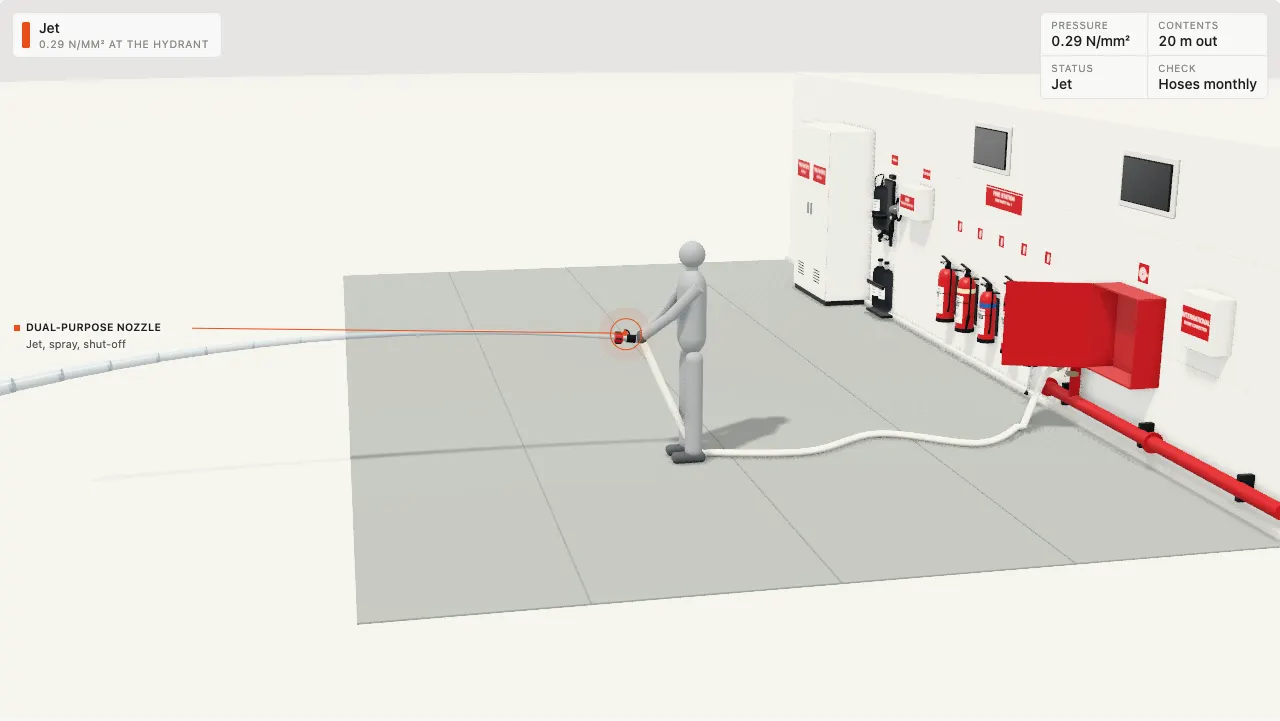
Pumps push sea water into the fire main, a pipe running the length of the ship. Along it are hydrants, each with its own valve. The crew clip on a hose and control the water with a nozzle.
The rules make sure two jets can reach any part of the ship, hoses fit every hydrant, and the pressure is strong but still holdable.
-
3/6Words you'll meet
Five words, in plain English
- Fire main
- the pipe that carries sea water from the fire pumps to every hydrant.
- Hydrant
- a tap on the fire main where a hose is connected.
- Dual-purpose nozzle
- a nozzle that gives a solid jet or a spray, and can be shut off.
- Coupling
- the fitting at each end of a hose that joins it to a hydrant or nozzle.
- International shore connection
- a standard flange that lets a fire brigade in any port pump water into the ship’s fire main.
-
4/6Why it matters
Minutes lost at the hydrant
In a real fire, a stuck hydrant valve or a burst hose costs minutes the crew does not have. Inspectors often find fire main valves that do not work and pumps that cannot deliver two jets.
In port, a shore connection missing its bolts or gasket means the local fire brigade may not be able to connect.
-
5/6In this lesson
What you’ll be able to do
- Check hydrants, hoses and nozzles against the rules.
- Work out how many hoses a ship must carry.
- Check the international shore connection and its fittings.
- Plan the checks from monthly to every five years.
-
6/6Quick check
What is the international shore connection for?
Right: it is a standard flange, so a fire brigade in any port can connect to the ship whatever couplings the ship uses.
The basics
The fire main is the one fire-fighting system every ship relies on, and the hose and nozzle are where the crew meet it. In the 2023 fire safety campaign, Tokyo MOU inspectors found fire main valves that did not work on 149 ships and detained 25 of them. Another 38 ships could not show that a fire pump delivered the two required jets of water.5 In a real fire, a seized hydrant valve or a burst hose length costs minutes the crew does not have.
In port, the international shore connection lets the shore fire brigade pump water into the ship’s fire main whatever couplings the ship uses. It only works if the flange, bolts and gasket are on board, the right size and easy to find. This lesson covers the hardware, the numbers and the test cycle.
Sign in to read the rest of this lesson
Continue reading
Save your progress, open all 115 lessons and get a Course completed card when you finish.
or use your email
In the rest of this lesson
- Try it: A hydrant station and the international shore connection
- In plain words
- In detail
- What the rules say
- Flag and class notes
- Key numbers
- What inspectors find
- Work it out: a calculator
- 4 questions people ask
- Quiz: 6 questions
- Ask our engineers about this lesson
Familiarisation training from Al Safwan Academy. Finishing a course shows completion of online familiarisation training: it is not an STCW, flag-approved or manufacturer qualification, and these courses don't replace that training. The manufacturer's manual and your flag's rules always come first.