Lesson 4 · 15 min
SCBA: checks, breathing air quality and cylinder testing
You will know what a compliant SCBA must have, what to check weekly, monthly and yearly, how breathing air is tested and when cylinders must be hydrostatically tested.
Start here
The 2-minute primer
New to this? These 6 cards explain the lesson in plain words. Go through them first and the lesson will make sense.
Primer done.
-
1/6Picture this
A fuel tank with a warning light
Think of a car’s fuel tank. You need enough fuel, clean fuel, a gauge you can read and a warning light before it runs dry. Without the warning, you only find out when the engine stops.
Breathing apparatus is a tank of air for a fire-fighter. It needs enough air, clean air, a gauge, and an alarm that sounds before the air runs out.
-
2/6The big idea
It keeps a person alive inside the fire
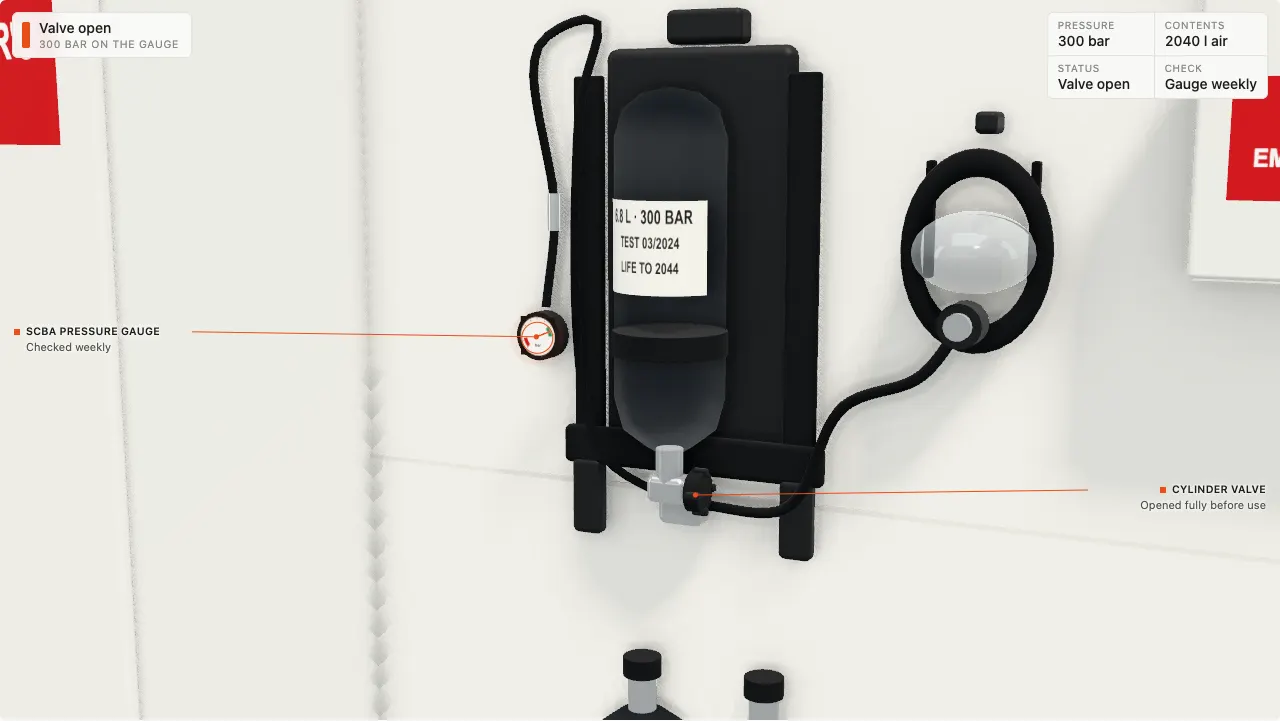
The apparatus is a cylinder of clean compressed air on a back frame, a face mask and a valve that gives air as you breathe in.
Its faults are silent. A cylinder can read full and hold dirty air. A mask can leak at the seal. That is why the gauges are checked every week, the masks and air every year, and the steel cylinders pressure-tested every five years.
-
3/6Words you'll meet
Six words, in plain English
- SCBA
- self-contained breathing apparatus, a portable air supply worn by fire-fighters.
- Demand valve
- the part on the mask that gives air each time the wearer breathes in.
- Low-air warning
- an alarm, usually a whistle, that sounds before the air left gets too low.
- Breathing air standard
- a set of limits that compressed air must meet to be safe to breathe.
- Hydrostatic test
- filling a cylinder with water under pressure to prove it is still strong.
- Spare charges
- extra full cylinders kept ready to swap in.
-
4/6Why it matters
Faults hide until you are inside
A wearer deep in a smoky engine room depends on every part working. A silent alarm, dirty air or a leaking mask can leave them in danger with no warning.
Inspectors often find older sets without the warning alarm, spare cylinders past their test date, and spares used in drills that were never refilled.
-
5/6In this lesson
What you’ll be able to do
- Name the parts of the apparatus and what each one does.
- Know what to check every week, month and year.
- Know how the ship’s own breathing air is tested.
- Know when cylinders need testing and how many spares to carry.
-
6/6Quick check
What must sound before the air runs out?
Right: every set must have an alarm that warns the wearer while there is still air left to get out.
The basics
A self-contained breathing apparatus (SCBA) is the one piece of fire-fighting equipment that keeps a person alive inside the fire. It also fails silently. A cylinder can read full and hold contaminated air. A face mask can look fine and leak at the seal. A demand valve can stick. A low-air warning can stay silent until the wearer is out of air, deep in a smoke-filled engine room. That is why the rules check the apparatus every week and test the air and the cylinders on fixed cycles.
This lesson goes through the apparatus part by part, then covers the checks, the air quality standard, cylinder testing and the spare charges the ship must carry.
Sign in to read the rest of this lesson
Continue reading
Save your progress, open all 115 lessons and get a Course completed card when you finish.
or use your email
In the rest of this lesson
- Try it: Parts of a fire-fighter's SCBA
- In plain words
- In detail
- What the rules say
- Flag and class notes
- Key numbers
- What inspectors find
- 4 questions people ask
- Quiz: 6 questions
- Ask our engineers about this lesson
Familiarisation training from Al Safwan Academy. Finishing a course shows completion of online familiarisation training: it is not an STCW, flag-approved or manufacturer qualification, and these courses don't replace that training. The manufacturer's manual and your flag's rules always come first.