Lesson 3 · 16 min
Inspection, servicing and hydrostatic testing of extinguishers
You will be able to run or check an extinguisher service against A.951(23), count spare charges correctly and recognise a unit that must be taken out of service.
Start here
The 2-minute primer
New to this? These 6 cards explain the lesson in plain words. Go through them first and the lesson will make sense.
Primer done.
-
1/6Picture this
A pressure cooker with a rusty base
Think of a pressure cooker. It holds steam under pressure, which is safe while the metal is sound. Let the base rust through and the pot can split open.
A fire extinguisher is also a container under pressure. It sits for years in salty air and shaking, then must work at once. Regular checks make sure it sprays when you need it, and never bursts.
-
2/6The big idea
A fixed cycle of checks
Every extinguisher follows the same cycle. Between services, someone on board checks it is in place and unused. Every year a competent person services it.
Every five years one of each type and year is fired off at a drill and checked inside. Every ten years each one is filled with water and pressure-tested. Any unit that is rusty, dented or damaged comes out of service, whatever the paperwork says.
-
3/6Words you'll meet
Five words, in plain English
- Annual service
- the yearly check of seal, pressure, outside condition, weight, hose and instructions.
- Test discharge
- firing an extinguisher on purpose at a drill, then checking it inside.
- Hydraulic test
- filling the body with water under high pressure to prove it will not burst.
- Spare charges
- refills kept on board so a used extinguisher can be refilled at once.
- Condemned
- taken out of service for good because it is no longer safe.
-
4/6Why it matters
A rusty extinguisher can kill
A badly corroded extinguisher can split open under its own pressure. In one case, a ship’s officer died when a corroded, condemned unit split as he was emptying it. A shore contractor had passed it at its yearly service two weeks earlier.
So look at the extinguishers yourself, and leave the emptying of old ones to a specialist.
-
5/6In this lesson
What you’ll be able to do
- Run or check a yearly extinguisher service.
- Know what falls due at five years and at ten years.
- Count how many spare charges the ship must carry.
- Spot a unit that must be taken out of service.
-
6/6Quick check
An extinguisher’s base is badly rusted. What now?
Right: rust that may affect safe use means the unit is condemned. A specialist should empty and dispose of it.
The basics
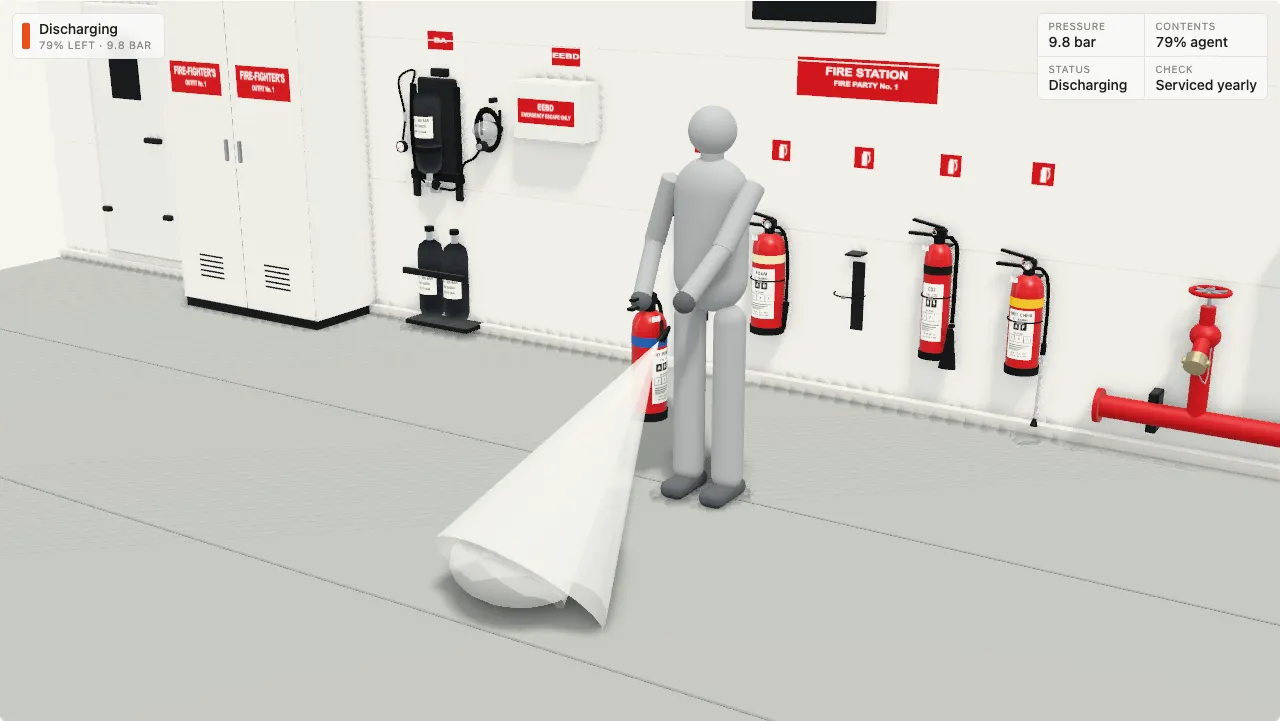
On 6 June 2022 a second officer on the tanker Seacross, alongside in Greece, was killed by a fire extinguisher. He was helping to dispose of condemned 9 litre cartridge-operated foam units. When one cap would not unscrew, he pressed the lever to empty it. The corroded base split at its weld seam and the body struck him in the chest. The extinguisher was 17 years old. The Bahamas Maritime Authority found that it and seven other badly corroded units had been passed at their annual service by a shore contractor only two weeks before the ship’s own officers condemned them.9 The same report records a 2021 fatality on an offshore unit with a corroded, condemned dry powder extinguisher.9 The UK MCA warns that fatalities “have previously occurred” when corroded extinguisher bases failed in use.8
An extinguisher is a pressure vessel that sits for years in salt air and vibration, then has to work at once. Servicing confirms that it will discharge, and that it will not fail as a pressure vessel. This lesson follows the cycle of resolution A.951(23) and what flags add to it.
Sign in to read the rest of this lesson
Continue reading
Save your progress, open all 115 lessons and get a Course completed card when you finish.
or use your email
In the rest of this lesson
- Try it: Annual extinguisher round: accommodation and engine room
- In plain words
- In detail
- What the rules say
- Flag and class notes
- Key numbers
- What inspectors find
- Work it out: a calculator
- 4 questions people ask
- Quiz: 6 questions
- Ask our engineers about this lesson
Familiarisation training from Al Safwan Academy. Finishing a course shows completion of online familiarisation training: it is not an STCW, flag-approved or manufacturer qualification, and these courses don't replace that training. The manufacturer's manual and your flag's rules always come first.