Lesson 2 · 15 min
Extinguisher types and fire classes on board ships
You will be able to match each extinguisher type to the fires it suits, explain why some agents are banned from some spaces, and check the number and placement against the rules.
Start here
The 2-minute primer
New to this? These 6 cards explain the lesson in plain words. Go through them first and the lesson will make sense.
Primer done.
-
1/6Picture this
The right tool from the toolbox
Think of a toolbox. A hammer is great for nails and terrible for screws. Pick the wrong tool and you can make the job worse.
Fire extinguishers are the same. Water is fine on a burning mattress, but on a pan of hot oil it throws flaming oil across the room. Each fire needs the right extinguisher.
-
2/6The big idea
Match the extinguisher to the fire
A fire needs fuel, heat and air. Each extinguisher takes one away: water cools, foam smothers, CO2 pushes the air out, powder stops the flame’s reaction.
Fires are sorted into classes by what is burning, and each label shows the classes it suits. The rules then make sure the right type hangs near each danger, close to the door of every space.
-
3/6Words you'll meet
Six words, in plain English
- Fire class
- a letter that groups fires by what is burning, such as solids, liquids or cooking oil.
- Class A
- fires in solids such as wood, paper, cloth and many plastics.
- Class B
- fires in burning liquids such as fuel, oil and paint.
- Class F or K
- fires in cooking oils and fats, as in a galley deep fat fryer.
- CO2
- carbon dioxide, a gas extinguisher that pushes the air away from a fire.
- Wet chemical
- an extinguisher that forms a soapy crust on burning cooking oil and cools it.
-
4/6Why it matters
The first minute decides it
A small fire stays small only if the right extinguisher is close by. The wrong one can spread the fire or hurt the person using it.
CO2 in a closed cabin can leave the user short of air, which is why it is banned there. Powder on a switchboard can damage the contacts. Inspectors check that each type hangs where it belongs.
-
5/6In this lesson
What you’ll be able to do
- Match each extinguisher type to the fires it suits.
- Read the fire classes on a label, including the confusing class C.
- Know why some extinguishers are banned from some spaces.
- Check the number and placement of extinguishers against the rules.
-
6/6Quick check
Which extinguisher suits a fryer fire in the galley?
Right: wet chemical forms a crust on burning cooking oil and cools it. Water would make the burning oil erupt.
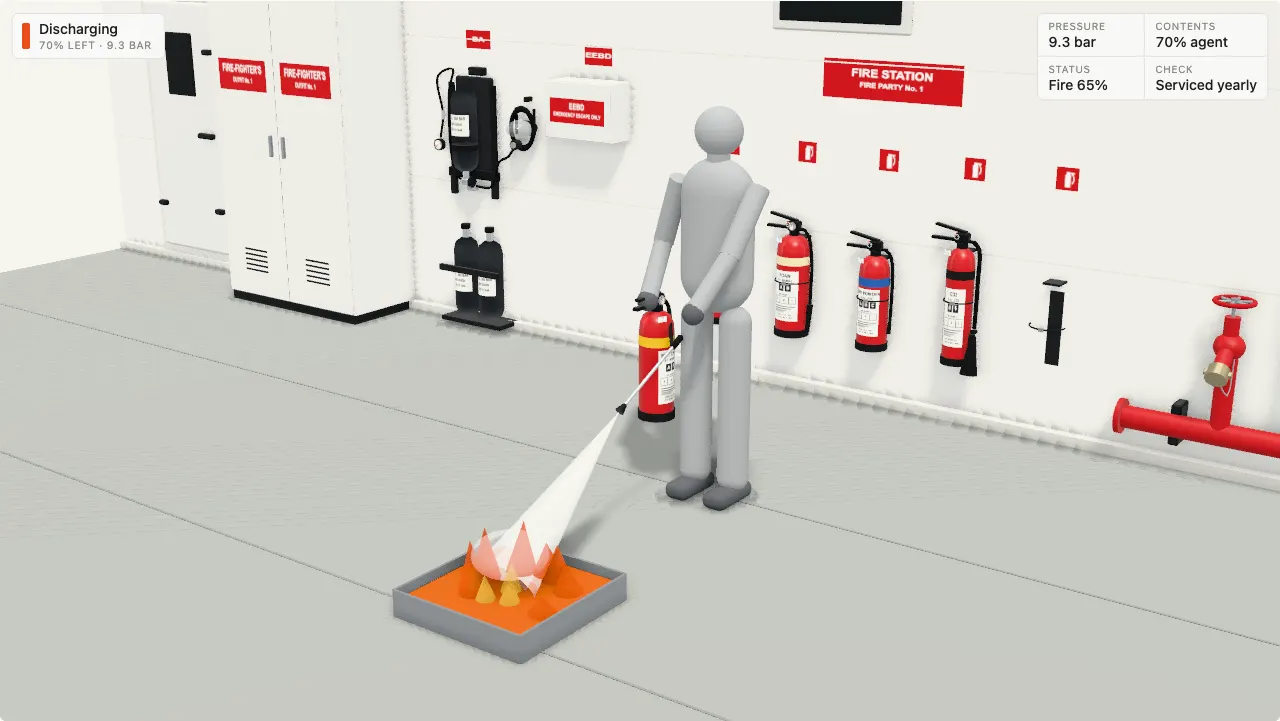
The basics
A portable extinguisher is the first thing a crew member reaches for, and the first minute decides whether a small fire stays small. The wrong agent can make things worse. Water on a fat fryer fire throws burning oil across the galley. CO2 released in a cabin can leave the person who fired it short of oxygen. Powder on a switchboard leaves a residue that can damage electrical contacts.
The rules on board are built around that problem. They specify which agents to carry, the minimum size of each extinguisher, and where each one must hang so that the right type is near every hazard. This lesson covers the types, the fire classes and the placement rules, starting with a sorting exercise.
Sign in to read the rest of this lesson
Continue reading
Save your progress, open all 115 lessons and get a Course completed card when you finish.
or use your email
In the rest of this lesson
- Try it: Match the fire to its class
- In plain words
- In detail
- What the rules say
- Flag and class notes
- Key numbers
- What inspectors find
- 3 questions people ask
- Quiz: 7 questions
- Ask our engineers about this lesson
Familiarisation training from Al Safwan Academy. Finishing a course shows completion of online familiarisation training: it is not an STCW, flag-approved or manufacturer qualification, and these courses don't replace that training. The manufacturer's manual and your flag's rules always come first.