Lesson 7 · 13 min
The fire-fighter's outfit and the two-way radio requirement
You will be able to check a fire-fighter's outfit item by item, count and place outfits correctly, and confirm that fire-party radios meet SOLAS regulation II-2/10.10.4.
Start here
The 2-minute primer
New to this? These 6 cards explain the lesson in plain words. Go through them first and the lesson will make sense.
Primer done.
-
1/6Picture this
Like an astronaut on a spacewalk
Think of an astronaut stepping outside the space station. They wear a protective suit, carry their own air, stay clipped on with a line, and talk by radio to someone safe inside.
A ship’s fire party works the same way. Two people go into heat and smoke, wearing protective kit and breathing apparatus, tied to a lifeline, and talking by radio to the person controlling them from outside.
-
2/6The big idea
A full kit, and a voice outside
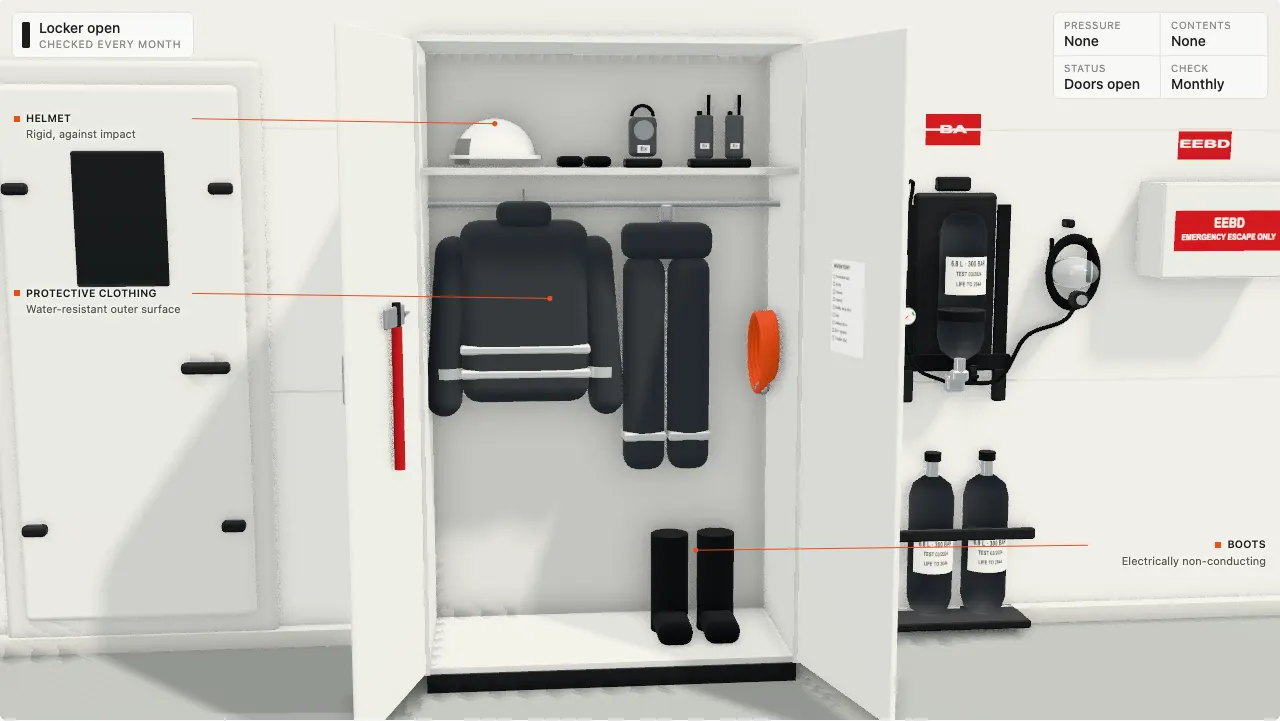
A fire-fighter’s outfit is a complete set for one person: heat-proof clothing, insulating boots, a helmet, a safety lamp, an axe, breathing apparatus and a fireproof lifeline.
Every ship carries at least two outfits, tankers at least four, stored well apart. Each fire party also needs at least two radios that cannot set off flammable gas.
-
3/6Words you'll meet
Six words, in plain English
- Fire party
- the small team of crew trained to go into a fire to fight it.
- Fire-fighter's outfit
- the full kit for one person going into a fire, including breathing apparatus.
- Lifeline
- a fireproof line clipped to the wearer so they can be found and pulled out.
- Explosion-proof
- built so it cannot make a spark that sets off flammable gas.
- Intrinsically safe
- a device that uses so little power it cannot cause a spark or heat strong enough to ignite gas.
- Locker
- the marked cupboard where an outfit is kept, ready to grab.
-
4/6Why it matters
Missing kit ends the attack
The fire party’s safety depends on what they put on in the first minutes and on hearing the person outside. A missing glove, a dead radio or an ordinary torch on a tanker can stop the attack, or put the team at risk.
Fire drills are where this shows most. Inspectors find many drills unsatisfactory, and drills are a leading reason ships are held in port.
-
5/6In this lesson
What you’ll be able to do
- Check a fire-fighter’s outfit item by item.
- Work out how many outfits a ship needs and where to keep them.
- Confirm the fire party radios meet the rule.
- Run the monthly locker check before a drill finds the gaps.
-
6/6Quick check
Why are the outfits stored well apart?
Right: if all the outfits were in one place, a single fire there could leave the ship with none to use.
The basics
When a fire is too big for an extinguisher, the ship sends in its fire party: two people in protective clothing and breathing apparatus, dragging a charged hose into heat and smoke they cannot see through. Their survival depends on the outfit they put on in the first two minutes and on talking to the person controlling them from outside. A missing glove, a torch that is not explosion-proof on a tanker, or a radio that dies or cannot be heard can end the attack, or worse.
Fire drills are where this goes wrong most visibly. In the 2023 Tokyo MOU fire safety campaign, 8.44% of the fire drills witnessed by inspectors were unsatisfactory, and drills caused more detentions (43) than any other campaign question.9 This lesson covers what the outfit must contain, how many the ship needs and where, the radio rule added in 2014, and how the monthly locker check catches problems before a drill or a fire does.
Sign in to read the rest of this lesson
Continue reading
Save your progress, open all 115 lessons and get a Course completed card when you finish.
or use your email
In the rest of this lesson
- Try it: Monthly check of the fire-fighter's outfits on an oil tanker
- In plain words
- In detail
- What the rules say
- Flag and class notes
- Key numbers
- What inspectors find
- 4 questions people ask
- Quiz: 6 questions
- Ask our engineers about this lesson
Familiarisation training from Al Safwan Academy. Finishing a course shows completion of online familiarisation training: it is not an STCW, flag-approved or manufacturer qualification, and these courses don't replace that training. The manufacturer's manual and your flag's rules always come first.