Lesson 2 · 18 min
CO2 systems: how they work, weighing and the 10-year tests
You will know every part of a high-pressure CO2 system, what each check involves, who may do it, and how to work on the system without killing anyone.
Start here
The 2-minute primer
New to this? These 6 cards explain the lesson in plain words. Go through them first and the lesson will make sense.
Primer done.
-
1/6Picture this
A glass jar over a candle
Put a glass jar over a burning candle. After a moment the flame shrinks and goes out. It has used up the air it can reach and cannot breathe.
A ship’s CO2 system does the same to a whole engine room. It floods the closed room with gas until a fire has too little oxygen to burn.
-
2/6The big idea
Powerful, and deadly if it escapes
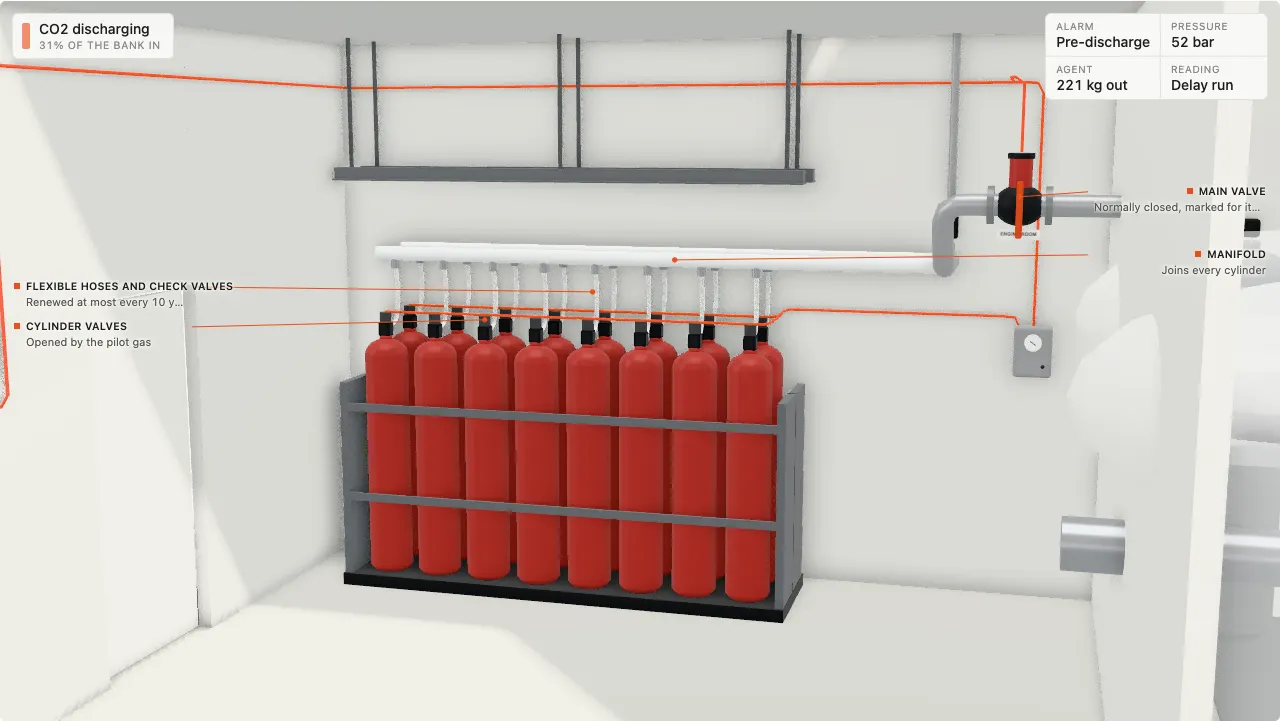
The system is a row of heavy bottles of liquid CO2, joined by pipes to nozzles in the spaces it protects. Two levers, pulled in order, send the gas in after a warning alarm.
The same gas that kills a fire kills people within a minute. So the system is checked often, and every job on it starts by making an accidental release impossible.
-
3/6Words you'll meet
Six words, in plain English
- Cylinder
- one of the strong steel bottles that hold the liquid CO2 under high pressure.
- Manifold
- the shared pipe that collects gas from all the cylinders before it goes to a space.
- Main valve
- a normally closed valve that sends the gas to one protected space only.
- Pre-discharge alarm
- a loud alarm in the space that sounds at least 20 seconds before the gas comes in.
- Weighing
- lifting each cylinder on a scale to check it still holds enough gas.
- Hydrostatic test
- filling a cylinder with water under pressure to prove the steel is still strong.
-
4/6Why it matters
Small slips have cost lives
People have died in CO2 rooms after gas leaked while the system was being prepared for an inspection. In other cases, faulty cylinder valves emptied whole banks of bottles into the cylinder room.
A cylinder that has quietly lost gas, a blocked nozzle or a pipe left disconnected after service means the system may fail on the day of a real fire.
-
5/6In this lesson
What you’ll be able to do
- Name each part of a CO2 system, from release cabinet to nozzle.
- Know the checks from monthly looks to the 10 and 20-year cylinder tests.
- Tell which jobs the crew does and which need trained technicians.
- Make the system safe before anyone works on it.
-
6/6Quick check
What must happen before anyone works on a CO2 system?
Right: the first step of any job is to lock the valves or remove the levers, so a mistake cannot fill a room with gas.
The basics
In September 2004, on the containership YM People, about 5 tonnes of CO2 escaped into the manifold while the chief engineer was preparing the fixed system for inspection. The master, the chief engineer, the chief officer and the third engineer all died in the CO2 room trying to vent it. In 2016 and 2017, on the ro-ro ships Eddystone and Red Eagle, malfunctioning cylinder valves released CO2 from whole banks of cylinders into the cylinder room. Only the closed engine room distribution valve kept the gas out of the engine room.
The UK Marine Accident Investigation Branch (MAIB) put the problem plainly: the CO2 concentration needed to put out a fire “is more than double that required to kill a human being within a minute”. A CO2 system is the most effective machinery space fire system on most ships, and the most dangerous thing on board to maintain. This lesson takes it apart.
Sign in to read the rest of this lesson
Continue reading
Save your progress, open all 115 lessons and get a Course completed card when you finish.
or use your email
In the rest of this lesson
- Try it: A high-pressure CO2 system, from release cabinet to nozzle
- In plain words
- In detail
- What the rules say
- Flag and class notes
- Key numbers
- What inspectors find
- 4 questions people ask
- Quiz: 6 questions
- Ask our engineers about this lesson
Familiarisation training from Al Safwan Academy. Finishing a course shows completion of online familiarisation training: it is not an STCW, flag-approved or manufacturer qualification, and these courses don't replace that training. The manufacturer's manual and your flag's rules always come first.