Lesson 8 · 15 min
The fire safety maintenance plan: weekly to ten-yearly
You will be able to build or audit a fire safety maintenance plan that covers every fixed system, splits crew work from specialist work, and stands up to a survey or PSC inspection.
Start here
The 2-minute primer
New to this? These 6 cards explain the lesson in plain words. Go through them first and the lesson will make sense.
Primer done.
-
1/6Picture this
A car’s service book for every system
A car comes with a service book. Oil every year, brakes every few years, a stamp each time a garage does the work. When you sell the car, the book proves it was looked after.
A ship needs the same, but for a dozen fire systems at once, each with its own weekly, yearly and ten-yearly jobs.
-
2/6The big idea
One list that ties it all together
The maintenance plan says, for every fire system on board, what is checked, how often, by whom and where the result is written down.
A good plan has three things. Everything is in it. It says which jobs the crew does and which need a trained technician. And every check leaves a record. It also says how the ship stays protected while a system is out for repair.
-
3/6Words you'll meet
Five words, in plain English
- Maintenance plan
- the ship’s list of every fire system check, how often it is due and who does it.
- Service technician
- a person specially trained on one kind of system, such as CO2, who does the specialist jobs.
- Record
- the written note of a check: date, who did it, the result and anything fixed.
- Survey
- a visit by the class society or flag surveyor to check the ship and its certificates.
- Port State control
- inspectors in a port who board foreign ships to check they meet the rules.
-
4/6Why it matters
A forgotten check is a hidden gap
Checks run from weekly to every twenty years, across many systems. Without one plan, something gets missed: a detector never tested, foam never sampled, cylinders overdue.
An item overdue on paper counts as a fault even if the equipment works. Worse, a system left out of the plan may simply fail in a real fire.
-
5/6In this lesson
What you’ll be able to do
- Know which systems the plan must cover.
- Split the work between crew and trained technicians.
- Keep records that stand up to a survey or inspection.
- Plan protection while a system is away for testing.
-
6/6Quick check
What does a good maintenance plan say for each check?
Right: the plan is the list that makes sure every check happens on time, by the right person, with a record to prove it.
The basics
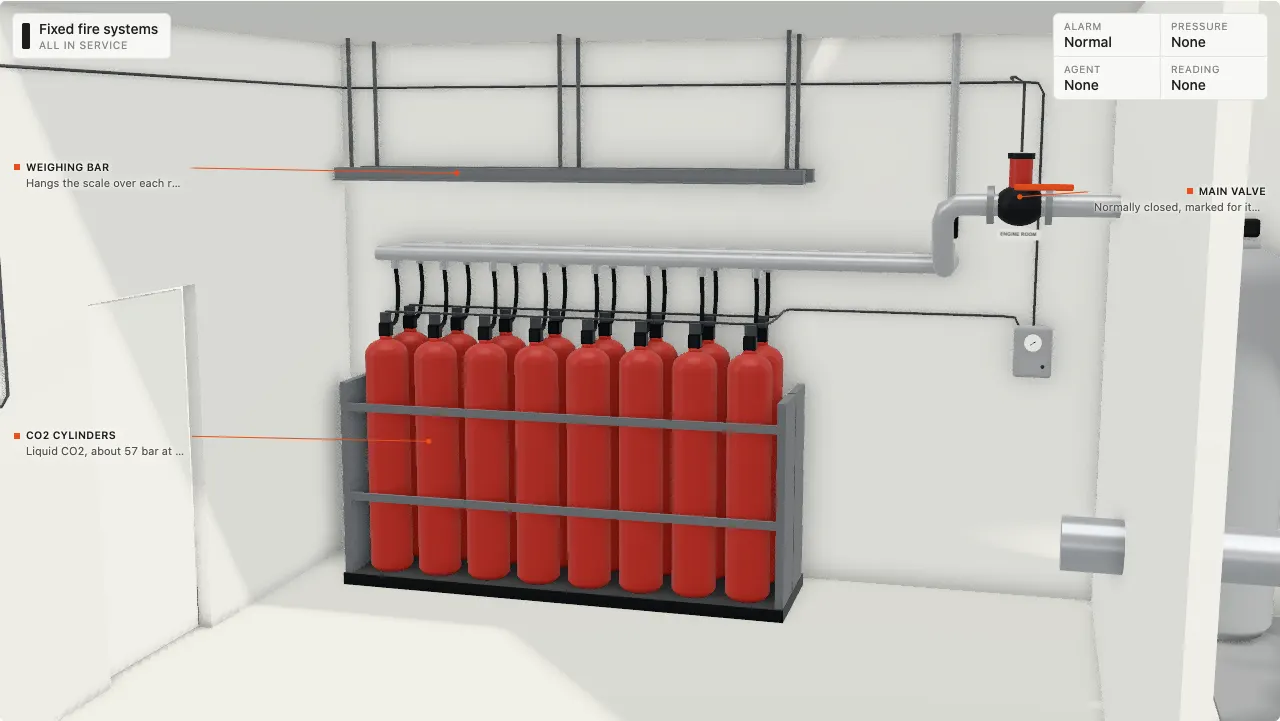
Every lesson so far has ended with a schedule: weekly lamp tests, monthly samples of detectors, quarterly damper tests, annual foam samples, two-yearly CO2 weighing, five-yearly valve inspections, ten and twenty-yearly cylinder tests. On a real ship all of these run at once, across a dozen systems, done partly by the crew and partly by visiting technicians, and checked by the class surveyor and any port State control officer who walks up the gangway.
SOLAS regulation II-2/14 asks for one thing that ties it together: a maintenance plan, kept on board and available for inspection. In the 2012 joint Paris and Tokyo MOU campaign on fire safety systems, the question “Is there a maintenance plan on board to show that fire protection systems and fire-fighting systems and appliances have been properly tested and inspected?” was answered “no” in 5.5% of Tokyo MOU inspections. This lesson shows how to make sure your ship is never in that group.
Sign in to read the rest of this lesson
Continue reading
Save your progress, open all 115 lessons and get a Course completed card when you finish.
or use your email
In the rest of this lesson
- Try it: Fixed fire systems from weekly to twenty-yearly
- In plain words
- In detail
- What the rules say
- Flag and class notes
- Key numbers
- What inspectors find
- 4 questions people ask
- Quiz: 6 questions
- Ask our engineers about this lesson
Familiarisation training from Al Safwan Academy. Finishing a course shows completion of online familiarisation training: it is not an STCW, flag-approved or manufacturer qualification, and these courses don't replace that training. The manufacturer's manual and your flag's rules always come first.