Lesson 7 · 15 min
Fire doors, fire dampers and structural fire protection
You will understand the passive fire protection that holds a fire inside its space, and know how to test fire doors and dampers and spot the damage that refits and repairs leave behind.
Start here
The 2-minute primer
New to this? These 6 cards explain the lesson in plain words. Go through them first and the lesson will make sense.
Primer done.
-
1/6Picture this
Shut the door before bed
Fire crews give families a simple tip: close the inside doors before you go to sleep. If a fire starts in the kitchen, a closed door holds it there for a while, and keeps smoke off the stairs.
A ship takes that idea much further. Its walls, decks, doors and air ducts are built to keep a fire boxed in the space where it started.
-
2/6The big idea
Boxes that hold a fire in
The ship is split into boxes with fire-resisting walls. Strong steel A class walls stop flame and smoke for an hour. Lighter B class panels stop flame for half an hour.
Every hole is a weak spot. Many doors must close by themselves, air ducts need flaps that snap shut, and cables must pass through tested seals. None of it does anything visible until the day of a fire.
-
3/6Words you'll meet
Six words, in plain English
- A class division
- an insulated steel wall or deck that stops flame and smoke for an hour.
- A-60
- an A class wall whose far side stays cool enough for 60 minutes in a fire test.
- B class division
- a lighter panel that cannot burn, often in cabins, that stops flame for the first half hour.
- Self-closing door
- a fire door that shuts on its own and must never be wedged or tied open.
- Fire damper
- a steel flap in an air duct that shuts so the duct cannot carry fire.
- Penetration
- a place where a pipe or cable passes through a fire wall, sealed with a tested system.
-
4/6Why it matters
Small changes undo the protection
These parts are damaged without anyone noticing. A door is tied open for a breeze. A damper rusts and sticks. New cables go through a wall and the hole is filled with foam from a can.
Then a fire that should stay in one cabin or one engine room can spread through the ship. Inspectors look hard at fire doors for this reason.
-
5/6In this lesson
What you’ll be able to do
- Read A and B class ratings and know what they promise.
- Test fire doors and fire dampers at the right intervals.
- Spot doors held open, stuck dampers and badly sealed holes.
- Know when a repair needs approved parts and the class society’s agreement.
-
6/6Quick check
A self-closing fire door is tied open with a rope. What should you do?
Right: self-closing fire doors must be free to close. Hooks and ropes are not allowed, so the door must shut and latch on its own.
The basics
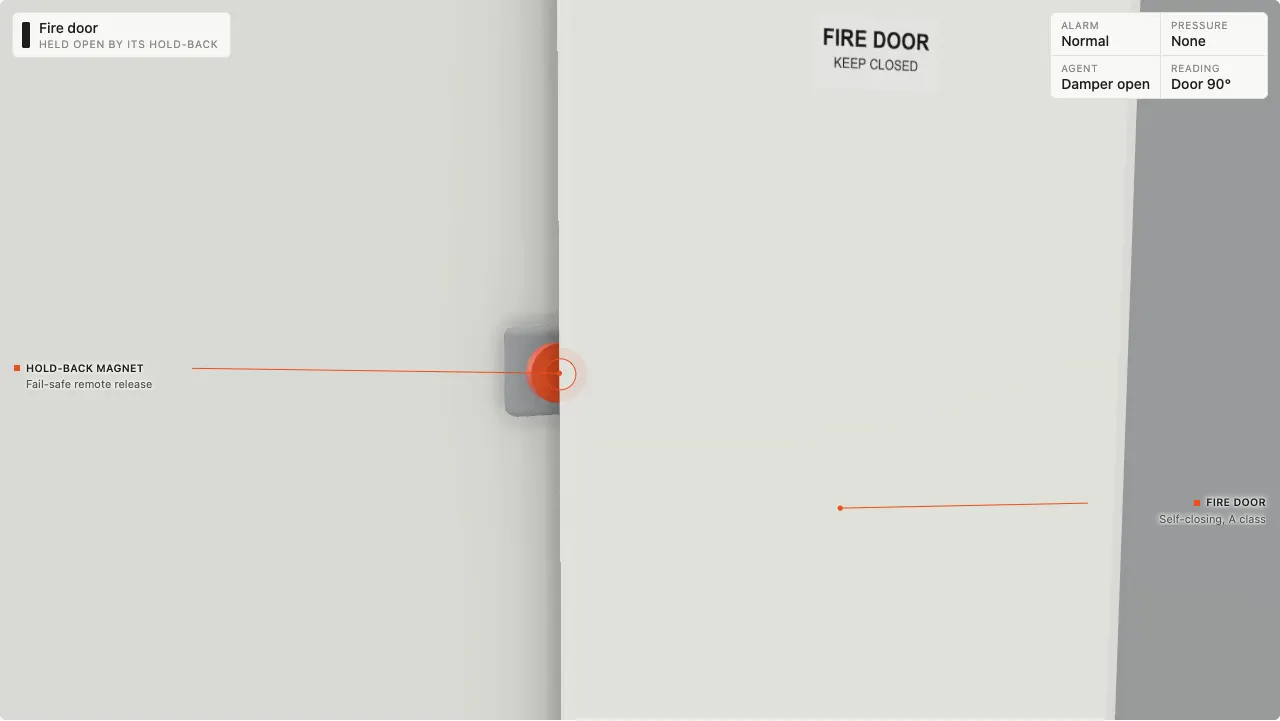
Passive fire protection does nothing visible for the whole life of a ship. Steel bulkheads with insulation, self-closing fire doors, fire dampers in ventilation ducts and sealed cable penetrations simply sit there. In a fire they decide whether the fire stays in one cabin or one engine room, or spreads through the ship. They are also the first things to be damaged without anyone noticing: a door wedged open for a breeze, a damper seized with rust, a new cable run pushed through a bulkhead and sealed with builder’s foam.
Port State control inspectors know this. In the 2023 Paris MoU annual report, fire doors (3.2% of deficiencies) were singled out as one of the specific items with a high rate of non-compliance. This lesson shows how the passive system is built and how to keep it intact.
Sign in to read the rest of this lesson
Continue reading
Save your progress, open all 115 lessons and get a Course completed card when you finish.
or use your email
In the rest of this lesson
- Try it: A port State control inspection of the passive fire protection
- In plain words
- In detail
- What the rules say
- Flag and class notes
- Key numbers
- What inspectors find
- 4 questions people ask
- Quiz: 6 questions
- Ask our engineers about this lesson
Familiarisation training from Al Safwan Academy. Finishing a course shows completion of online familiarisation training: it is not an STCW, flag-approved or manufacturer qualification, and these courses don't replace that training. The manufacturer's manual and your flag's rules always come first.