Lesson 5 · 14 min
Galley exhaust ducts and deep-fat fryer fire systems
You will know what protects a ship's galley range hood, exhaust duct and deep-fat fryers, how each part is tested, and the faults that start galley fires.
Start here
The 2-minute primer
New to this? These 6 cards explain the lesson in plain words. Go through them first and the lesson will make sense.
Primer done.
-
1/6Picture this
A chimney nobody has swept
In an old house, soot builds up inside the chimney year after year. One day a spark catches it, and the whole chimney roars like a blowtorch.
A ship’s galley has the same problem. Grease from cooking settles inside the exhaust duct above the stove. If a flame gets in, the grease burns like a fuse and can carry fire through the ship.
-
2/6The big idea
Two fire risks in one kitchen
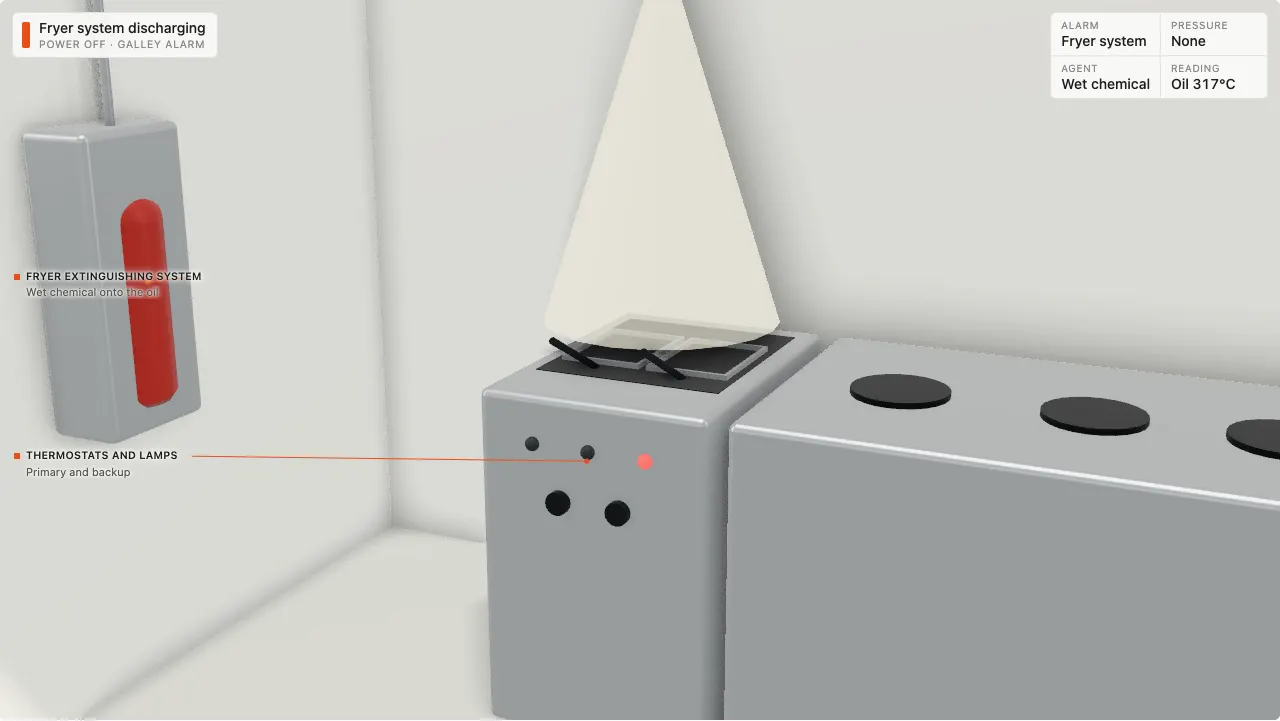
The deep-fat fryer holds a lot of very hot oil. If its heat never switches off, the oil bursts into flame, and water on it makes a fireball. So it has two thermostats and its own small fire system.
The exhaust duct has grease filters, fire flaps that slam shut, fan stops and its own fire system. Keeping all of it clean and working is the real protection.
-
3/6Words you'll meet
Five words, in plain English
- Exhaust duct
- the metal pipe that carries hot, greasy air from above the stove out of the ship.
- Grease trap
- a part of the duct that catches grease and can be taken out for cleaning.
- Fire damper
- a metal flap inside a duct that shuts to stop fire and smoke travelling along it.
- Thermostat
- the switch that cuts the heat when the oil gets hot enough. Fryers must have two.
- Wet chemical
- a fryer fire agent that turns the oil surface into a soapy crust that smothers the flame.
-
4/6Why it matters
Galley fires start with small things
Most galley fires begin with something the crew could see: a filter thick with grease, a fault light that someone reset, a release handle hidden behind trays.
A fire that escapes into the duct is much harder to put out than one in a pan. It can spread to cabins and corridors, and fighting it can take a long time.
-
5/6In this lesson
What you’ll be able to do
- Name the parts that protect a fryer and an exhaust duct.
- Know which checks happen daily, quarterly and yearly.
- Spot the faults on a galley walk round.
- Know what to do, and not do, after a fryer system fires.
-
6/6Quick check
Why is grease inside the exhaust duct dangerous?
Right: grease in the duct is fuel. A flame that gets in can burn along it like a fuse, so filters, traps and ducts are kept clean.
The basics
On the morning of 21 August 1998, the cruise ship Edinburgh Castle was on passage from Lisbon to Liverpool with 1,000 passengers and 500 crew. A fire patrol found a fire in the main galley, at a group of three deep-fat fryers. The power contactor of one fryer had welded closed, so the heating never switched off; the fat overheated and ignited. The fire spread into the ventilation ducting. It took several attempts with portable extinguishers, the automatic sprinklers and the steam smothering system in the duct, and one hour, to put it out. The galley’s fire detection loop had been shut down, and nobody could tell from the drawings or labels which damper control served which duct.
Galleys combine everything a fire needs: hot oil, grease-coated ducts that act as a chimney, and people working fast. SOLAS treats the fryer and the exhaust duct as fire hazards in their own right, each with its own fixed protection. This lesson shows what they are and how to keep them working.
Sign in to read the rest of this lesson
Continue reading
Save your progress, open all 115 lessons and get a Course completed card when you finish.
or use your email
In the rest of this lesson
- Try it: Galley walk-round on a cargo ship built in 2018
- In plain words
- In detail
- What the rules say
- Flag and class notes
- Key numbers
- What inspectors find
- 4 questions people ask
- Quiz: 6 questions
- Ask our engineers about this lesson
Familiarisation training from Al Safwan Academy. Finishing a course shows completion of online familiarisation training: it is not an STCW, flag-approved or manufacturer qualification, and these courses don't replace that training. The manufacturer's manual and your flag's rules always come first.