Lesson 3 · 16 min
Foam systems and foam concentrate analysis
You will know the foam systems on tankers, engine rooms and ro-ro decks, how foam concentrate ages, and how to sample, test and record it so it still works when needed.
Start here
The 2-minute primer
New to this? These 6 cards explain the lesson in plain words. Go through them first and the lesson will make sense.
Primer done.
-
1/6Picture this
Milk that has quietly gone off
A carton of milk at the back of the fridge can look perfectly normal. You only find out it has gone off when you pour it.
Fire-fighting foam is like that. The liquid sits in a tank for years, in heat and sun, and slowly spoils. Nothing outside the tank tells you. The only way to know is to take a sample and test it.
-
2/6The big idea
A foam blanket that must stay fresh
A little foam liquid is mixed into water, then blown full of air. The bubbles float on burning oil like a blanket and shut out the air.
Thick, wet foam is sprayed onto a tanker’s deck. Light, dry foam fills a whole engine room like bath foam fills a bath. Either way, it only works if the liquid in the tank is still good.
-
3/6Words you'll meet
Five words, in plain English
- Foam concentrate
- the liquid kept in the tank, which is mixed with water in a small amount to make foam.
- Proportioner
- the device that mixes the right small amount of concentrate into the water.
- High-expansion foam
- very light, airy foam that fills a whole room from the floor up.
- Foam analysis
- a laboratory test of a sample, to check the concentrate still makes good foam.
- PFOS
- perfluorooctane sulfonic acid, a harmful chemical in some older foams, now banned on ships.
-
4/6Why it matters
Bad foam collapses on the fire
Spoiled concentrate looks normal in the tank, but it makes weak foam that falls apart on burning oil. A tank topped up with the wrong product, or left half empty, can be ruined the same way.
The crew finds out on the worst day, with a fire on deck. Since 2026 there is a second reason to know what is in the tank: foam containing PFOS must go ashore.
-
5/6In this lesson
What you’ll be able to do
- Tell which foam systems tankers, engine rooms and car decks carry.
- Take a good sample and send it for the yearly test.
- Read a lab report and know when foam must be replaced.
- Check whether your foam falls under the PFOS ban.
-
6/6Quick check
How can you tell if the foam in the tank is still good?
Right: foam concentrate spoils without showing it, so a laboratory test of a proper sample is the only way to know.
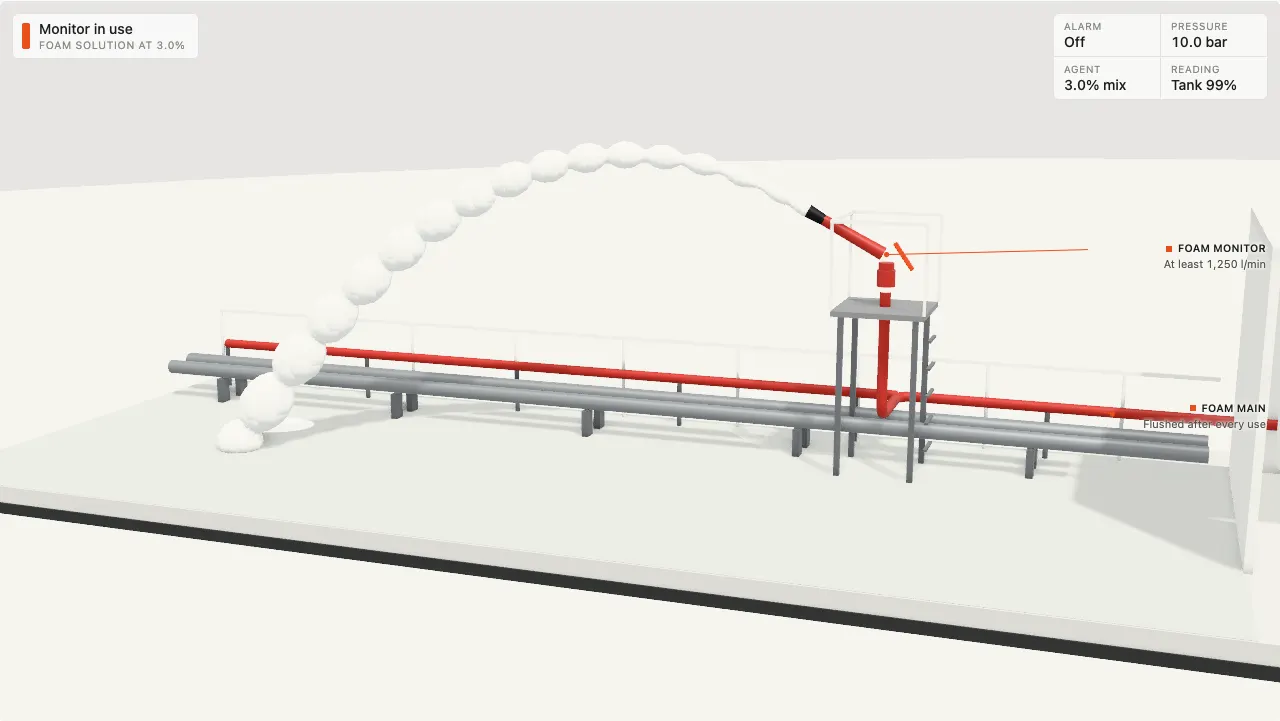
The basics
Foam concentrate is the one fire-fighting medium on board that quietly goes off. It sits in a tank for years, in a hot pump-room or on deck in the sun, and slowly separates, forms sludge or changes its chemistry. Nothing on the outside of the tank tells you. The only way to know whether the foam in your deck foam system would still make a blanket on burning crude oil is to take a sample and test it.
That is why IMO asks for a periodical laboratory analysis of foam concentrate, first within three years of supply and then every year. Since 1 January 2026 there is a second reason to know exactly what is in the tank: SOLAS now bans foam containing PFOS, a persistent and toxic chemical once common in film-forming foams.
Sign in to read the rest of this lesson
Continue reading
Save your progress, open all 115 lessons and get a Course completed card when you finish.
or use your email
In the rest of this lesson
- Try it: Foam system records and walk-round on a product tanker
- In plain words
- In detail
- What the rules say
- Flag and class notes
- Key numbers
- What inspectors find
- 4 questions people ask
- Quiz: 6 questions
- Ask our engineers about this lesson
Familiarisation training from Al Safwan Academy. Finishing a course shows completion of online familiarisation training: it is not an STCW, flag-approved or manufacturer qualification, and these courses don't replace that training. The manufacturer's manual and your flag's rules always come first.