Lesson 6 · 16 min
Fire detection and alarm systems
You will know which spaces need which detectors, how the panel, loops and power supplies must work, and how to test every detector and call point within the IMO intervals.
Start here
The 2-minute primer
New to this? These 6 cards explain the lesson in plain words. Go through them first and the lesson will make sense.
Primer done.
-
1/6Picture this
A baby monitor for the whole ship
Parents put a baby monitor in the nursery. They can be downstairs, but the moment there is a cry, the little speaker tells them, and which room it came from.
A fire detection system listens to every cabin, corridor and engine room at once. In a sleeping cabin or an empty hold at three in the morning, it is the only witness to a fire.
-
2/6The big idea
Find the fire early, and say where
Detectors sense smoke, heat or flame. Red call points let anyone raise the alarm by hand. A panel on the bridge shows where the alarm came from, and if nobody answers within two minutes, it alerts the whole crew.
Each space gets the detector that suits it. A galley full of steam needs a heat detector, not a smoke one.
-
3/6Words you'll meet
Five words, in plain English
- Smoke detector
- a sensor on the ceiling that raises the alarm when it senses smoke.
- Heat detector
- a sensor that raises the alarm when the air gets too hot, used where steam would fool a smoke detector.
- Manual call point
- the red box on the wall that anyone can press or break to raise the alarm.
- Control panel
- the screen and buzzer on the bridge that shows which detector has gone off.
- Sample extraction
- a fan that sucks air from each cargo hold through small pipes to a panel, so the crew can see which hold has smoke.
-
4/6Why it matters
Quiet failures leave rooms unguarded
Detection systems fail without fuss. A detector stays covered in plastic after painting. A section is switched off after a false alarm and never switched back on.
Then a fire grows unseen until someone happens to walk past. The earlier the alarm, the smaller the fire the crew has to fight.
-
5/6In this lesson
What you’ll be able to do
- Match each space with the right kind of detector.
- Know how the panel must react to an alarm or a fault.
- Test every detector and call point within the set time.
- Spot switched-off, covered or blocked detectors.
-
6/6Quick check
Why does a galley often use heat detectors instead of smoke detectors?
Right: where cooking makes steam and fumes, the rules allow heat detectors so the alarm is not constantly false.
The basics
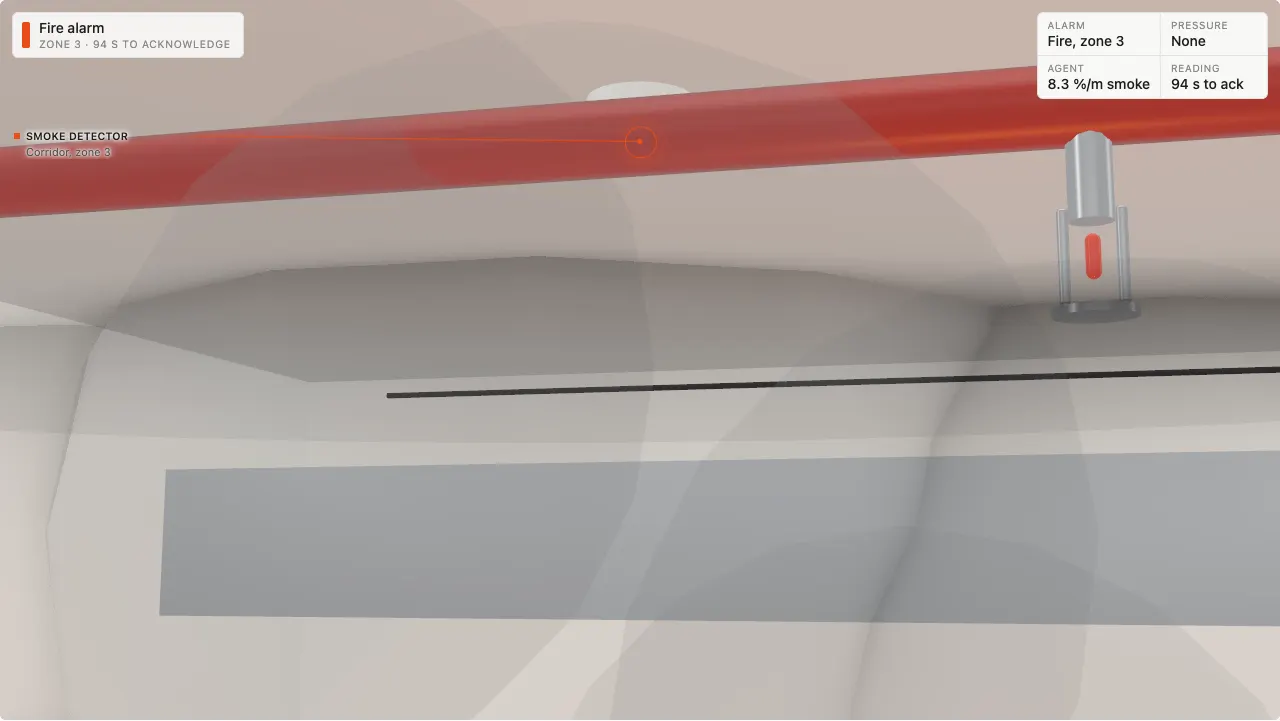
Every fixed system in this course depends on someone knowing there is a fire. In a manned engine room or a busy galley, people may see it. In a cabin at 3 a.m., an unattended engine room, a container hold or a cable trunk, the fire detection system is the only witness. The sooner it raises the alarm, the smaller the fire the crew has to fight.
Detection systems also fail in quiet ways: a detector covered with a plastic bag during painting, a loop isolated after a false alarm and never restored, a smoke detector in a galley that keeps going off. On the cruise ship Edinburgh Castle in 1998, the galley’s detection loop had been isolated after a fault, and the fire was found by a patrol. This lesson covers where detectors go, how the system must behave, and how to test it.
Sign in to read the rest of this lesson
Continue reading
Save your progress, open all 115 lessons and get a Course completed card when you finish.
or use your email
In the rest of this lesson
- Try it: Which detection fits the space?
- In plain words
- In detail
- What the rules say
- Flag and class notes
- Key numbers
- What inspectors find
- 4 questions people ask
- Quiz: 6 questions
- Ask our engineers about this lesson
Familiarisation training from Al Safwan Academy. Finishing a course shows completion of online familiarisation training: it is not an STCW, flag-approved or manufacturer qualification, and these courses don't replace that training. The manufacturer's manual and your flag's rules always come first.