Lesson 4 · 17 min
Water mist, sprinklers and water spray systems
You will know how water-based fire systems on ships are built and approved, and how to run the weekly to ten-yearly tests, including when failed sprinkler heads mean replacing a whole batch.
Start here
The 2-minute primer
New to this? These 6 cards explain the lesson in plain words. Go through them first and the lesson will make sense.
Primer done.
-
1/6Picture this
A garden hose left all winter
Leave a garden hose in the shed all winter, still full of water. In spring you turn on the tap and get a trickle. The water went stale, and dirt clogged the nozzle.
A sprinkler head can sit over a cabin bed for twenty years, full of still water. On the day of a fire it must open and spray properly first time.
-
2/6The big idea
Three ways to fight fire with water
Sprinklers guard cabins and corridors. Each head opens on its own when a little glass bulb bursts in the heat. Water mist sprays tiny droplets that soak up heat and push oxygen away, and it is safe for people in an engine room. Water spray opens every nozzle in a section at once, for big car decks.
All three use water kept in pipes, so all three need regular testing.
-
3/6Words you'll meet
Five words, in plain English
- Sprinkler head
- a small valve held shut by a glass bulb that bursts and lets water out when it gets hot.
- Section
- one group of sprinkler heads with its own valve and alarm.
- Water mist
- very fine water droplets that cool a fire fast while using little water.
- Local application system
- a water system aimed at engine hot spots that works without stopping the engines.
- Function test
- taking real heads off and checking that they open and let water flow.
-
4/6Why it matters
Clogged heads stay shut
Rust, scale and slime build up inside the pipes. A head that is corroded inside, painted over or blocked by a new ceiling may not open, or may spray the wrong way.
The first anyone knows is when a fire grows in a cabin that was meant to be protected. That is why heads are sampled and tested every year, and the water itself is checked.
-
5/6In this lesson
What you’ll be able to do
- Tell sprinklers, water mist and water spray apart, and where each is used.
- Know the weekly to ten-yearly checks.
- Pick how many sprinkler heads to test, and when failures mean replacing many.
- Spot painted, damaged or blocked heads on a walk round.
-
6/6Quick check
How does a single sprinkler head know when to open?
Right: each head has its own glass bulb that bursts at a set temperature, so only the heads over the fire spray.
The basics
A sprinkler head is a small valve held shut by a glass bulb. It may hang over a cabin bed for twenty years, wet on the inside with stagnant water and exposed on the outside to steam, paint and cleaning sprays. On the day of a fire it has to open at the right temperature and spray the right pattern. Sprinkler heads that are corroded or clogged from the inside do not, and on ships that problem became serious enough for IMO to write a special testing procedure.
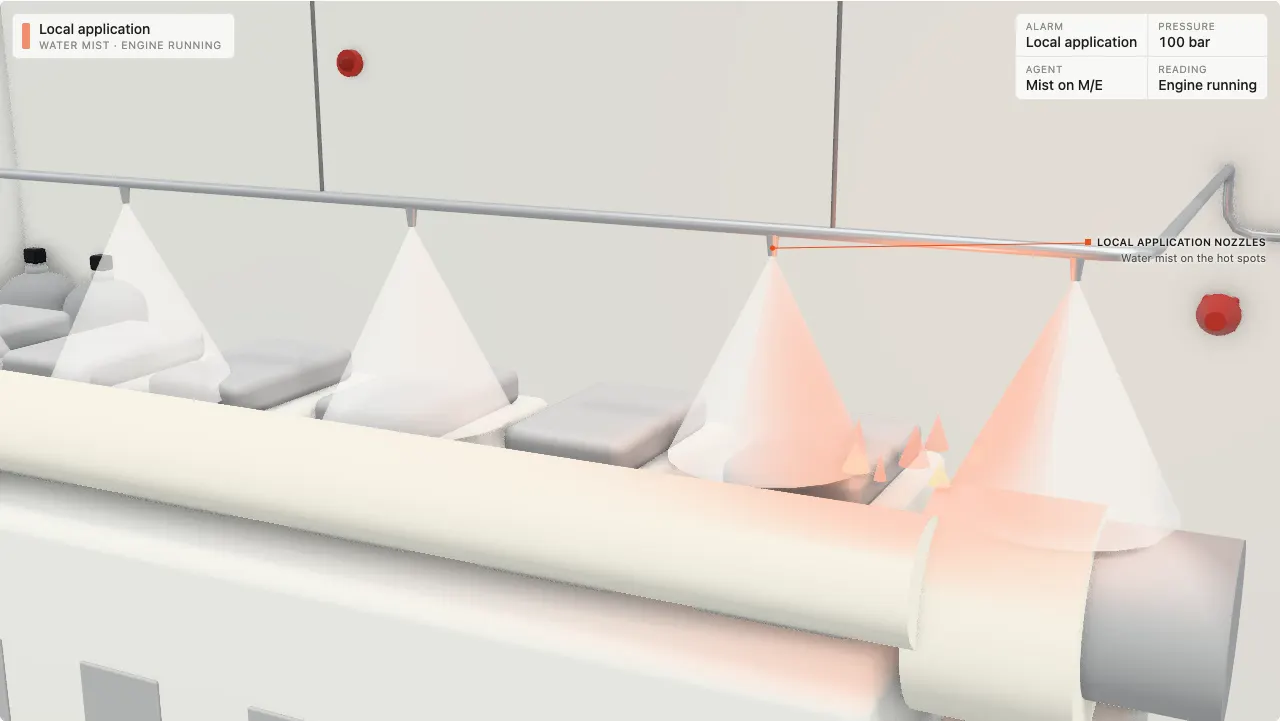
Water mist systems are now common in engine rooms, both as the main fixed system and as the local application system that sprays the hot spots on diesel engines and purifiers without stopping them. Ro-ro and car decks rely on large water spray (drencher) systems. This lesson covers all three: how they are built, how they are approved, and how they are tested.
Sign in to read the rest of this lesson
Continue reading
Save your progress, open all 115 lessons and get a Course completed card when you finish.
or use your email
In the rest of this lesson
- Try it: The annual sprinkler test on a seven-year-old cruise ferry
- In plain words
- In detail
- What the rules say
- Flag and class notes
- Key numbers
- What inspectors find
- 4 questions people ask
- Quiz: 6 questions
- Ask our engineers about this lesson
Familiarisation training from Al Safwan Academy. Finishing a course shows completion of online familiarisation training: it is not an STCW, flag-approved or manufacturer qualification, and these courses don't replace that training. The manufacturer's manual and your flag's rules always come first.