Lesson 2 · 15 min
Anatomy of a lifeboat, davit, winch and release gear
You will be able to trace the load path from davit to hook and name what each part must do under the LSA Code, and how each part fails.
Start here
The 2-minute primer
New to this? These 6 cards explain the lesson in plain words. Go through them first and the lesson will make sense.
Primer done.
-
1/6Picture this
A bucket on a well rope
Think of an old well. A wooden beam sticks out over the hole, a rope runs over a wheel, a crank winds it in, and a hook holds the bucket.
A lifeboat hangs in much the same way: davit, wires, winch and hooks. Like any chain, it is only as strong as its weakest link.
-
2/6The big idea
The chain from ship to sea
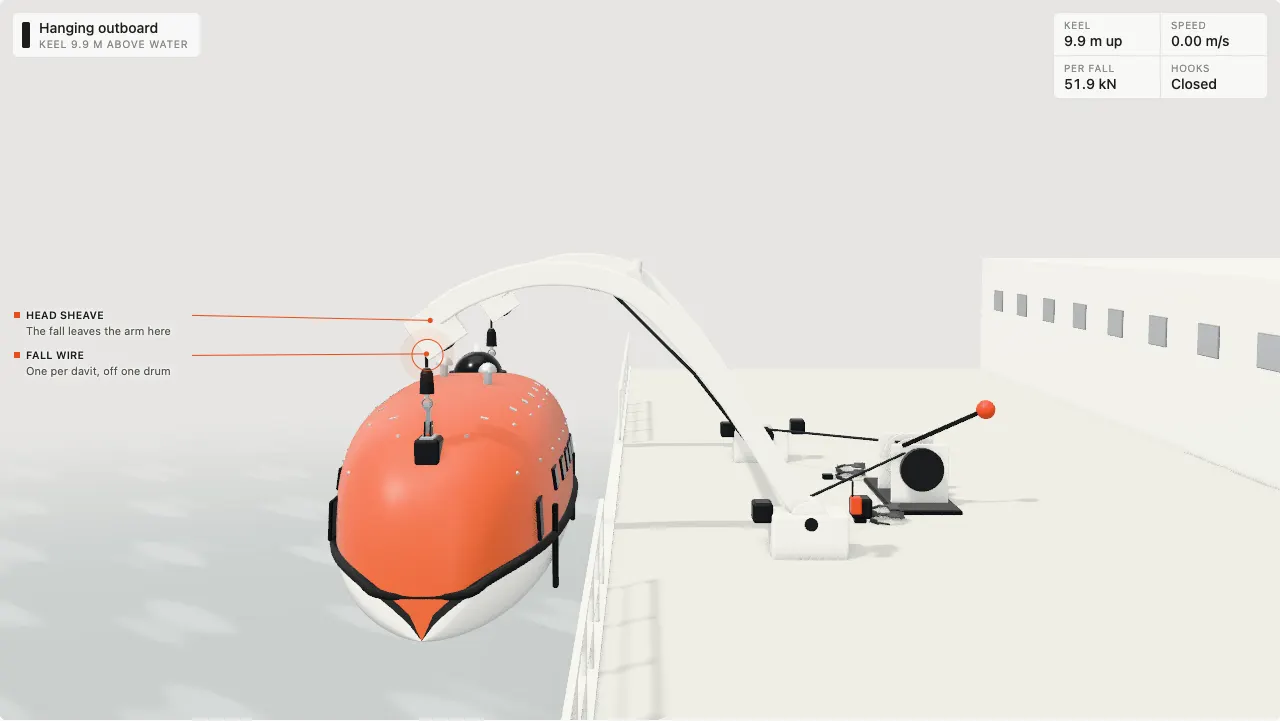
The davit swings the boat out. The falls run from the winch over wheels at the davit head down to the hooks. The winch brake stays on unless someone holds it off. The hooks join the wires to the boat and open when it floats.
If any link fails with people inside, the boat falls. So every link has a safety margin, a test and an inspection date.
-
3/6Words you'll meet
Six words, in plain English
- Falls
- the steel wire ropes the lifeboat hangs from.
- Sheave
- a grooved wheel at the davit head that the wire runs over.
- Winch brake
- the brake that holds the wire; it stays on unless someone holds the lever off.
- On-load release
- opening the hooks while the boat’s weight still hangs on them, for emergencies only.
- Hydrostatic interlock
- a safety device that blocks on-load release until the boat is really in the water.
- Safety factor
- how many times stronger a part is built than the load it normally carries.
-
4/6Why it matters
Hidden faults drop boats
In 2013, during a drill, a lifeboat’s wire parted while it was being hoisted with eight crew on board. The boat fell about 20 metres and five crew died. The wire had corroded inside, where it looked dry.
Knowing each part, and how it usually fails, is how you catch a fault like that in time.
-
5/6In this lesson
What you’ll be able to do
- Trace the load from the davit down to the hook.
- Name what each part must do under the design rules.
- Spot how each part typically fails.
- Tell off-load release from on-load release.
-
6/6Quick check
Why does the winch brake stay on unless someone holds it off?
Right: it is a “dead man” safeguard. If the operator lets go of the lever, the brake comes back on and holds the boat.
The basics
A lifeboat hanging from its davit is one chain of parts, and it is only as strong as its weakest link. On 10 February 2013, during a drill alongside in Santa Cruz de La Palma, the forward fall wire of lifeboat No. 9 on the passenger ship Thomson Majesty parted while the boat was being hoisted with eight crew on board. The boat swung on its aft hook, that end failed too, and the boat fell about 20 m. Five crew died. Malta’s investigators found that the wire had parted at a site of corrosion inside the rope, where it looked dry and ungreased.
Nothing in that boat was exotic. A wire, a sheave, a hook. To inspect or service a lifeboat system you need a clear picture of every link in the load path, what the LSA Code demands of it, and how it typically fails. Click each numbered part below.
Sign in to read the rest of this lesson
Continue reading
Save your progress, open all 115 lessons and get a Course completed card when you finish.
or use your email
In the rest of this lesson
- Try it: A davit-launched lifeboat and its launching appliance
- In plain words
- In detail
- What the rules say
- Flag and class notes
- Key numbers
- What inspectors find
- Work it out: a calculator
- 3 questions people ask
- Quiz: 6 questions
- Ask our engineers about this lesson
Familiarisation training from Al Safwan Academy. Finishing a course shows completion of online familiarisation training: it is not an STCW, flag-approved or manufacturer qualification, and these courses don't replace that training. The manufacturer's manual and your flag's rules always come first.