Lesson 9 · 14 min
Flag, class and port State control: what inspectors look for
You will know how each inspector looks at your lifeboats, which deficiencies lead to detention and how to prepare the ship and its records.
Start here
The 2-minute primer
New to this? These 6 cards explain the lesson in plain words. Go through them first and the lesson will make sense.
Primer done.
-
1/6Picture this
Three checks on one passport
Your home country issues your passport and sets the rules for it. The airline checks it at check-in. Then the border officer where you land checks it all again.
A lifeboat gets three similar checks: from the flag, from the class society, and from the port state officer in the country the ship is visiting.
-
2/6The big idea
Same boat, three different questions
The flag decides who may service the lifeboat. The class society, surveying for the flag, checks once a year that it was serviced and works. The port state officer checks that it would work today, with this crew.
Prepare for all three the same way: working equipment, honest records, and a crew that knows its boat.
-
3/6Words you'll meet
Five words, in plain English
- Flag
- the country where the ship is registered; it writes the national rules.
- Class society
- a private organisation that surveys ships on the flag’s behalf.
- Port State Control (PSC)
- the inspection of a ship by the country whose port it is visiting.
- Detainable deficiency
- a fault serious enough for the ship to be held in port until it is fixed.
- Signs of disuse
- clues that a boat is never used, such as overpainted pivots or dry wires.
-
4/6Why it matters
Lifeboats get tested in front of the crew
A port inspector can ask for a boat to be lowered, an engine started or a drill run. In 2025, lifeboats were the third most common reason for holding ships in Asia-Pacific ports.
A seized davit, an engine that won’t start, or a boat leader who can’t explain the hooks shows up in minutes.
-
5/6In this lesson
What you’ll be able to do
- Know what the flag decides about lifeboat service.
- Know what the class surveyor checks each year.
- See how a port inspector looks at the boat station.
- Prepare the ship, the records and the crew for all three.
-
6/6Quick check
What does the port state officer want to know about a lifeboat?
Right: the port state officer checks that the boat would work today, with this crew, which is why they may ask for a drill.
The basics
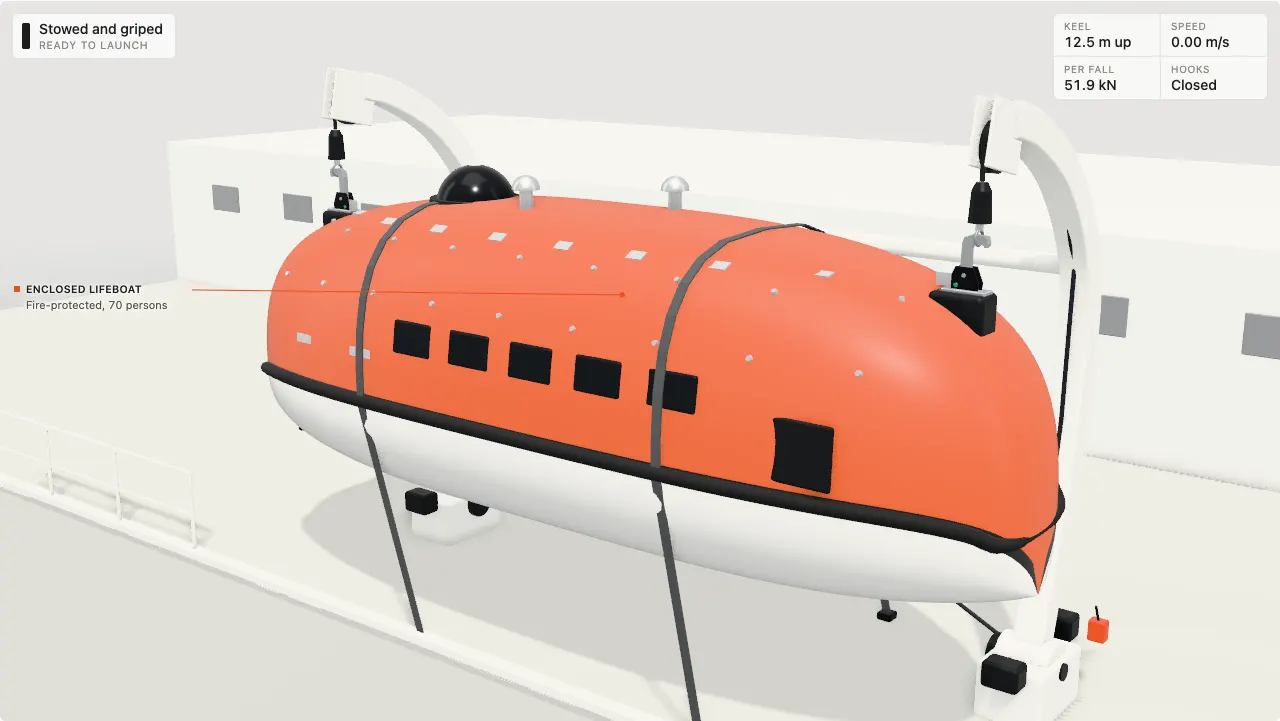
Lifeboats are one of the few items on a ship that a port State control officer can test in front of the crew: ask for a boat to be lowered, an engine started, a drill run. And they are among the items most often found wanting. In 2025, member Authorities of the Tokyo MOU carried out 35,546 inspections and recorded 11,818 life-saving appliance deficiencies, 13% of everything they found. Lifeboats were the third most frequent reason for detention, with 152 detainable deficiencies, up from 136 the year before.
Three kinds of inspector look at the same lifeboat with different questions. The flag decides who may service it. The class society, surveying on the flag’s behalf, checks that it was serviced and works. The port State officer checks that it would work today, with this crew. This lesson shows what each of them looks for.
Sign in to read the rest of this lesson
Continue reading
Save your progress, open all 115 lessons and get a Course completed card when you finish.
or use your email
In the rest of this lesson
- Try it: Port State control walk-round: bulk carrier, starboard lifeboat
- In plain words
- In detail
- What the rules say
- Flag and class notes
- Key numbers
- What inspectors find
- 4 questions people ask
- Quiz: 6 questions
- Ask our engineers about this lesson
Familiarisation training from Al Safwan Academy. Finishing a course shows completion of online familiarisation training: it is not an STCW, flag-approved or manufacturer qualification, and these courses don't replace that training. The manufacturer's manual and your flag's rules always come first.