Lesson 5 · 15 min
The five-yearly overhaul and 1.1 load tests
You will be able to plan the five-yearly overhaul and load test, work out the test load and spot unsafe test methods.
Start here
The 2-minute primer
New to this? These 6 cards explain the lesson in plain words. Go through them first and the lesson will make sense.
Primer done.
-
1/6Picture this
Testing a shelf with extra weight
Before trusting a new shelf, you might hang a little more on it than you ever plan to, and stand well back while you do.
Every five years, a lifeboat system gets that treatment. It is loaded beyond its normal full weight and tested, so that if something is going to break, it breaks with nobody inside.
-
2/6The big idea
Take it apart, then test at 1.1 times
At least once every five years, a certified technician takes the hook units apart, measures the parts, checks them for cracks and rebuilds them.
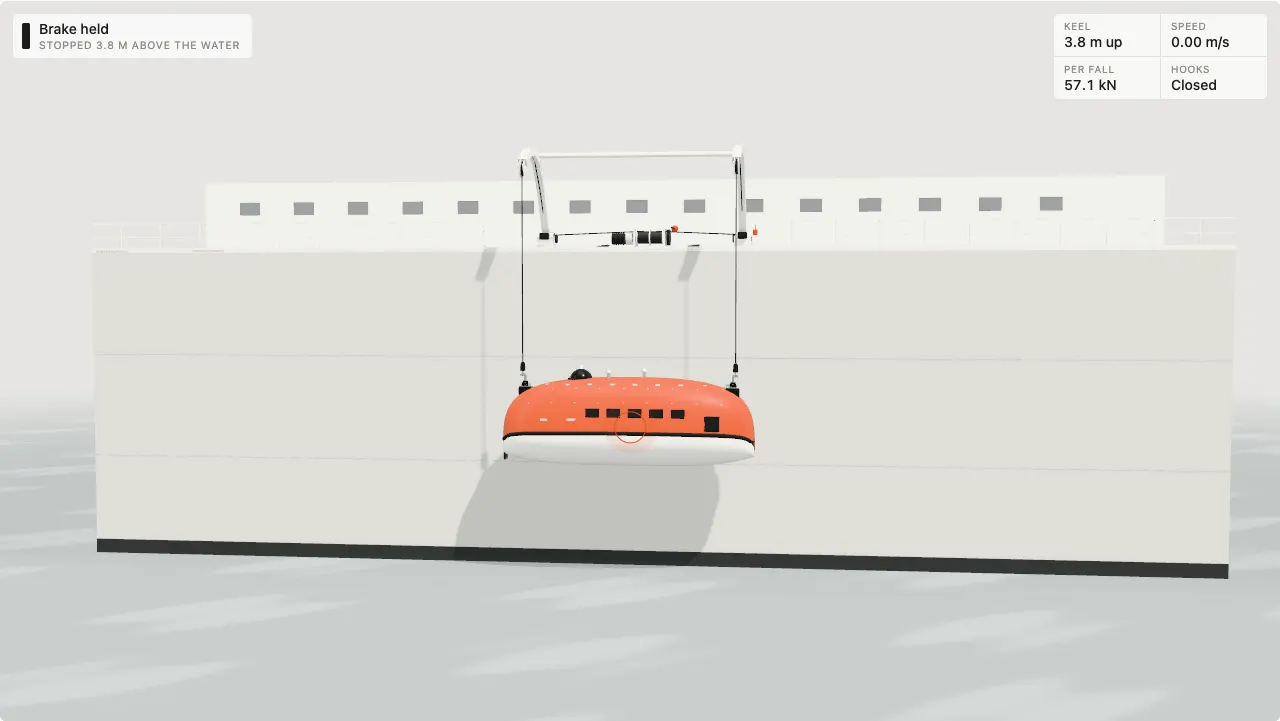
Then the system is tested with 1.1 times the weight of the fully loaded boat: the boat, its full number of people and its equipment. The winch brake is tested the same way, at full lowering speed.
-
3/6Words you'll meet
Five words, in plain English
- Overhaul
- taking equipment apart, checking every part against the maker’s limits, and putting it back together.
- Proof load
- the test weight, here 1.1 times the fully loaded boat.
- Fully loaded mass
- the boat plus its equipment plus every person it is approved to carry.
- Water bags
- large bags filled with water, used as test weights inside the boat.
- Weight growth
- a boat getting heavier over the years, for example when water soaks into its foam.
-
4/6Why it matters
Loading a hanging boat is risky work
Loading tonnes of test weight into a boat hanging over the side, then lowering it at full speed, is one of the most hazardous jobs on a ship.
A test load worked out from the wrong weight proves nothing. And UK guidance is clear: once the boat holds 70% of its test load, nobody climbs back in.
-
5/6In this lesson
What you’ll be able to do
- Know what the five-yearly work includes.
- Work out the test load from the boat’s papers.
- Follow a safe loading and testing sequence.
- Spot unsafe test methods before they hurt anyone.
-
6/6Quick check
The test load is 1.1 times what?
Right: the test load is 1.1 times the fully loaded boat, so it covers the boat, everyone it can carry and its equipment.
The basics
Every five years the whole system is pushed beyond its normal working load. The release gear is taken apart, measured and rebuilt, then tested with 1.1 times the weight of the fully loaded boat. The winch brake is tested the same way: a boat loaded to 110% of its full weight, lowered at full speed and stopped sharply. If something is going to break, the test is designed to make it break with nobody inside.
That only works if the test is planned. Loading tonnes of water bags or weights into a boat hanging over the side, then dropping it at full speed, is one of the most hazardous jobs on a ship. The UK flag’s guidance is blunt: once the boat reaches 70% of its test load, nobody enters it again.
Sign in to read the rest of this lesson
Continue reading
Save your progress, open all 115 lessons and get a Course completed card when you finish.
or use your email
In the rest of this lesson
- Try it: When is the five-yearly overhaul and load test due?
- In plain words
- In detail
- What the rules say
- Flag and class notes
- Key numbers
- What inspectors find
- Work it out: a calculator
- 3 questions people ask
- Quiz: 6 questions
- Ask our engineers about this lesson
Familiarisation training from Al Safwan Academy. Finishing a course shows completion of online familiarisation training: it is not an STCW, flag-approved or manufacturer qualification, and these courses don't replace that training. The manufacturer's manual and your flag's rules always come first.