Lesson 4 · 15 min
The annual thorough examination of lifeboats, davits and release gear
You will know what an authorised technician must examine and test each year, in which order, and what the ship must receive afterwards.
Start here
The 2-minute primer
New to this? These 6 cards explain the lesson in plain words. Go through them first and the lesson will make sense.
Primer done.
-
1/6Picture this
A yearly check-up at the doctor
At a yearly health check, the doctor reads your notes, examines you, runs a few tests, then signs a letter saying you’re fit.
The lifeboat’s yearly thorough examination follows the same steps. A certified technician reads the crew’s records, examines the boat, davit and hooks, tests them, and signs a statement at the end.
-
2/6The big idea
Look, examine, test, sign
First the records: the crew’s weekly and monthly checklists. Then the hardware: boat, engine, davit, winch, wires and release gear.
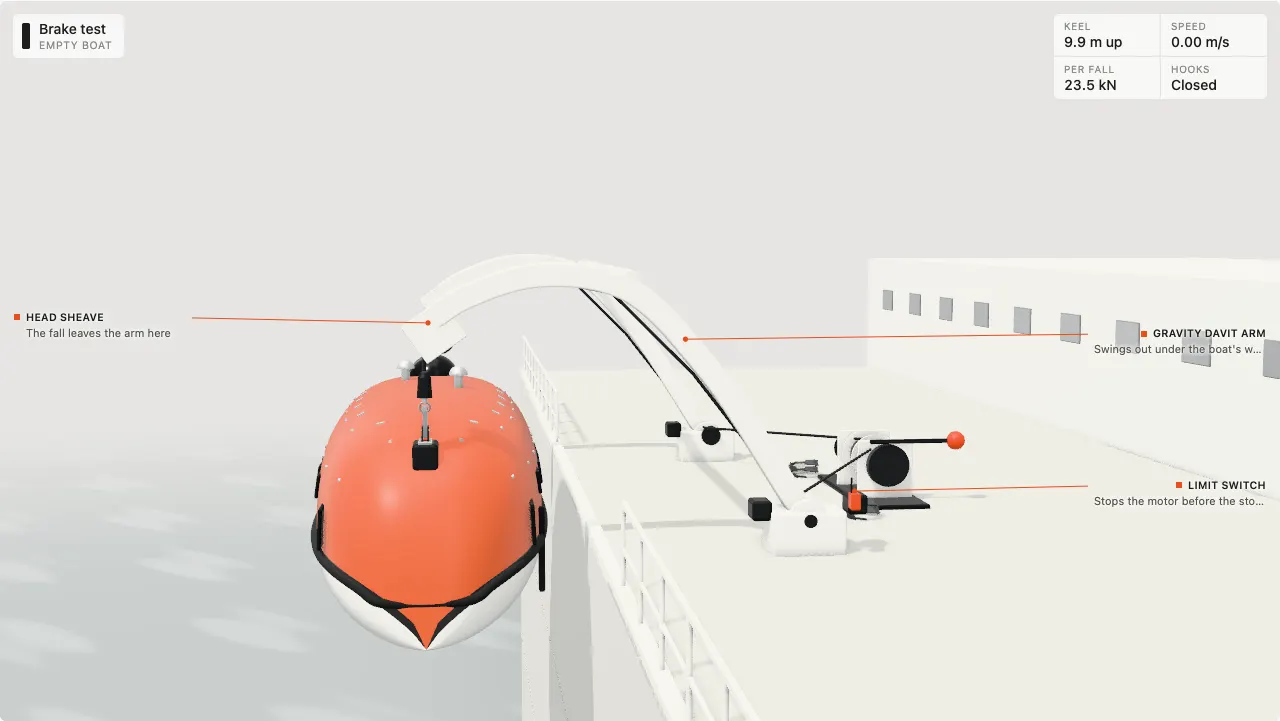
Then the tests. The winch brake is tested by lowering the empty boat and stopping it sharply. The hooks are tested with the boat partly in the water, then fully afloat. Order matters: brake test first, then examine the release gear.
-
3/6Words you'll meet
Five words, in plain English
- Thorough examination
- a close, hands-on inspection of every part by a certified technician.
- Dynamic brake test
- lowering the boat at full speed, then braking hard to prove the brake holds.
- Off-load release
- opening the hooks once the boat floats and the wires are slack.
- Statement of fitness
- the signed note saying the lifeboat arrangements remain fit for purpose.
- Certified technician
- a person trained and approved for that make and type of equipment.
-
4/6Why it matters
The test itself can be the hazard
The brake test is a sudden stop of a moving boat. The hook test is done with most of the boat’s weight still on the wires.
Done in the wrong order, or by someone not certified for that make, the examination itself can hurt people. And a statement without the right papers attached won’t satisfy the surveyor.
-
5/6In this lesson
What you’ll be able to do
- Know who may do the yearly exam, and when.
- Walk through what is examined on the boat, davit and hooks.
- Run the brake and release tests in the right order.
- Check the paperwork before the technician leaves.
-
6/6Quick check
What load is used for the yearly winch brake test?
Right: the yearly brake test uses the empty boat, or an equal weight. Heavier test loads belong to the five-yearly work.
The basics
Once a year a certified technician comes on board and does what the crew may not: a thorough examination of the boats, the release gear and the launching appliances, and operational tests that prove they work. On most ships this is the only time anyone looks closely at the hook cams, the brake linings and the davit structure with the authority to declare them fit, or not.
It is also where a lot can go wrong. The annual test of the on-load release is done with the boat hanging partly in the water, and the winch brake test is an abrupt stop of a boat at full lowering speed. Done in the wrong order, or by someone not certified for that make, the examination itself becomes the hazard. This lesson walks through MSC.402(96) section 6.2 as a technician or a supervising officer would.
Sign in to read the rest of this lesson
Continue reading
Save your progress, open all 115 lessons and get a Course completed card when you finish.
or use your email
In the rest of this lesson
- Try it: Where the annual examination sits in the lifeboat cycle
- In plain words
- In detail
- What the rules say
- Flag and class notes
- Key numbers
- What inspectors find
- 4 questions people ask
- Quiz: 6 questions
- Ask our engineers about this lesson
Familiarisation training from Al Safwan Academy. Finishing a course shows completion of online familiarisation training: it is not an STCW, flag-approved or manufacturer qualification, and these courses don't replace that training. The manufacturer's manual and your flag's rules always come first.