Lesson 7 · 15 min
Free-fall lifeboats, rescue boats and fast rescue boats
You will know the special design, test and drill rules for free-fall lifeboats, rescue boats and fast rescue boats, including the changes adopted in 2026.
Start here
The 2-minute primer
New to this? These 6 cards explain the lesson in plain words. Go through them first and the lesson will make sense.
Primer done.
-
1/6Picture this
A water slide and a lifeguard’s boat
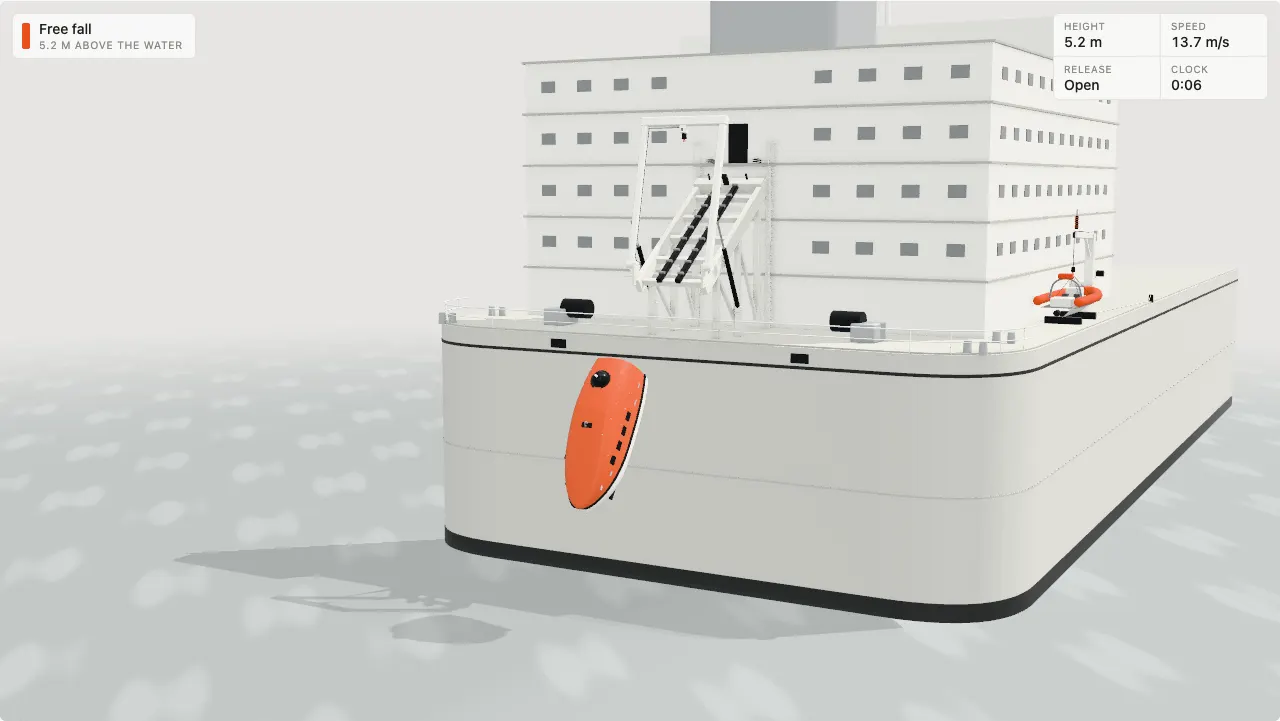
A free-fall lifeboat is like a water slide. Everyone sits strapped in, the boat slides down a ramp and splashes into the sea. No wires to lower, no hooks to open.
A rescue boat is more like the lifeguard’s little boat: small, quick, and launched often to pull someone out of the water.
-
2/6The big idea
Three craft, three sets of rules
Free-fall boats sit on a sloping ramp at the back of the ship. The release must hold the boat in any weather, yet open instantly. It can be tested without letting the boat go.
Rescue boats recover people and tow liferafts. Fast rescue boats go at 20 knots or more, with launching gear built to cope with waves.
-
3/6Words you'll meet
Five words, in plain English
- Free-fall lifeboat
- a lifeboat that slides off a ramp and drops straight into the sea.
- Certification height
- the highest drop the free-fall boat is approved for.
- Simulated launching
- a practice launch, done the way IMO guidelines describe, without the boat actually dropping.
- Secondary means of launching
- a davit or crane with wires, for lowering the free-fall boat gently and recovering it.
- Fast rescue boat
- a small, very fast rescue boat that rights itself, or is easily righted, after a capsize.
-
4/6Why it matters
Each type hurts crews differently
A real free-fall launch is a hard drop, and the people inside take a real impact. Recovering boats from the water is a high-risk job too, especially in waves.
Knowing which rule belongs to which craft stops crews using the wrong test, or the wrong drill, on the wrong boat.
-
5/6In this lesson
What you’ll be able to do
- Tell free-fall, rescue and fast rescue boats apart.
- Know how a free-fall release is tested without launching.
- Plan free-fall and rescue boat drills at the right intervals.
- Know what the 2026 rule changes mean for future free-fall boats.
-
6/6Quick check
How can a free-fall release be tested without dropping the boat?
Right: the maker’s test arrangement holds the boat while the release is operated, then it is removed so the boat is ready to launch.
The basics
A free-fall lifeboat leaves the ship in one movement: the crew straps in, the release is operated from inside, and the boat slides down its ramp and drops into the sea. There are no falls to foul and no hooks to open under load. But the release must hold several tonnes on a sloping ramp in any weather, and open instantly when asked, and the people inside take a real impact on every launch. Testing that release without actually dropping the boat is the problem the IMO was still solving in May 2026.
Rescue boats are the opposite: small, fast and launched often, to recover a person overboard or marshal liferafts. Fast rescue boats go further, at 20 knots or more in a seaway, with launching gear designed to cope with waves slamming the boat as it comes back up the ship’s side. Each type has its own rules, and its own ways to hurt crews.
Sign in to read the rest of this lesson
Continue reading
Save your progress, open all 115 lessons and get a Course completed card when you finish.
or use your email
In the rest of this lesson
- Try it: Which craft does this rule belong to?
- In plain words
- In detail
- What the rules say
- Flag and class notes
- Key numbers
- What inspectors find
- 3 questions people ask
- Quiz: 6 questions
- Ask our engineers about this lesson
Familiarisation training from Al Safwan Academy. Finishing a course shows completion of online familiarisation training: it is not an STCW, flag-approved or manufacturer qualification, and these courses don't replace that training. The manufacturer's manual and your flag's rules always come first.