Lesson 6 · 15 min
On-load release hooks and the hook rule
You will be able to judge whether a lifeboat's release and retrieval system meets the hook rule and handle hooks safely in service.
Start here
The 2-minute primer
New to this? These 6 cards explain the lesson in plain words. Go through them first and the lesson will make sense.
Primer done.
-
1/6Picture this
A seat belt that must click fully home
A seat belt buckle must hold firm in a crash, yet open the moment you press the button. If it is only half clicked in, a jolt can pop it open.
Lifeboat hooks have the same two jobs. Hold the boat completely reliably while it hangs. Open on purpose, even under weight, when the crew needs them to.
-
2/6The big idea
A hook that can’t open by itself
Older hooks relied on a perfect reset. When the reset was incomplete, the boat’s own weight could push the hook open.
The “hook rule” fixed this. A new design standard says a fully reset hook must stay shut under any load until someone deliberately opens it. Ships had to replace hooks that failed it, by 1 July 2019 at the latest.
-
3/6Words you'll meet
Five words, in plain English
- On-load release hook
- a hook that can be opened even while the boat’s weight hangs on it.
- Hook rule
- the international rule, adopted in 2011, that forced unsafe older hooks off ships.
- Reset indicator
- a mark or pointer showing whether the hook is fully closed and locked.
- Fall preventer device (FPD)
- a pin or strap that catches the boat if a hook opens by accident.
- Factual statement
- the paper proving a ship’s hooks passed their one-time check under the hook rule.
-
4/6Why it matters
Hooks caused most of the deaths
In a ten-year UK review, hook failures caused 7 of the 12 lifeboat deaths. Crews often did not understand how their hooks worked.
Sometimes only one hook opened and the boat dropped. The deadline has passed, but surveyors still check the hook papers, and a hook that isn’t fully reset is still dangerous.
-
5/6In this lesson
What you’ll be able to do
- Explain why older hooks opened by themselves.
- Know the key design rules a safe hook must meet.
- Keep the papers that prove your hooks comply.
- Use fall preventer devices and handle hooks safely.
-
6/6Quick check
What made the older hooks open by themselves?
Right: when the reset was incomplete, the boat’s own weight could drive the hook open. The new design rule stops that.
The basics
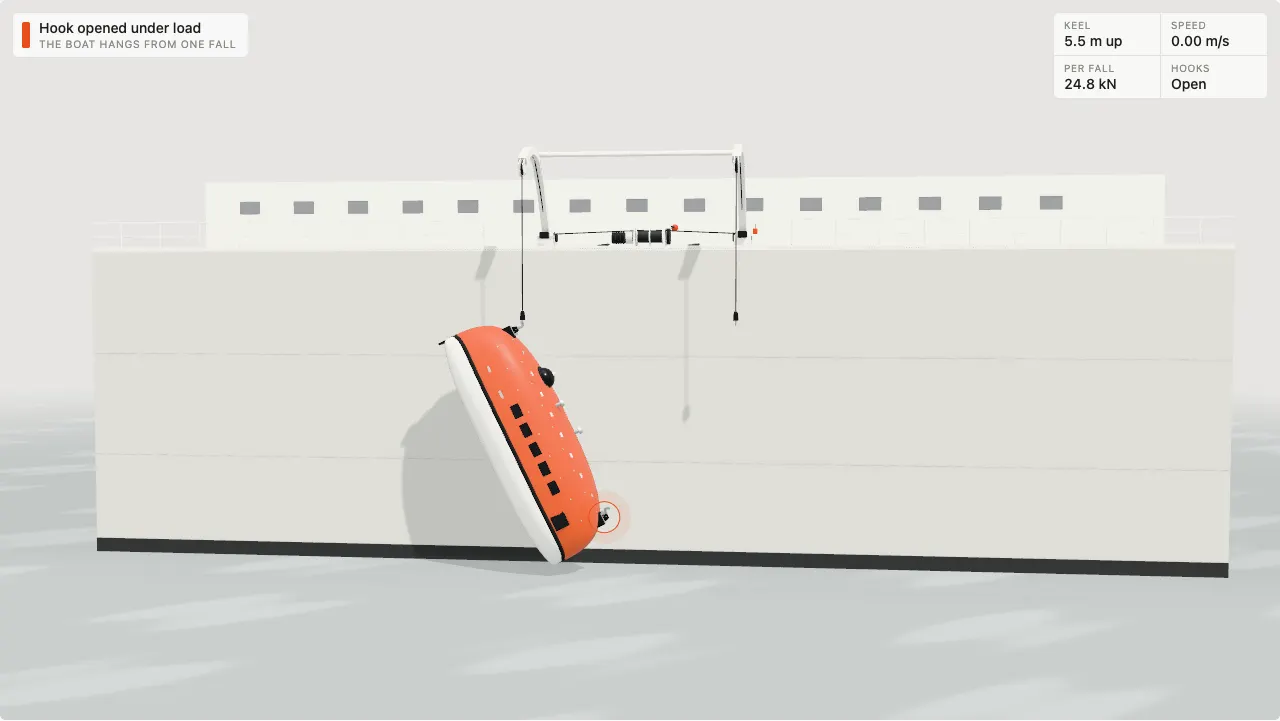
For years, the most dangerous part of a lifeboat was the device meant to set it free. In the MAIB’s ten-year review, hook failures caused 7 of the 12 lifeboat deaths on UK ships. The investigators described the pattern: on-load hooks had become over-complicated, crews often did not understand how they worked, and once a hook was not fully reset, the weight of the boat itself could drive it open. Sometimes only one hook opened; the attachment at the other end was often torn away, and the boat dropped into the water, sometimes upside down.
The IMO’s answer, adopted in 2011, was the hook rule: a new design standard for release mechanisms and a deadline by which every non-compliant hook on every ship had to be replaced. The deadline passed on 1 July 2019, but the rule still shapes every inspection of release gear today.
Sign in to read the rest of this lesson
Continue reading
Save your progress, open all 115 lessons and get a Course completed card when you finish.
or use your email
In the rest of this lesson
- Try it: A release gear question during your first week as chief officer
- In plain words
- In detail
- What the rules say
- Flag and class notes
- Key numbers
- What inspectors find
- 4 questions people ask
- Quiz: 6 questions
- Ask our engineers about this lesson
Familiarisation training from Al Safwan Academy. Finishing a course shows completion of online familiarisation training: it is not an STCW, flag-approved or manufacturer qualification, and these courses don't replace that training. The manufacturer's manual and your flag's rules always come first.