Lesson 9 · 14 min
Anchors, chain cable and windlass – design limits, surveys and wear
You will understand the design limits of anchors, chain and windlasses, what a surveyor checks when the cable is ranged, and how to avoid losing an anchor.
Start here
The 2-minute primer
New to this? These 6 cards explain the lesson in plain words. Go through them first and the lesson will make sense.
Primer done.
-
1/6Picture this
A handbrake, not a tow rope
A car’s handbrake holds the car still on a gentle slope. It was never meant to stop a car rolling fast down a steep hill.
A ship’s anchor is like that handbrake. It holds the ship while it waits in calm, sheltered water. Ask it to hold the ship off an open coast in a gale and it can drag, break or be lost.
-
2/6The big idea
Know the limits, keep it in shape
Every ship carries anchors and chain sized to the ship. The windlass, a powerful winch at the bow, lifts them. Its brake and a separate chain stopper hold the chain.
Three things keep it safe. Use it only as designed. Look after the brake and stopper. Have the chain laid out and checked at the big class surveys.
-
3/6Words you'll meet
Six words, in plain English
- Windlass
- the heavy winch at the front of the ship that raises and lowers the anchor chain.
- Gypsy
- the toothed wheel on the windlass that grips each chain link, also called the cable lifter.
- Chain stopper
- a separate clamp on deck that holds the chain so the brake doesn’t have to.
- Hawse pipe
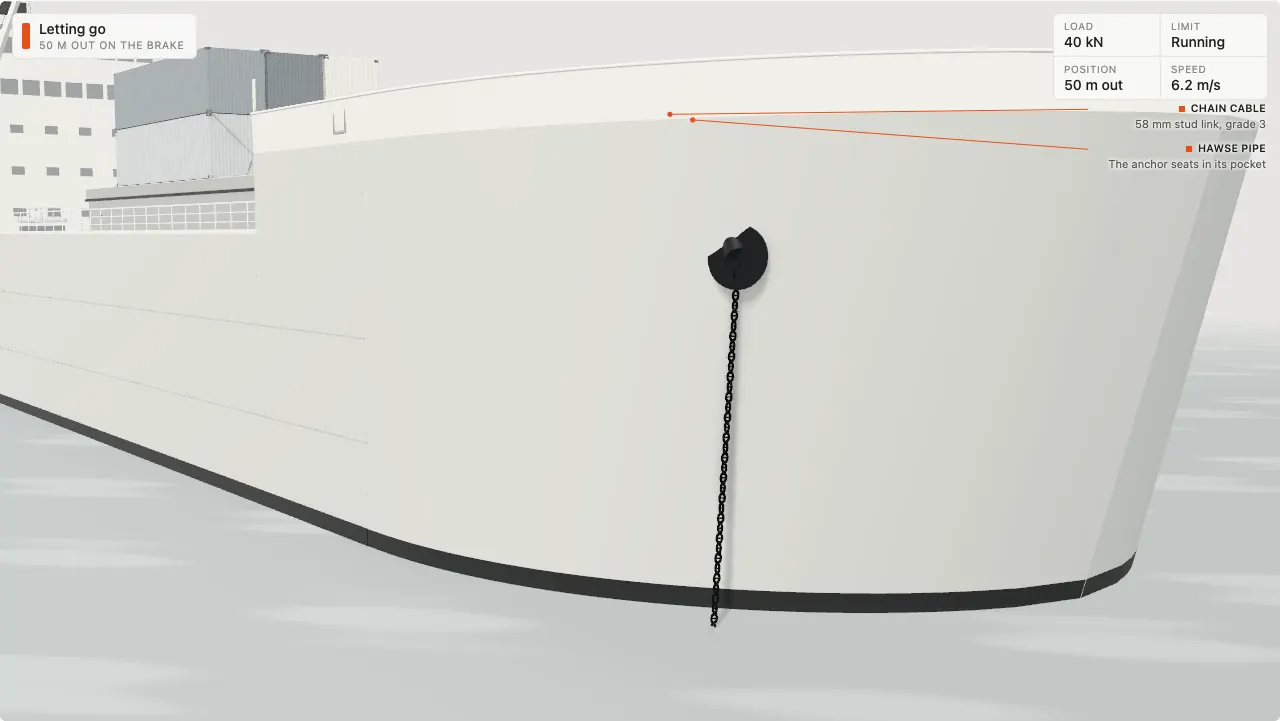
- the tube in the bow the chain runs through, where the anchor sits at sea.
- Ranging
- laying the whole chain out in dry dock so every link can be examined.
- Gauging
- measuring the chain links to see how much they have worn.
-
4/6Why it matters
Anchors get lost more than you think
Ships lose anchors far more often than most people expect. When investigators looked into a run of anchor losses, they found the gear was being used beyond its design.
A lost anchor means cost, delay and a ship less able to hold itself in an emergency. Worn brake linings, loose links and unsecured anchors are what inspectors find.
-
5/6In this lesson
What you’ll be able to do
- Know what the anchoring gear is, and is not, designed for.
- Tell how much the brake and the stopper must each hold.
- Know what a surveyor checks when the chain is ranged.
- Spot the habits that help prevent losing an anchor.
-
6/6Quick check
What is a ship’s anchoring gear designed for?
Right: the gear is meant for temporary mooring in sheltered water. In worsening weather, the advice is to act early and head to sea.
The basics
Ships lose anchors far more often than most people think. Gard, a P&I insurer, reported in 2011 that class societies saw roughly one anchor lost per 100 ships a year, about twice the rate in Gard’s own claims. In the winter of 2020 to 2021, with many cruise ships laid up at anchor off the English south coast during the pandemic, the UK Marine Accident Investigation Branch (MAIB) recorded several anchor losses in a row and found that the gear was being used beyond what it was designed for.
The key fact is in the first paragraph of the IACS rule: ship’s anchoring equipment is designed for temporary mooring in a harbour or sheltered area, not to hold a ship off an exposed coast in a gale. Knowing the design limits of the anchor, the chain, the brake and the stopper is what keeps them in the hawse pipe.
Sign in to read the rest of this lesson
Continue reading
Save your progress, open all 115 lessons and get a Course completed card when you finish.
or use your email
In the rest of this lesson
- Try it: Windlass, chain cable and anchor: what to check
- In plain words
- In detail
- What the rules say
- Flag and class notes
- Key numbers
- What inspectors find
- 4 questions people ask
- Quiz: 6 questions
- Ask our engineers about this lesson
Familiarisation training from Al Safwan Academy. Finishing a course shows completion of online familiarisation training: it is not an STCW, flag-approved or manufacturer qualification, and these courses don't replace that training. The manufacturer's manual and your flag's rules always come first.